

2027 Federal Tax Rates and What Retirees Need to Watch For
By Danny Gudorf | Founder, Gudorf Financial Group | Updated November 2026
The IRS released the 2027 federal tax rates and brackets on November 5, 2026. The rates didn't change.
The income ranges did.
So the headline is boring. What it means for someone in their 60s with most of their money in a traditional IRA is not.
These are the same federal brackets everyone pays. Nothing in the tax code gives retirees their own rates.
But retirees deal with things a 40-year-old never thinks about. The senior deduction, Social Security taxation, required minimum distributions, Medicare surcharges, and what happens to your brackets when a spouse dies.
Let me show you the 2027 numbers first, and then what to watch for.
The 2027 Federal Tax Brackets
The seven 2027 federal tax rates are the same as 2026. The IRS adjusted each bracket for inflation in Revenue Procedure 2026-35, so more of your income fits in each one.
These brackets apply to taxable income, meaning income after your deductions. They apply to the return you file in early 2028.
| Rate | Married filing jointly | Single |
|---|---|---|
| 10% | $0 to $25,600 | $0 to $12,800 |
| 12% | $25,600 to $104,050 | $12,800 to $52,025 |
| 22% | $104,050 to $218,250 | $52,025 to $109,125 |
| 24% | $218,250 to $416,650 | $109,125 to $208,325 |
| 32% | $416,650 to $529,100 | $208,325 to $264,550 |
| 35% | $529,100 to $793,650 | $264,550 to $661,375 |
| 37% | Over $793,650 | Over $661,375 |
Two things to notice right away:
- The single brackets are roughly half the joint brackets through the 32 percent bracket. That matters a lot later, when we get to the widow's tax trap.
- The jump from 12 to 22 percent is the big one. For most of the retirees we work with, the top of the 12 percent bracket and the top of the 22 percent bracket are the two lines that drive most planning decisions.
If you want a refresher on how a bracket actually works, we walk through it in understanding marginal tax rates for retirees. The short version: only the dollars inside a bracket get taxed at that bracket's rate.
2027 Standard Deduction and the Senior Deductions
So the brackets are half the picture. The other half is how much income never reaches them because of your deductions.
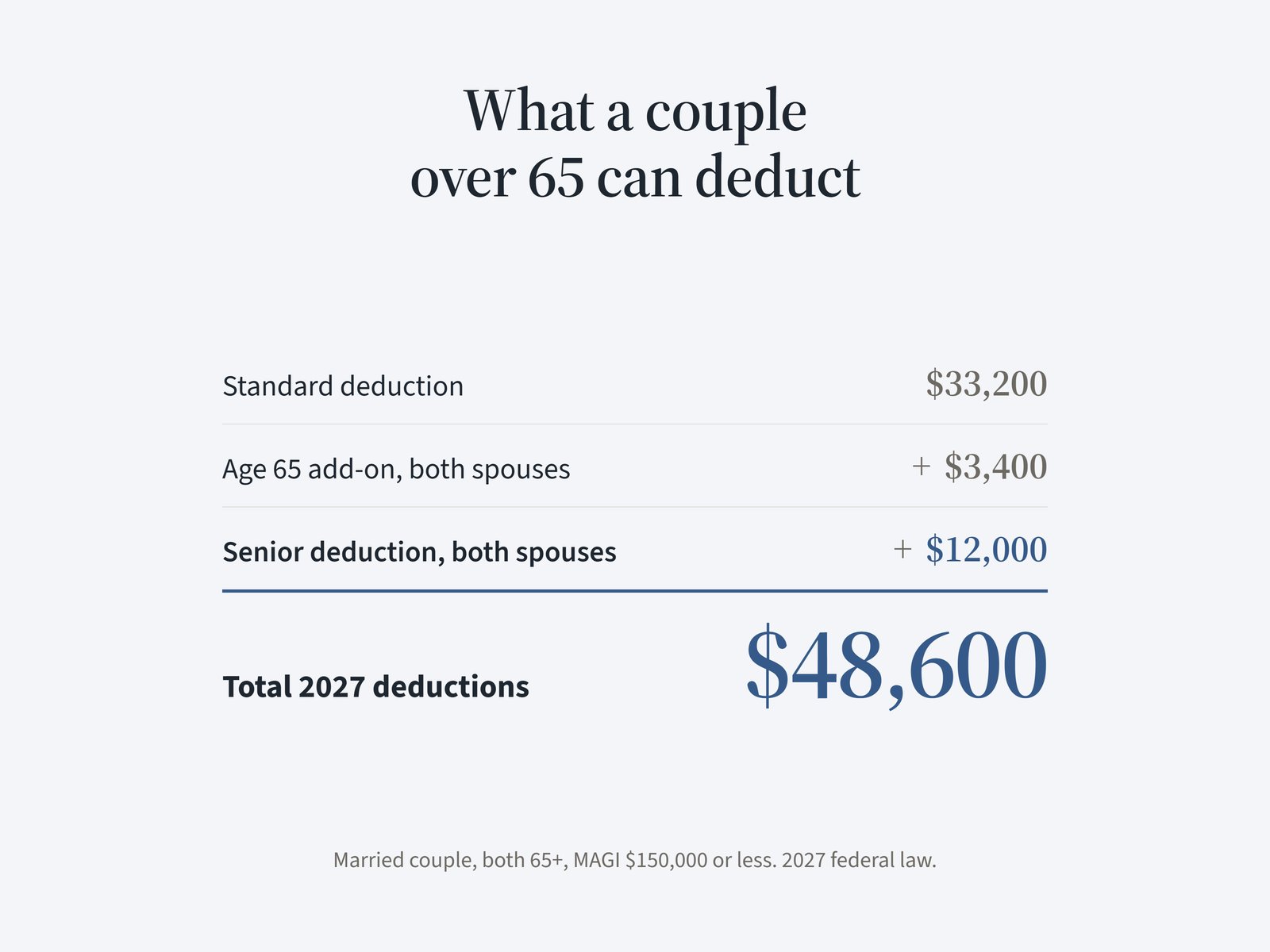
For 2027, you have three layers if you're 65 or older:
- The standard deduction. $33,200 for married couples filing jointly and $16,600 for single filers.
- The age 65 add-on. $1,700 for each spouse 65 or older on a joint return, or $2,100 if you're single.
- The $6,000 senior deduction. $6,000 for each person 65 or older, from the 2025 tax law, for tax years 2025 through 2028 only.
| Deduction | Married, both 65+ | Single, 65+ |
|---|---|---|
| Standard deduction | $33,200 | $16,600 |
| Age 65 add-on | $3,400 | $2,100 |
| Senior deduction | $12,000 | $6,000 |
| Total | $48,600 | $24,700 |
That $48,600 is real money. A married couple, both over 65, can have $48,600 of IRA withdrawals, pension, or interest before they owe a dollar of federal income tax.
Now, the senior deduction has a catch. According to the IRS fact sheet on the senior deduction, it phases out once modified adjusted gross income (MAGI) goes over $150,000 for joint filers or $75,000 for single filers.
You also have to file jointly if you're married to claim it. We cover the rules in detail in our post on the $6,000 senior bonus tax deduction.
What Changed From 2026
Here's how much each married filing jointly bracket grew from 2026 to 2027:
| Bracket | 2026 top | 2027 top | Increase |
|---|---|---|---|
| 10% | $24,800 | $25,600 | $800 |
| 12% | $100,800 | $104,050 | $3,250 |
| 22% | $211,400 | $218,250 | $6,850 |
| 24% | $403,550 | $416,650 | $13,100 |
| 32% | $512,450 | $529,100 | $16,650 |
| 35% | $768,700 | $793,650 | $24,950 |
The standard deduction went up $1,000, and the age 65 add-on went up $50 per spouse. Put together, a couple over 65 gets $1,100 more in deductions than in 2026.
I mean, nobody is going to throw a party over $1,100. The brackets keep pace with prices, so your real tax room stays about the same.
What did change is the calendar. The senior deduction ends after 2028, which means 2027 is one of the last two years you get it.
What Retirees Need to Watch For in 2027
All right. Here's where the 2027 federal tax rates start to matter for retirees.
There are five things we're watching for clients this year.
1. The Senior Deduction Phase-Out Zone
Each $6,000 senior deduction shrinks by 6 cents for every dollar of MAGI over the threshold. For a married couple, both deductions shrink at once, so the couple loses 12 cents of deduction for every dollar over $150,000.
The deduction is gone completely at $250,000 of MAGI for joint filers and $175,000 for single filers. Between those lines, a married couple's real tax rate is higher than their bracket says:
- In the 12% bracket: each extra dollar costs about 13.4 cents, not 12.
- In the 22% bracket: each extra dollar costs about 24.6 cents, not 22.
That doesn't mean you have to stay under $150,000 at all costs. It means you should know the real rate before you push income through that zone.
2. Roth Conversions in the Gap Years
This is the big one. We call the years between retirement and required minimum distributions your gap years, and the 2027 federal tax rates make them even more valuable.
A Roth conversion moves money from your traditional IRA into a Roth IRA, and you pay income tax on what you convert this year. The question is always how much, which is what we call the sweet spot.
Let me show you what 2027 looks like. Say you've got a couple, both 66, retired, with about $1.6 million in IRAs.
They're delaying Social Security and living off savings. Their only taxable income is about $15,000 of interest.
Without a conversion, they owe nothing. Their $48,600 of deductions covers all $15,000.
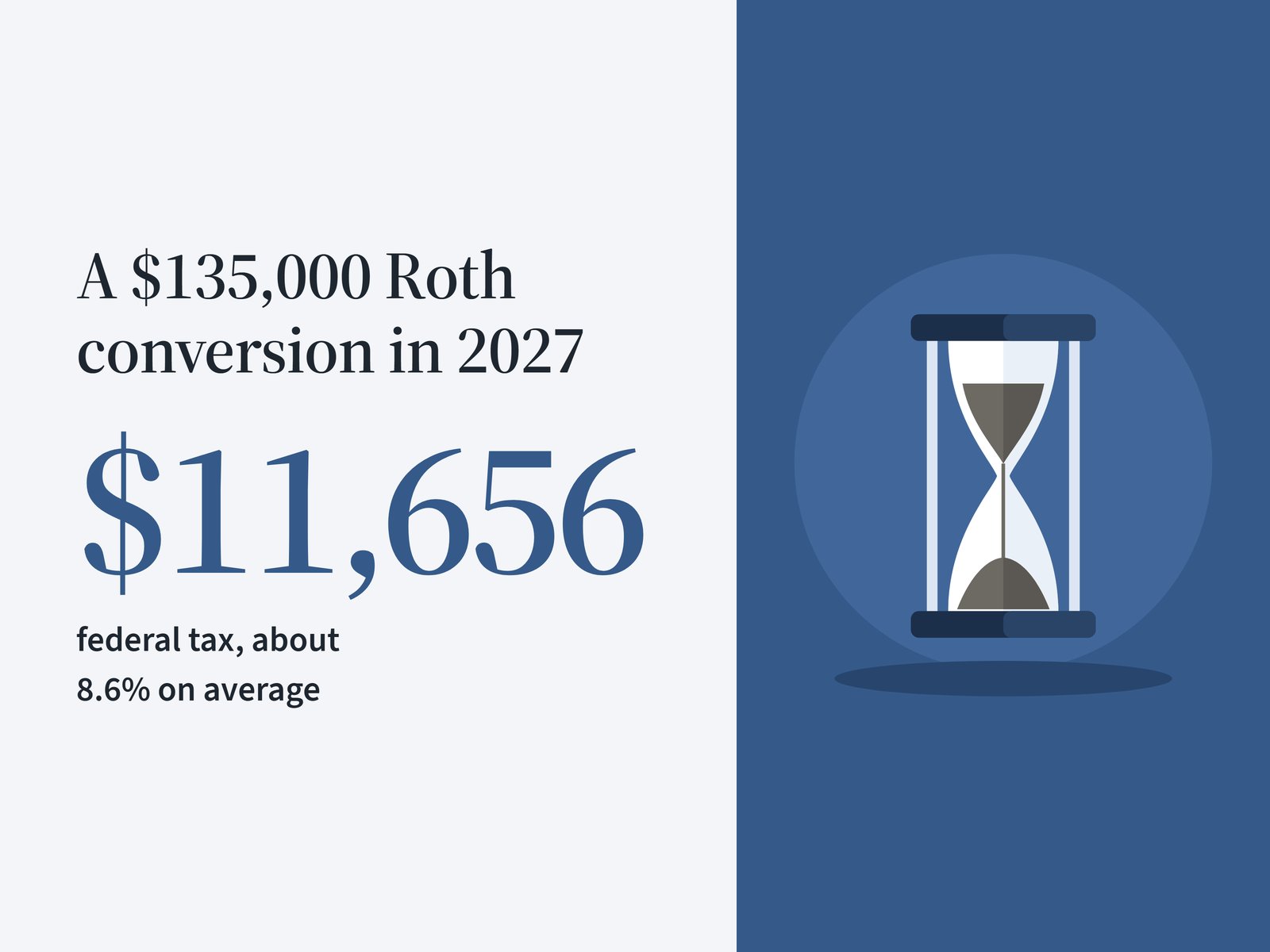
Now say they convert $135,000 from the IRA to a Roth. That puts their MAGI right at $150,000, so they keep the full $12,000 senior deduction:
- The first $33,600 of the conversion is covered by deductions they weren't using. Federal tax: zero.
- The next $25,600 lands in the 10 percent bracket.
- The rest lands in the 12 percent bracket, with $2,650 of 12 percent room left over.
Their federal tax on a $135,000 conversion comes to $11,656. That's an average of about 8.6 percent.
Compare that to what the same money could cost later. Once Social Security starts and RMDs kick in, that couple could easily be in the 22 or 24 percent bracket, and the survivor could be higher.
Who knows exactly where tax rates will be in 15 years. What we do know is what they are in 2027.
Every situation is different. For some households the math says convert into the 22 or even the 24 percent bracket, and for some it says don't convert at all.
If you're weighing it, start with our posts on the Roth conversion window most retirees miss, what you need to know about Roth conversions, the five questions to ask before a Roth IRA conversion, and how Roth conversions changed after the 2025 tax bill.
3. The 0% Capital Gains Rate
Long-term capital gains and qualified dividends get their own brackets. For 2027, the 0 percent rate covers taxable income up to $102,100 for married couples and $51,050 for single filers.
The 15 percent rate runs to $633,600 for married couples and $563,200 for single filers. Above that, gains are taxed at 20 percent.
Here's the catch most people miss. Your gains sit on top of your ordinary income, so a Roth conversion and the 0 percent rate compete for the same room.
Our couple above ended at $101,400 of taxable income. That leaves only $700 of room for 0 percent gains that year.
So you pick. Some years you fill the room with conversions, and some years you harvest gains at 0 percent.
Doing both in the same year usually means one of them gets taxed at a higher rate than you planned.
4. Social Security Taxation Is Not Indexed
The brackets go up with inflation every year. The thresholds that decide how much of your Social Security gets taxed do not.
Under IRS Publication 915, up to 85 percent of your benefit becomes taxable once your income, counting half of your benefit, passes $44,000 on a joint return or $34,000 single. Those numbers were set decades ago and have never moved.
Add RMDs on top of that, and each extra IRA dollar raises your taxable income and also makes more of your Social Security taxable.
Now put that stack on one survivor filing at single rates. That's what we call the tax torpedo.
That's one more reason the gap years, before Social Security starts, are such a clean window for conversions.
5. Your 2027 Income Sets Your 2029 Medicare Premiums
Medicare's income surcharge, called IRMAA, looks back two years. Your 2027 tax return decides whether you pay extra for Medicare Part B and Part D in 2029.
For 2026, the first IRMAA tier starts at $218,000 of MAGI on a joint return. The 2029 tiers won't be published until late 2028, so plan with a cushion.
We break down the tiers in our guide to the Medicare IRMAA brackets.
The Widow's Tax Trap at 2027 Rates
Here's what happens when the brackets get cut in half. Fast forward a few years for a couple in their late 70s, using 2027 rules.
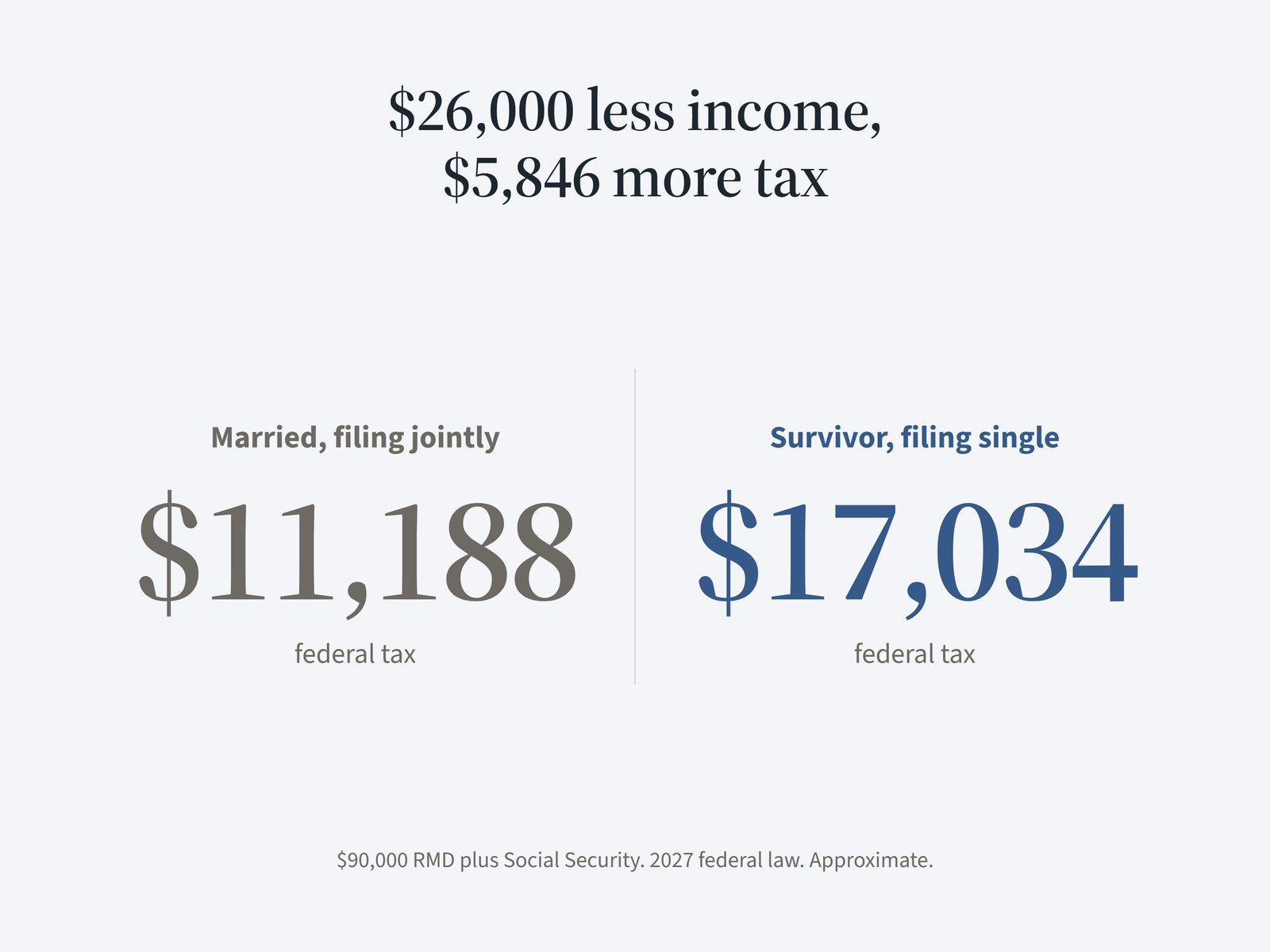
They get $66,000 a year from Social Security, $40,000 for him and $26,000 for her. They also take a $90,000 RMD from their IRAs.
| Married filing jointly | Survivor filing single | |
|---|---|---|
| Social Security | $66,000 | $40,000 |
| RMD | $90,000 | $90,000 |
| Total income | $156,000 | $130,000 |
| Senior deduction | $12,000 | $3,060 |
| Taxable income | $97,500 | $102,240 |
| Federal tax | $11,188 | $17,034 |
| Top bracket | 12% | 22% |
Now say he passes away. Starting the year after his death, she files as a single filer, keeps the larger Social Security check, and the IRAs are all hers, so the RMD stays about the same.
Her income drops by $26,000. Her federal tax goes up by $5,846.
That's what we call the widow's tax trap. Same IRA, less income, a higher bracket, and a phase-out that now starts at $75,000 instead of $150,000.
Let's face it, nobody wants to plan for this. But the conversions you do in your 60s, while you're both alive and filing jointly at the wider brackets, are what shrink that RMD later.
How to Use the 2027 Brackets
So what do you actually do with all this? There are three steps.
- Project your 2027 income before the year starts. Pensions, interest, dividends, any IRA withdrawals, and when Social Security begins. You can't plan around a bracket if you don't know where you're starting.
- Pick your ceiling. The top of the 12 percent bracket, $150,000 of MAGI to keep the full senior deduction, the top of the 22 percent bracket, or an IRMAA tier. That ceiling decides how much you convert or how many gains you harvest.
- Act before December 31. Roth conversions count in the year you do them. There's no doing one in March and calling it last year.
This is the work we do on the tax planning side of Gudorf Financial Group. Because we also prepare clients' tax returns, we see the actual numbers instead of guessing at them.
We walk through the whole year in the annual tax planning process we run for every retiree we work with.
Frequently Asked Questions
What are the 2027 federal tax brackets for married couples?
For married couples filing jointly in 2027, the 10 percent bracket covers taxable income up to $25,600. The 12 percent bracket runs to $104,050, 22 percent to $218,250, 24 percent to $416,650, 32 percent to $529,100, and 35 percent to $793,650, with 37 percent above that.
What is the 2027 standard deduction for seniors over 65?
The 2027 standard deduction is $33,200 for married couples and $16,600 for single filers. Add $1,700 for each spouse 65 or older on a joint return, or $2,100 if single.
The $6,000 senior deduction comes on top of that, for a total of up to $48,600 for a married couple who are both 65 or older.
Do retirees pay different federal tax rates?
No. Retirees pay the same 2027 federal tax rates as everyone else.
What changes is the deductions available at 65 and the way Social Security, RMDs, and Medicare premiums interact with your income.
Is the $6,000 senior deduction available in 2027?
Yes. The senior deduction is available for tax years 2025 through 2028 for anyone 65 or older, so 2027 and 2028 are the last two years.
It phases out between $150,000 and $250,000 of MAGI for joint filers and between $75,000 and $175,000 for single filers.
Is 2027 a good year for a Roth conversion?
For many retirees in their gap years, yes. The wider brackets and the senior deduction give you room to convert at 10 or 12 percent.
Whether it fits your situation depends on your income, your IRA balance, your Social Security timing, and your heirs.
Here's What Matters
- The 2027 federal tax rates are unchanged, and every bracket is about 3 percent wider.
- A married couple, both 65 or older, can deduct up to $48,600 in 2027.
- The $6,000 senior deduction phases out above $150,000 of MAGI for couples and ends after 2028.
- 2027 and 2028 are the last two years to pair gap-year Roth conversions with the senior deduction.
- Watch the 0 percent capital gains room, Social Security thresholds, and your 2029 IRMAA tier before you add income.
- The widow's tax trap is real. The conversions you do now while filing jointly are what soften it later.
Gudorf Financial Group is a fee-only, fiduciary retirement planning firm based in Dayton, Ohio. We serve clients locally and virtually nationwide.
Article References
- "IRS releases tax inflation adjustments for tax year 2027." Internal Revenue Service, IR-2026-133. November 2026.
- "Rev. Proc. 2026-35." Internal Revenue Service. November 2026.
- "Working Families Tax Cuts: Tax deductions for working Americans and seniors." Internal Revenue Service. July 2025.
- "Publication 915, Social Security and Equivalent Railroad Retirement Benefits." Internal Revenue Service. Accessed November 2026.