


New $6,000 Senior Bonus Tax Deduction: Are You Claiming It Correctly?
By Danny Gudorf | Founder, Gudorf Financial Group | Updated May 2026

What Is the Senior Bonus Deduction?
The One Big Beautiful Bill, signed July 4, 2025, created a new bonus deduction for taxpayers 65 and older. Starting with the 2025 tax year, eligible seniors can deduct an additional $6,000.
A married couple where both spouses are 65 or older can deduct $12,000. This applies whether you take the standard deduction or itemize.
The first thing to understand: this deduction exists and it is available to you. A lot of retirees do not know it is there.
The second thing to understand: how much you actually receive depends entirely on your income for the year. Your income is not a fixed number. It responds to decisions you make about distributions, conversions, and investment sales.
How the Three Deductions Stack
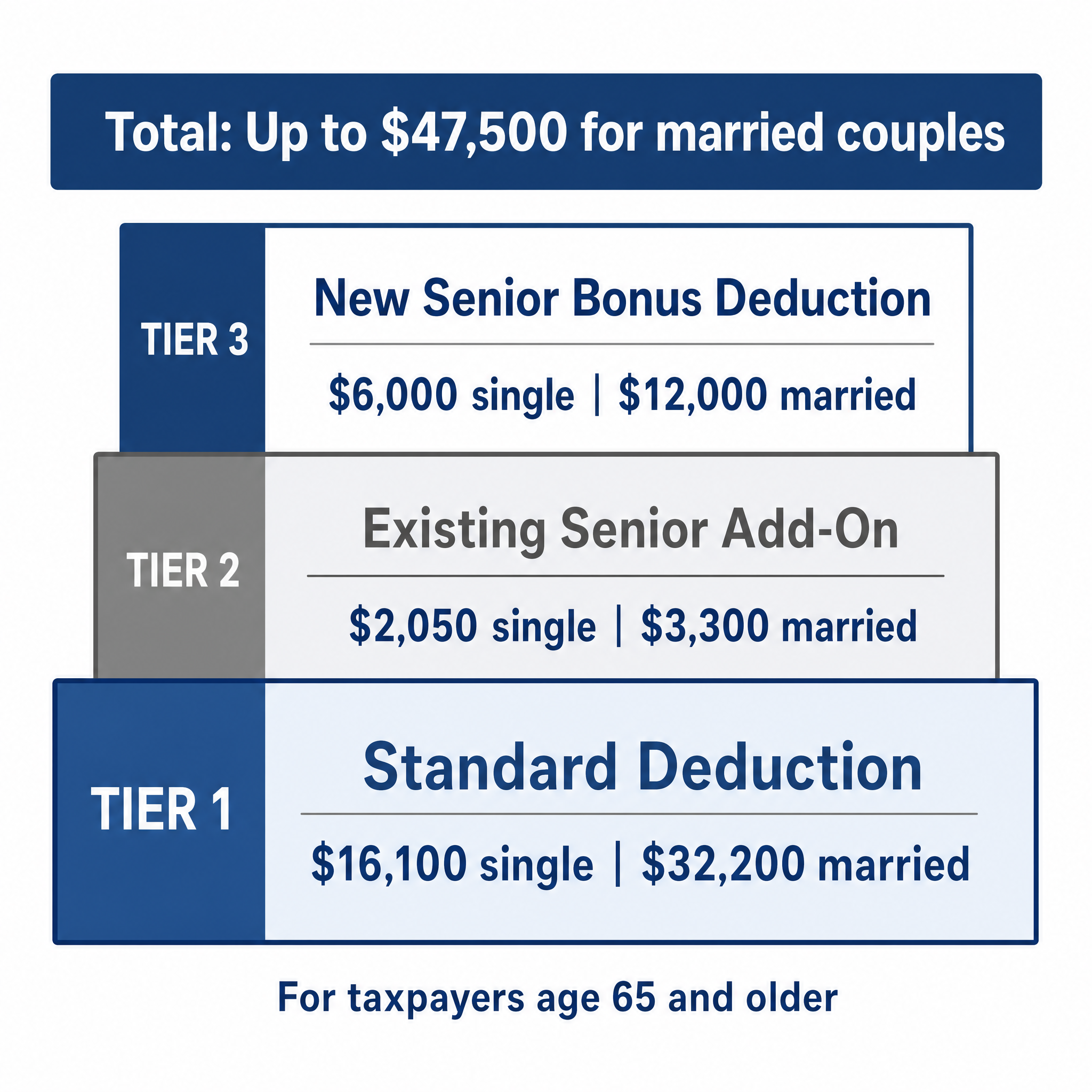 So here is what actually happens for a married couple where both spouses are 65 or older in 2026:
| Deduction | Single Filer | Married Filing Jointly |
|---|---|---|
| Standard deduction | $16,100 | $32,200 |
| Existing senior add-on | $2,050 | $3,300 |
| New OBBBA bonus | $6,000 | $12,000 |
| Total | $24,150 | $47,500 |
A married couple can potentially shelter up to $47,500 of income from federal income tax. The new bonus deduction does not replace anything. It stacks on top of what was already there.
The extra senior deduction from prior law is still in place. The new $6,000 sits on top of that.
Who Qualifies
To claim the full deduction, you need to meet three requirements.
First, you must be 65 or older by December 31 of the tax year. For the 2025 return, that means born on or before December 31, 1960.
Second, you must have a valid Social Security number. Taxpayers using an Individual Taxpayer Identification Number (ITIN) are not eligible.
Third, your modified adjusted gross income (MAGI) has to fall within the qualifying range.
Income phase-out thresholds:
- Single filer: Full $6,000 if MAGI is $75,000 or below. Phases out between $75,000 and $175,000. Gone above $175,000.
- Married filing jointly: Full $12,000 if MAGI is $150,000 or below. Phases out between $150,000 and $250,000. Gone above $250,000.
Most retirees we work with at Gudorf Financial Group have income that lands somewhere in that phase-out range. That is not a problem. It is a planning variable.
What Triggers the Phase-Out
Here is what most articles skip over. MAGI for this deduction is not just your pension and Social Security.
Several income events can push your MAGI up and reduce your deduction:
- IRA distributions -- including required minimum distributions at RMD age
- Investment sales -- selling a stock, fund, or property triggers capital gains that count toward MAGI
- Roth conversions -- the converted amount adds directly to MAGI for the year
A lot of retirees make these decisions without knowing the downstream effects. A $30,000 IRA withdrawal in November could phase out part of your senior bonus deduction. A large Roth conversion could eliminate it entirely for that year.
The deduction responds to your choices. That is the part worth planning around.
The Real Question: Stay Under the Phase-Out, or Plan Through It?
All right. Here is where the conversation gets practical.
Some people read about the phase-out and conclude: "I need to keep my income low enough to protect the deduction." That thinking is not always wrong, but it is often backwards for people with substantial assets.
If you have significant savings in a pre-tax IRA, the math may work better by doing the tax planning and moving right through the phase-out.
Think about it this way. Say you have $1.2 million in a traditional IRA and you are in your gap years -- retired, but not yet at RMD age. A Roth conversion of $50,000 this year might push you above the phase-out threshold and cost you some or all of the $12,000 deduction.
But that same conversion could save your family $30,000 to $60,000 in taxes over the next 10 to 15 years. It reduces future RMD income, protects against the widow's tax trap, and keeps your heirs out of a higher bracket.
Losing the $12,000 deduction to execute a conversion that saves six times as much is not a loss. It is a trade.
The opposite mistake is real too. A client who obsesses over staying under the income threshold may freeze up on good tax planning in order to protect a deduction worth a few thousand dollars.
Optimizing one piece of the return while ignoring the rest costs you more in the long run.
The right question is not "how do I protect the deduction?" It is "what does my full tax plan look like this year, and how does the deduction fit into it?"
That is exactly what proactive tax planning is supposed to answer before the year ends, not after you file.
How to Use the Deduction as a Planning Tool
 Here is where this deduction gets useful for the right client.
If your income is low enough to qualify for the full deduction, or even a partial one, you have a window to make intentional moves without paying much tax on them.
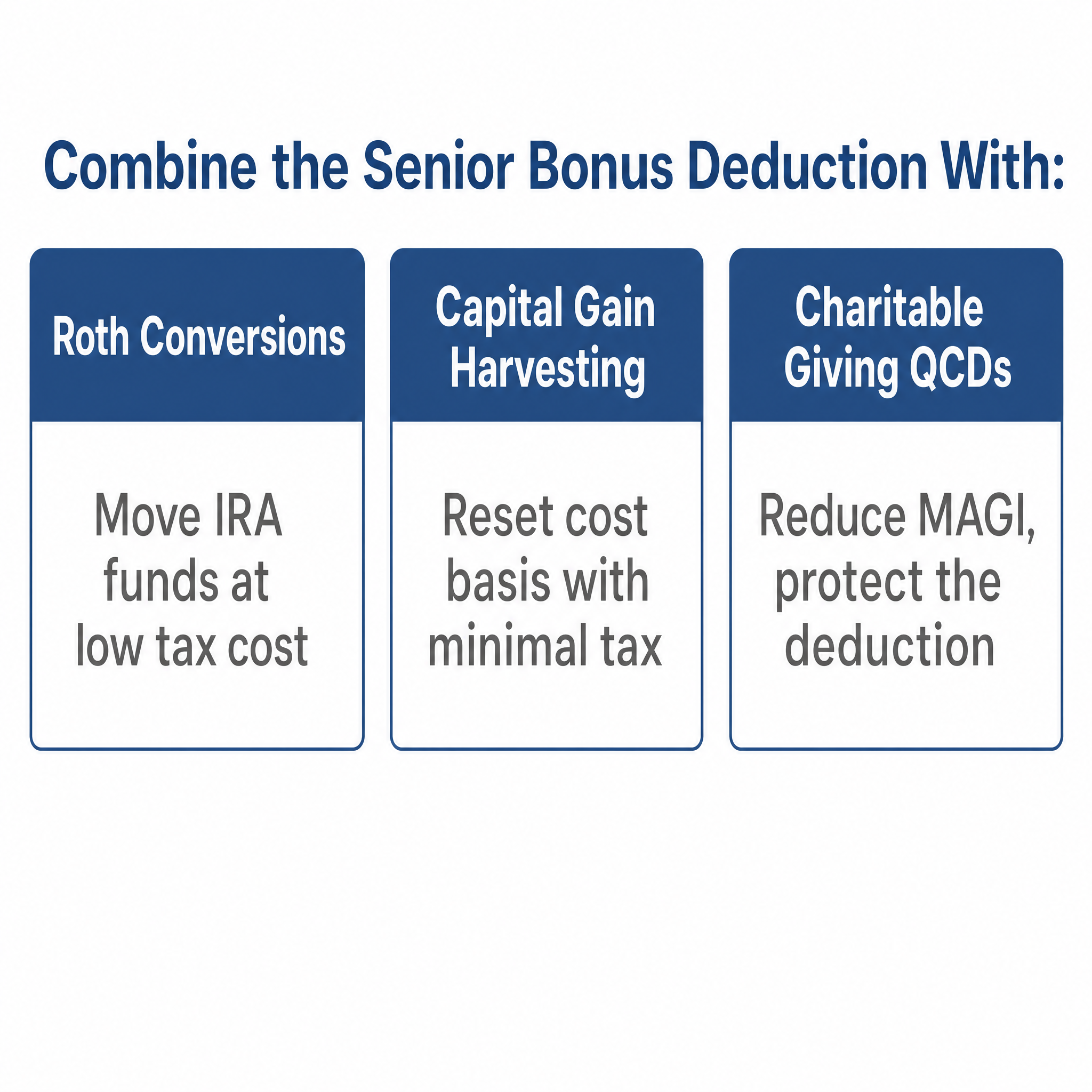
Three combinations worth knowing about:
1. The deduction plus small Roth conversions. In a year where your income falls below or near the bottom of the phase-out range, your senior bonus deduction is absorbing income that would otherwise be taxable. You can use that room to do a partial Roth conversion -- moving money from your IRA to your Roth while paying low or no federal tax on it. This is the sweet spot. You are not converting so much that you blow up your bracket. The deduction is doing real work.
2. The deduction plus capital gain harvesting. If you have appreciated investments in a taxable brokerage account, you may be able to sell them and recognize the gains in a year where the senior bonus deduction offsets the income. For clients in the 0% long-term capital gains bracket, this resets your cost basis with little or no tax owed at all.
3. The deduction plus charitable giving. If you give to charity and you are over 70.5, a qualified charitable distribution (QCD) from your IRA reduces your MAGI directly. That keeps your income lower, which can protect more of your senior bonus deduction. Our guide to QCDs covers how this works in detail.
The common thread: the deduction creates room. What you do with that room is where the real planning happens.
The IRMAA Connection
One more thing retirees need to know. The same income that phases out your senior bonus deduction is the same income that triggers IRMAA surcharges on your Medicare premiums.
In 2026, Medicare Part B is $202.90 per month at the base rate. Push your MAGI above $109,000 single or $218,000 married, and surcharges start. IRMAA uses a two-year lookback, so decisions you make in 2025 affect your 2027 Medicare costs.
Income management is not just about this deduction. It connects to your IRMAA exposure, your Social Security taxation, and your Roth conversion math at the same time. These decisions need to be made together, not separately.
How to Claim It
The mechanics are straightforward. The senior bonus deduction is claimed directly on Form 1040. There is no separate election form.
The IRS updated Form 1040 to capture the deduction automatically when you check the "65 or older" box and your Social Security number is on the return.
What is not straightforward is the planning that should happen before you file. Most CPAs are looking backwards. They review what happened during the year and report it accurately.
They are not sitting down with you in October to ask: "Are we going to be in the phase-out range? Should we do a QCD? Should we hold off on that distribution or accelerate a Roth conversion?" That proactive conversation is where the deduction either gets protected or used strategically.
If your advisor or CPA has not brought this up with you, it is worth asking about.
The 2025-2028 Window
The senior bonus deduction is temporary. It applies to tax years 2025, 2026, 2027, and 2028. After that, it expires unless Congress extends it.
We do not know what happens in 2029. Plan around what the law says today.
Four years is enough time to build a real strategy around this deduction, especially if you are still in your gap years and have flexibility to manage your income. You can read about how the rest of the One Big Beautiful Bill affects retirement planning in our breakdown of how the new tax law benefits retirees.
Frequently Asked Questions
Does the $6,000 senior bonus deduction apply if I take the standard deduction?
Yes. The senior bonus deduction stacks on top of the standard deduction. You do not have to itemize to claim it. Whether you take the standard deduction or itemize, the $6,000 bonus is available as long as you meet the age and income requirements.
Do both spouses need to be 65 to claim $12,000?
Yes. The $12,000 amount applies when both spouses are 65 or older by December 31 of the tax year. If only one spouse qualifies, the deduction is $6,000.
Does a Roth conversion reduce my senior bonus deduction?
It can. The converted amount adds to your MAGI for the year. If the conversion pushes your income above the phase-out threshold, part or all of the deduction phases out. Whether that trade makes sense depends on the full math. A Roth conversion that saves significant future taxes is often worth losing the deduction for that year.
Does this deduction eliminate taxes on Social Security?
No. The deduction reduces your taxable income, which may indirectly reduce how much of your Social Security is taxable. But it does not directly change the rules for how Social Security benefits are taxed. Those rules remain in place.
Will the senior bonus deduction still exist after 2028?
Under current law, it expires after the 2028 tax year. Congress could extend it, but that is not guaranteed. Plan around the four-year window you have now.
Here's What Matters
- The $6,000 senior bonus deduction exists and you need to know about it. It is $12,000 for couples where both spouses are 65 or older.
- It stacks on top of the standard deduction and the existing senior add-on, potentially sheltering up to $47,500 for married couples.
- How much you receive depends on your MAGI. IRA distributions, investment sales, and Roth conversions all affect that number.
- If you have substantial assets, the right move is often to do the tax planning anyway. The savings from a well-executed Roth conversion or capital gain strategy can far outweigh the deduction you give up.
- In years where you do qualify, the deduction creates room to do small Roth conversions and capital gain harvesting at low or no tax.
- The window is 2025-2028. Four years to build this into your plan.
Gudorf Financial Group is a fee-only, fiduciary retirement planning firm based in Dayton, Ohio. We work with clients in the Dayton and Cincinnati area and nationwide via Zoom.
Article References
- "Check your eligibility for the new enhanced deduction for seniors." IRS.gov. Accessed May 2026.
- "How the New $6,000 'Senior Bonus' Tax Deduction Works." Kiplinger. Accessed May 2026.
- "The new $6,000 senior tax deduction: who qualifies and how to claim it." CNBC. Accessed May 2026.