

The Best RMD Strategy for a $1.7 Million IRA: We Tested Nine Plans
By Danny Gudorf | Founder, Gudorf Financial Group | Updated October 2026
Once your IRA crosses $1.7 million, the plan with the lowest tax bill is not the plan that leaves your family the most money. That sounds backwards, so we tested it.
We ran one couple, both 64 and just retired, through nine different ways of handling their IRA and their required minimum distributions. The right RMD strategy for an IRA this size came down to one question: who pays the tax, and at what rate?
- The lowest family tax bill left them about $124,000 worse off than doing nothing.
- The winning plan paid more tax than that one and still came out $451,000 ahead.
- A big part of the gap shows up after one spouse passes away.
In the video, I walk through all nine plans on screen with the model's numbers, so you can see where each one pulls ahead and where it falls apart.
The Couple We Modeled
Say you've got a couple, both 64, just retired.
| What they have | Amount |
|---|---|
| Traditional IRAs | $1.7 million |
| Brokerage account | $450,000 |
| Roth IRA | $50,000 |
| Pension | $24,000 a year |
| Social Security (from 67) | About $66,000 a year combined |
| Spending | About $105,000 a year |
Every number in this post comes from our retirement tax model for this couple, using 2026 federal tax law and 6% growth. The full assumptions are listed further down.
Doing Nothing: The Plan That Looks Perfect for 11 Years
The conventional advice says spend the brokerage account first and leave the IRA alone. And that's not wrong, at least not at first.
From 64 to 74, their total federal tax is about $12,000.
Not per year. Total.
But here's what is happening underneath that low tax bill:
- The IRA keeps growing. Untouched, it climbs from $1.7 million to about $3.2 million by 74.
- The IRS sets the withdrawal. At 75, their first RMD is $131,183.
- The bracket jumps. That puts them in the 22% bracket, and the RMD gets bigger every year after that.
The RMD is the prior year-end balance divided by a factor from the IRS Uniform Lifetime Table. At 75 that factor is 24.6, and it shrinks every year, so the share you're forced to take keeps rising.
The Widow's Tax Trap: Where the Real Cost Shows Up
Now, here's the part most plans never model. Say he passes away at 79 and she starts filing single.
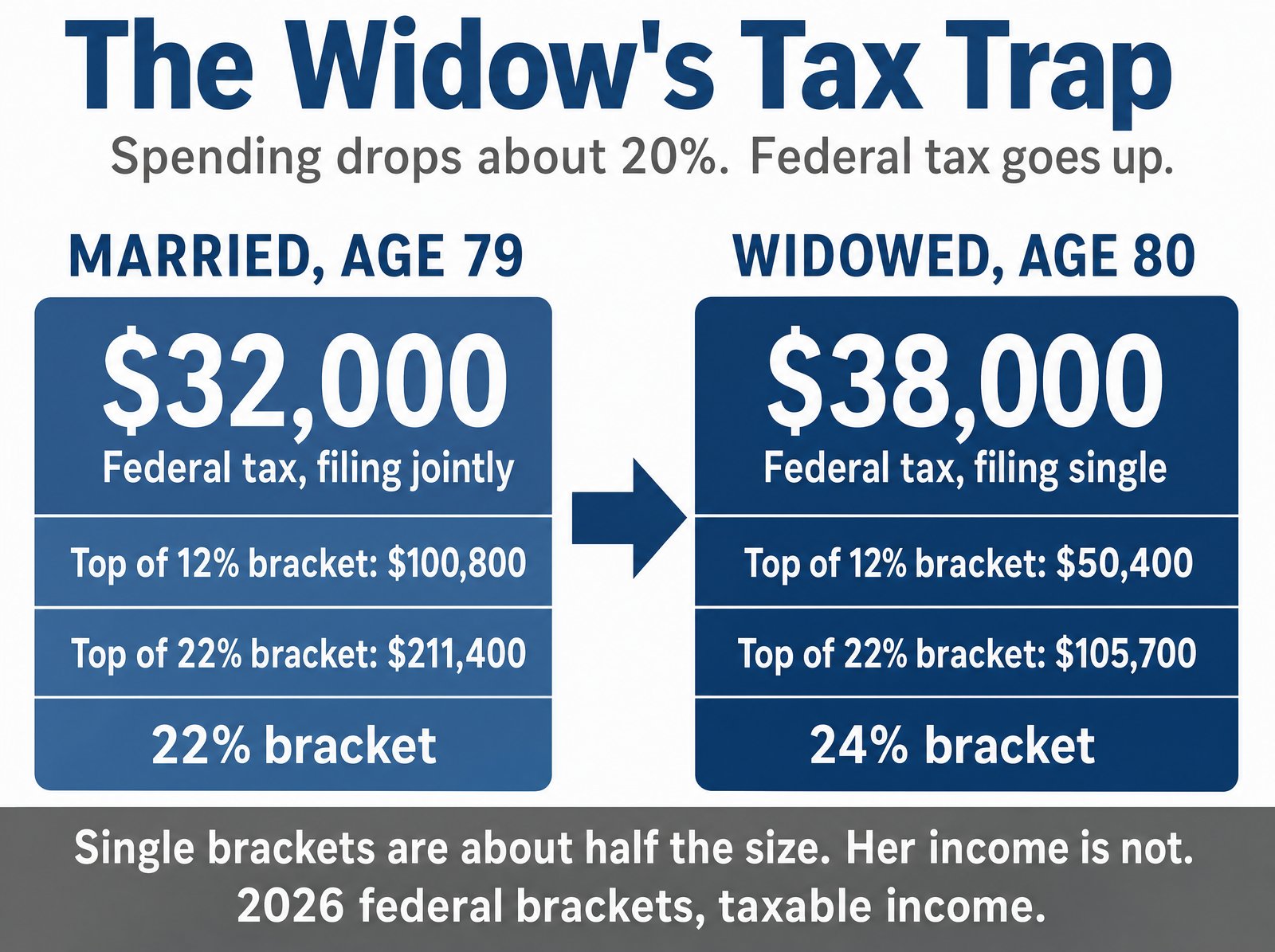
Her spending drops by about 20%. Her tax goes up anyway, from about $32,000 their last year filing together to about $38,000 her first year alone.
That's the 24% bracket, and a couple of years later Medicare IRMAA surcharges get added on top. The 2026 IRS brackets show why: the single brackets are about half the size, but her income did not drop by half.
| 2026 federal figure | Married filing jointly | Single |
|---|---|---|
| Top of the 12% bracket (taxable income) | $100,800 | $50,400 |
| Top of the 22% bracket | $211,400 | $105,700 |
| Standard deduction (before age 65 add-ons) | $32,200 | $16,100 |
| First IRMAA tier (MAGI) | $218,000 | $109,000 |
She keeps the larger Social Security check, half the pension, and every dollar of the IRA. The RMD stacking on her Social Security at single rates is the tax torpedo.
That's what we call the widow's tax trap. Less income, narrower brackets, and still a bigger tax bill.
By 92, she still has $2.95 million in the IRA. Add her taxes, the Medicare surcharges, and what the kids owe when they inherit the IRA at a 24% rate, and the family's federal tax bill is about $1.6 million.
The point is, at $1.7 million, the first RMD is the warning. The survivor gets the bill.
Try This Tonight: Ballpark Your First RMD
If you were born in 1960 or later, your RMDs start at 75 under the final IRS RMD regulations. You can get a rough read in four steps.
- Take your IRA balance today.
- Roughly double it if you're 11 or 12 years from 75. That assumes about 6% growth, so it's a ballpark, not a promise.
- Divide by 24.6. That's about what your first RMD will look like.
- Ask one question. If one of us were filing single on top of that, which bracket would it land us in?
For this couple, $3.2 million divided by 24.6 is about $131,000. Our 2026 RMD table has the factor for every age.
The Three Common Fixes
There are about three fixes you'll hear about for a large IRA:
- Spend from the IRA first instead of the brokerage account.
- Do Roth conversions up to the first IRMAA line, so Medicare never adds a surcharge.
- Convert all the way through the 24% bracket and shrink the IRA fast.
Fix 1: Spend From the IRA First
Flip the order. You're paying tax on that IRA money eventually either way, so the only question is at what rate.
- In the gap years, the stretch between retiring and your first RMD, your income is low. Those IRA dollars come out in the 12% bracket.
- If you wait, the same dollars come out later at 22% or 24% as RMDs.
- The brokerage account you didn't touch keeps growing. When it passes to the kids, it gets a step-up in basis, so nobody ever pays tax on that gain.
In this model, that one change leaves the family about $308,000 better off than doing nothing. It's the simplest fix, and it gets you about two-thirds of the way to the best plan.
Your gap years are probably the cheapest tax years you'll ever have. Spending from the IRA uses them.
Here's where it falls short. Their first RMD is still about $100,000, and when she's widowed she still lands in the 24% bracket.
Fix 2: Roth Conversions Up to the IRMAA Line
A Roth conversion means moving money from the IRA to the Roth on purpose and paying the tax now. (Our Roth conversion basics cover the mechanics.)
The common rule is to convert right up to the first IRMAA line, about $218,000 of income for a married couple in 2026. This is where a lot of people, and plenty of advisors, start to overshoot.
- Conversions: about $153,000 a year for the first few years
- Result: the family ends up almost $300,000 ahead of doing nothing
- Cost: about $342,000 of federal tax during the gap years
- Side effect: the brokerage account is gone by 70, spent paying that tax
It works. But it pays a lot up front and still lands just behind Fix 1.
Fix 3: Fill the 24% Bracket
Fix number three is the "if some is good, more is better" version. They convert about $412,000 at 64 alone.
The family's federal tax bill drops to $481,886, the lowest of all nine plans we ran. And the family ends up about $124,000 worse off than if they had done nothing.
Think about it this way. You're paying 24% today on IRA dollars that would have sat untaxed for years.
And when those dollars did come out later, this couple would have paid 24% or less on them.
And you're paying it with money that would have kept growing. You can convert too little, but you can also convert too much.
The Scoreboard So Far
| Plan | Family's result vs. doing nothing |
|---|---|
| Fix 1: Spend the IRA first | +$308,000 |
| Fix 2: Convert to the IRMAA line | +$298,000 |
| Fix 3: Fill the 24% bracket | -$124,000 |
The goal is the most money left for you and your family after everything is said and done. The least tax is not the same thing.
The RMD Strategy That Beat Them All
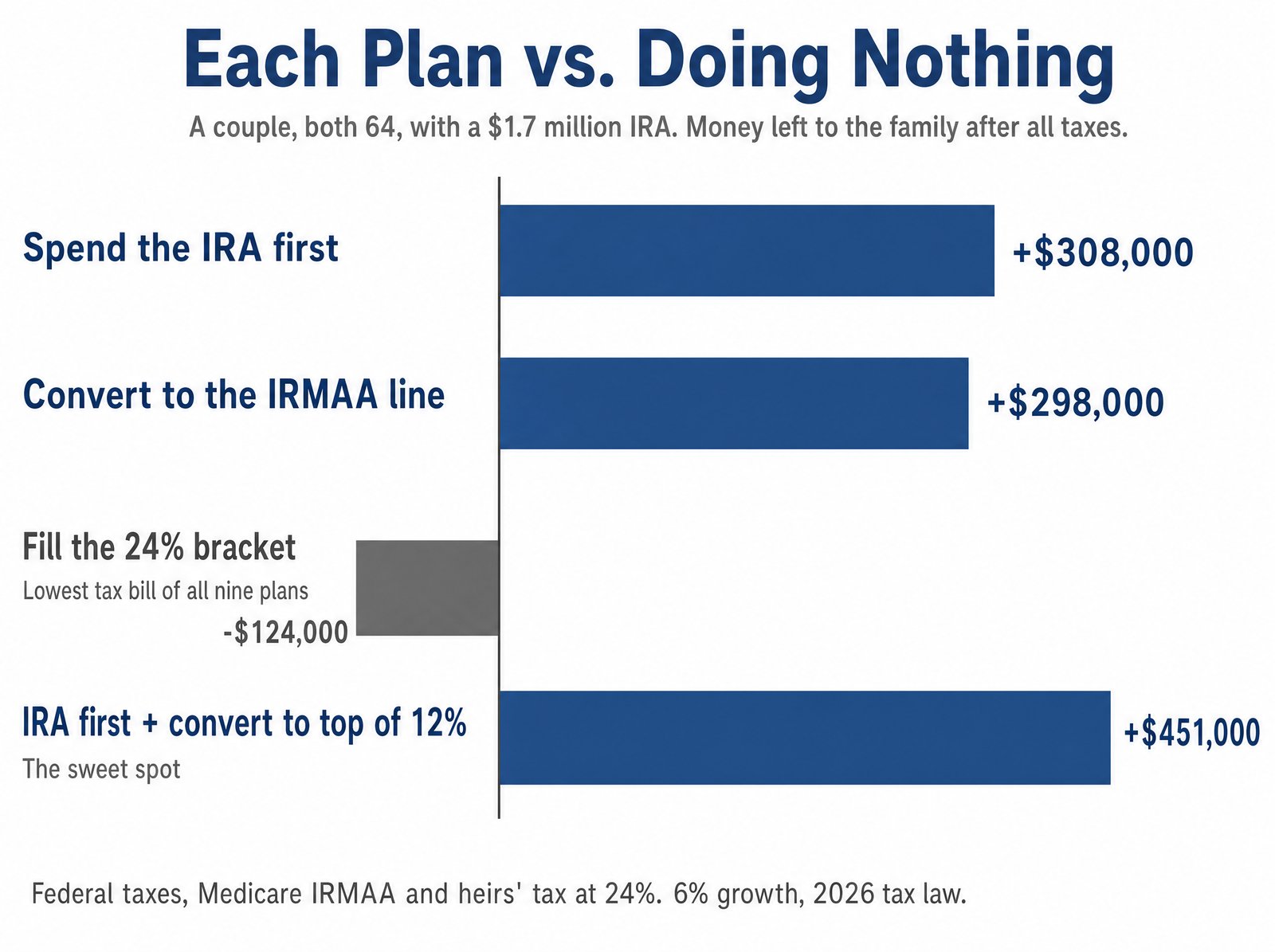
The plan that beat all of them did both, in pieces so small they look like they shouldn't matter. From 64 to 74, they spend from the IRA first, then convert just enough to fill up the 12% bracket, and they stop.
- First year: about a $16,400 conversion
- Each year after: somewhere around $32,000 to $38,000
- Total: about $359,000 converted over 11 years
Their federal tax in those gap years grows from about $12,000 to about $145,000. That's real money, and nobody enjoys writing that check.
So what did it buy them?
- A smaller first RMD. It drops from about $131,000 to $75,000, and they stay in the 12% bracket at 75.
- A lower bracket for the survivor. When he passes at 79, she lands in the 22% bracket instead of 24%.
- A lower first-year tax on her own. About $21,000 instead of $38,000.
- Less tax over her widowed years. Over 13 years filing single, about $302,000 less in federal tax and about $50,000 less in IRMAA surcharges.
Their family tax bill is just over $1 million, about double the lowest-tax plan. And the family still comes out $451,000 ahead of doing nothing, more than any single fix on its own.
That's the sweet spot. The right amount, sized to your brackets, paid while you're both alive and your income is low, so the survivor isn't the one paying for it later.
How We Knew Where to Stop
We kept the same IRA-first spending and pushed the conversions higher.
| IRA first, then convert up to... | Family's result vs. doing nothing |
|---|---|
| The top of the 12% bracket | +$451,000 |
| The first IRMAA line ($218,000) | +$399,000 |
| The top of the 22% bracket | +$172,000 |
Every step past the 12% bracket gave money back. And the reason for that is simple.
For this couple, the dollars left in the IRA come out later at 12% for most of the years they're both here, and 22% for the years she's alone. Converting them now at 22% or 24% means paying a higher rate today to avoid a lower one later.
We don't want to leave the IRS a tip.
The Assumptions Behind the Answer
Now, we're making a lot of assumptions here:
- 6% growth on every account
- Today's federal tax law staying put (state income tax was not modeled)
- One spouse passing away at 79, the survivor living to 92
- The kids paying 24% on the IRA when they inherit it
Who knows what tax rates are going to be in five, ten, or fifteen years. Change any of those and the sweet spot moves: for some people it's higher, and for some people it's zero.
When the Right Answer Is Zero
Say you've got a couple already at RMD age, with money in a Roth, a brokerage account, Social Security, and a pension. Their IRA is large, but not large enough to make converting pay off.
They're past their gap years, so every dollar they convert stacks on top of what they're already forced to take out. For a couple like that, the math says don't convert at all, and I'd rather tell them that than run a Roth conversion that costs them money.
So before anyone converts a dollar for you, ask one question: what bracket does this money come out at if we don't convert it at all? If they can't answer that, they're guessing.
Your Kids' Tax Bracket Can Move the Line
Most adult children who inherit an IRA have to empty it within 10 years. That income can land right on top of their own peak earning years.
- Kids in the 24% bracket: the sweet spot for this couple was the top of the 12% bracket.
- Kids at 32% or higher: the best plan we tested moved up to the first IRMAA line.
That's why this is a family decision, and why retirement tax planning has to look past this year's return.
Your Three-Number Test

Pull out last year's tax return and line up three numbers.
- Your taxable income from last year's return.
- The top of the 12% bracket for married couples in 2026: $100,800 of taxable income.
- Your ballpark first RMD from the exercise above.
If there's empty room between the first two every year, and that first RMD would fill the 12% bracket by itself, you're probably sitting right where this couple was.
IRMAA looks back two years, so a conversion at 63 can raise your premiums at 65, and the Medicare IRMAA brackets are cliffs. The CMS 2026 Medicare premium fact sheet lists every 2026 IRMAA tier.
Frequently Asked Questions
What is the best RMD strategy for a large IRA?
In our model of a couple with a $1.7 million IRA, the best result came from spending from the IRA first in the gap years and converting only up to the top of the 12% bracket. It finished $451,000 ahead of doing nothing.
The right ceiling depends on your brackets, your survivor's brackets, and your kids' brackets.
Should I do Roth conversions before RMDs start?
With a large IRA, the gap years before RMDs are usually the cheapest years to convert.
But filling the 24% bracket gave this couple the lowest tax bill and left the family $124,000 worse off. Convert enough to fill the brackets that are cheaper than what's coming, then stop.
How do I estimate my first RMD?
If you're 11 or 12 years from 75, roughly double your IRA balance, then divide by 24.6, the IRS factor at 75. A $1.7 million IRA that grows to about $3.2 million produces a first RMD of about $131,000.
What happens to taxes when a spouse dies?
The survivor starts filing single, and single brackets are about half the size of married brackets. In our model, her federal tax went from about $32,000 to $38,000 even though her spending dropped about 20%.
Here's What Matters
- At about $1.7 million, the lowest tax bill and the most money left are two different plans.
- Doing nothing looks great for 11 years, then RMDs and the widow's tax trap build about a $1.6 million family tax bill.
- Spending from the IRA first in your gap years gets you about two-thirds of the way there.
- Adding conversions to the top of the 12% bracket was the sweet spot for this couple: +$451,000.
- Every step past the 12% bracket gave money back, unless the kids are in the 32% bracket or higher.
You've got three options.
Hire us, take what we find and compare it against what you're doing now, or keep doing what you're doing. All three are fine.
Gudorf Financial Group is a fee-only, fiduciary retirement planning firm based in Dayton, Ohio. We serve clients locally and virtually nationwide.
Article References
- "Publication 590-B, Distributions from Individual Retirement Arrangements (IRAs)." IRS.gov. Accessed October 2026.
- "IRS Releases Tax Inflation Adjustments for Tax Year 2026, Including Amendments From the One, Big, Beautiful Bill." IRS.gov. Accessed October 2026.
- "Internal Revenue Bulletin: 2024-33 (Final Required Minimum Distribution Regulations)." IRS.gov. Accessed October 2026.
- "2026 Medicare Parts A & B Premiums and Deductibles." Centers for Medicare & Medicaid Services. November 2025.