

The Roth Conversion Window Most Retirees Miss Between 60 and 70
By Danny Gudorf | Founder, Gudorf Financial Group | Updated October 2026
If you're between 60 and 70 and the bulk of your retirement savings sits in a traditional IRA or 401(k), there's a window open right now. Most people walk right past it.
I'm talking about the Roth conversion window, the stretch of years between when you retire and when the IRS starts forcing money out of your accounts. Here's what I've seen after reviewing hundreds of retirement plans.
The people who convert during this window pay dramatically less in taxes over their lifetime. The people who don't pay for it when required minimum distributions begin at 73 or 75, depending on their birth year, and the IRS forces their hand.
I'll show you exactly what this window is and how to use it.
If you'd rather hear me talk it through, I walk through the gap years, the sweet spot, and the legacy piece in this video.
The Couple Who Did Everything Right
Say you've got a couple, both 62, and they just retired. Combined, they have about $1.5 million in their 401(k)s and another $400,000 in a brokerage account.
They did everything right. They saved aggressively, lived below their means, and never touched the money.
They think they're in great shape. And they are.
But run their numbers out to age 92 and a different picture shows up. Their first required minimum distribution at 75 is about $104,000, and it gets bigger every year after that.
Now say one of them passes away at 79. By 82, the survivor's return shows about $215,000 of income, and about $150,000 of it is an RMD.
Not because she's earning that. Because the government is forcing her to take it out.
Nobody has ever shown them that picture.
Why RMDs Turn Good Savers Into Big Taxpayers
Here's what's happening. At age 73 or 75, depending on when you were born, required minimum distributions kick in.
The IRS doesn't ask. They tell you how much you have to pull out of your pre-tax accounts every single year, whether you need the money or not.
And the older you get, the higher the required amount gets. You can see how the withdrawal percentages climb with age in our IRA required minimum distribution table for 2026.
That forced income stacks on top of Social Security. Suddenly up to 85 percent of your Social Security benefit becomes taxable.
So you've got forced withdrawals pushing income up and Social Security getting taxed on top of it. Two people who spent 35 years doing the right thing are now sitting in a tax bracket they never saw coming.
For the couple we modeled, the RMDs push them into the 22 percent bracket by 78.
That's not bad luck. That's a system that rewards deferral and then punishes it.
Now add one more layer. Later in retirement, one spouse passes away, and the survivor starts filing at single rates.
Those brackets compress down hard. We call that the widow's tax trap.
The largest Social Security benefit, any pension, and all the IRA money land on one return at single-filer rates, with no way to undo it. That's the tax torpedo, and for our couple it puts the survivor in the 24 percent bracket by 82.
The time to deal with it is now, not once RMDs start.
The Roth Conversion Window: Your Gap Years
Most people think their taxes go down in retirement. You stop working, income drops, taxes drop.
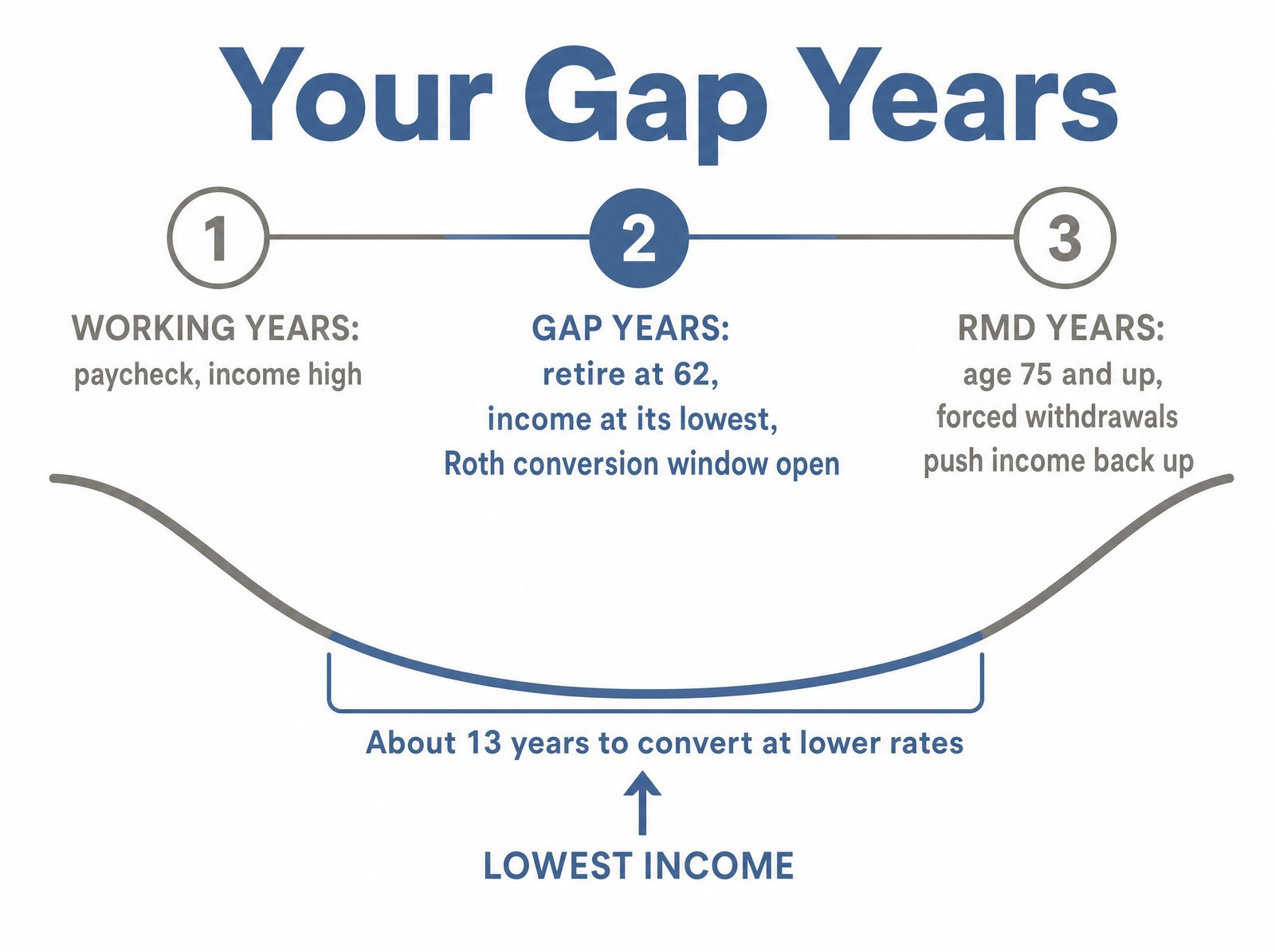
For a lot of our clients, that's not what happens. Income drops for a period of time, then RMDs hit and income climbs right back up, sometimes higher than it was when they were working.
But that dip in the middle is the opportunity. We call it your gap years: the window between when you retire and when you have to start taking required minimum distributions.
Say you retire at 62 and, like anyone born in 1960 or later, your RMDs begin at 75. You've got roughly 13 years where your taxable income will be lower than it will ever be again.
Think about what's happening in those years. First, your paycheck has stopped, so earned income is gone.
Second, Social Security hasn't started yet, so nothing is stacking on top. And third, RMDs haven't kicked in, so nothing is forced out of your accounts.
Put those three together and you may be sitting in the 10 or 12 percent bracket for the first time in decades.
That's your chance to intentionally move money from your pre-tax IRA into a Roth and pay the tax at today's lower rates. Then when RMDs hit, there's less in the account for the IRS to force out.
You're not eliminating those taxes. You're choosing when to pay them and at what rate.
That's the whole game. If you want the mechanics of how a conversion actually works, we cover them in our guide to Roth conversions and what you need to know.
Why the Window Won't Stay Open Forever
Here's something that doesn't get talked about enough. We're living in one of the lowest tax rate environments in American history.
The 2025 tax bill made today's brackets permanent, and we walked through what that changed in Roth conversions after the Trump bill. But permanent only means there's no end date written into the law.
Congress can change the brackets in any year. And there are real structural reasons to believe this window is closing.
The national debt has reached a point where every major credit rating agency is questioning the government's creditworthiness.
That's not a political statement. That's just the math.
Look at what the government spends versus what it collects, and the obligations coming due. There are really only two levers: cut spending or raise taxes.
Meaningful cuts to Social Security, Medicare, defense, and debt service aren't politically realistic. So the pressure lands on tax rates.
The Penn Wharton Budget Model has projected that fixing the imbalance through taxes alone would take an increase of about 33 percent in all federal taxes.
I'm not saying that's guaranteed. Who knows what tax rates will be five, 10, or 15 years from now.
But the direction of the pressure is clear. And right now you have the ability to lock in today's rates.
Most financial planning software doesn't account for any of this. It assumes current rates continue indefinitely, and that assumption is costing people a lot of money.
What the Math Showed for This Couple
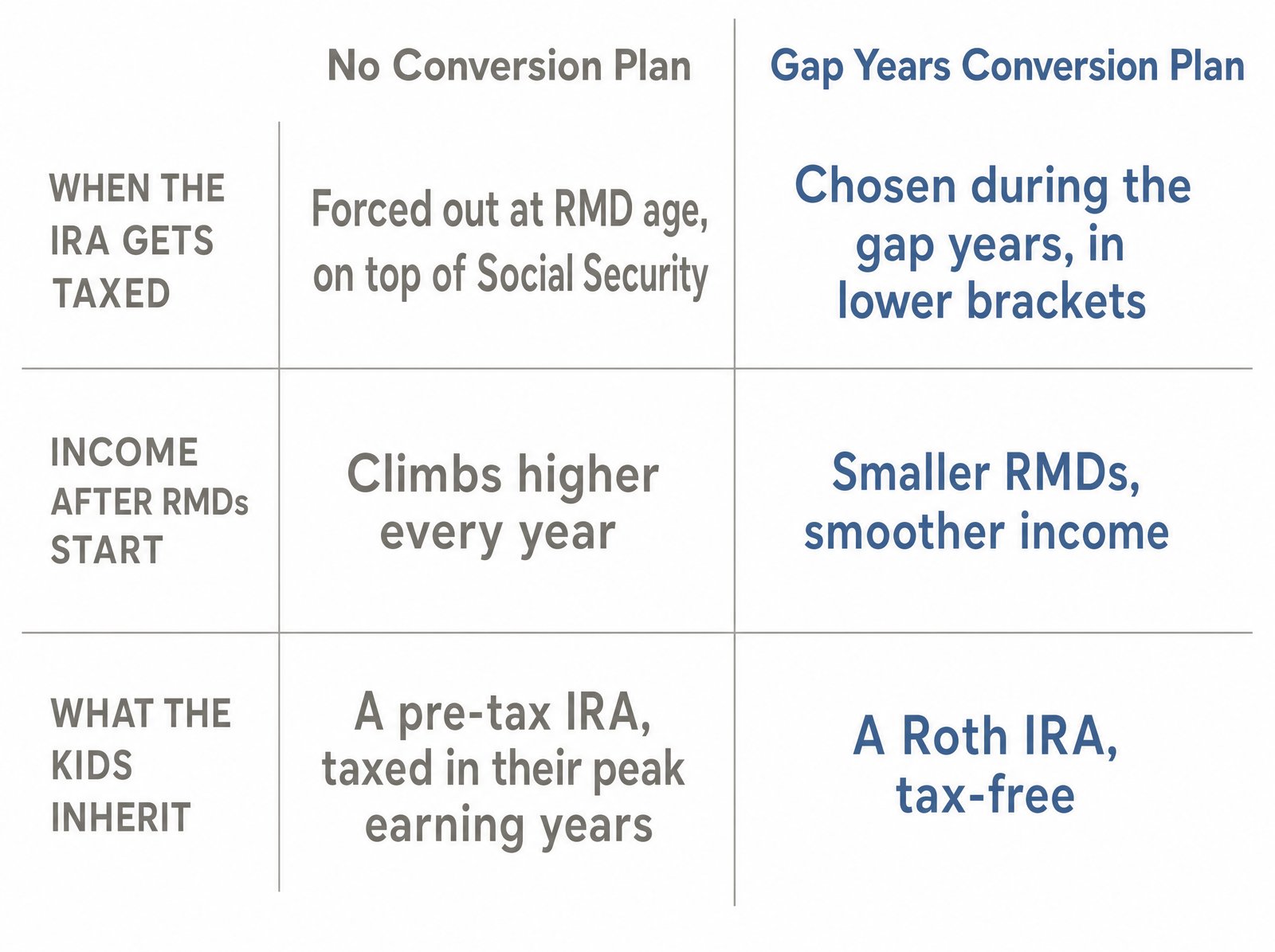
So here's what happens when this couple uses the window. Every year from 62 to 74, they convert just enough of the IRA to a Roth to fill up the 12 percent bracket, and they stop there.
The biggest conversions come first, about $133,000 to $140,000 a year from 62 to 64, before Social Security starts stacking on top. They convert about $874,000 in total and never trigger an IRMAA surcharge, the extra Medicare premium for higher incomes.
| No conversions | Fill the 12 percent bracket, 62 to 74 | |
|---|---|---|
| Federal tax in the gap years | About $45,000 | About $195,000 |
| First RMD at 75 | About $104,000 | About $34,000 |
| RMD at 82, survivor filing single | About $150,000 | About $38,000 |
| Survivor's federal tax, 80 to 92 | About $479,000 | About $193,000 |
| Kids' tax on the inherited IRA, at 24 percent | About $561,000 | $0 |
| Family's total federal tax bill, IRMAA included | About $1.19 million | About $422,000 |
They pay about $150,000 more in tax during the gap years. That's the price of using the window.
Look at what it buys. Their own lifetime federal tax drops from about $609,000 to about $422,000, and the kids inherit a Roth instead of a pre-tax IRA.
Add it all up, counting the kids' tax and Medicare surcharges, and the family's federal tax bill falls by about $772,000. After the growth they give up by paying tax early, the family still ends up about $441,000 ahead of doing nothing.
That's not a rounding error. That's the difference between a plan and a guess.
Now, I want to be clear. We're making a lot of assumptions here:
- 6 percent growth on every account and 2.5 percent inflation
- Today's federal tax law staying put, with brackets indexed for inflation (state tax not modeled)
- About $100,000 a year of spending, and Social Security at 67 of about $66,000 a year combined, in today's dollars
- One spouse passing at 79, the survivor living to 92, and the kids paying 24 percent on what they inherit
- Every other dollar amount above is in future dollars
But the direction of the math is clear. Paying 12 percent today on dollars that would otherwise come out at 22 or 24 percent later, for you, your survivor, or your kids, is a trade worth making.
Why More People Don't Do This
So why do so many people, and so many advisors, miss this window? A few reasons, and one of them might be sitting in your own situation right now.
First, most CPAs are looking backwards. They're filing last year's return, not modeling what your return looks like at 75 or 82.
That's not a criticism. They have hundreds and hundreds of returns to file, and they're focused on compliance.
But that's where the gap is: a financial planner who won't touch retirement tax planning and a CPA who doesn't have time for forward projections. You end up being the orchestrator instead of just living your life in retirement.
Second, a lot of people hear Roth conversions and think it means converting everything. It doesn't.
There's a sweet spot: the right amount, not too much and not too little. You want to fill up the lower brackets without pushing yourself into rates you'd never otherwise reach.
For the couple we modeled, converting up to the top of the 12 percent bracket left the family about $441,000 ahead. Converting up to the top of the 22 percent bracket left them only about $76,000 ahead, and filling the 24 percent bracket left them about $248,000 behind doing nothing.
Getting the sweet spot right means coordinating several moving pieces at once.
First, your current bracket and how much room you have before the next one. The second thing is Social Security timing, since claiming changes what stacks on your return.
Third, Medicare premiums. Conversions can push you over the IRMAA income brackets and raise what you pay for Medicare two years later.
The fourth piece is your beneficiaries' tax rates, because a dollar taxed at 12 percent today can save your kids from paying 24 or 32 percent later. And fifth, your RMD age, which sets the deadline on the whole window.
That's the work, and it has to happen before the window closes. I see way too many people come to us at 70 or 73 or 75 looking for a way to shrink a tax bill that's already locked in.
When Roth Conversions Don't Make Sense
Now I want to be honest about something. This strategy doesn't fit everyone, and I'd rather tell you that than run a conversion that costs you money.
If you're already at RMD age, already collecting Social Security, and have a pension stacking on top, converting on top of all that is probably the worst possible time.
That's not your gap years. That's the opposite.
The strategy works because of the timing. If the timing isn't there, the strategy changes.
What might still make sense in that situation is looking at your beneficiaries. If your kids are in a higher bracket and will inherit a large IRA, converting now so they receive it tax-free has real value, even if the math is tighter for you personally.
The Legacy Piece Almost Nobody Talks About
Your own tax return is only half of this. The other half is what happens to that money after you're gone.
With the passage of the SECURE Act, most adult non-spouse beneficiaries now have to empty an inherited IRA within 10 years. They can't stretch it out over their lifetimes anymore.
And your kids will probably be in their peak earning years when you pass away, maybe their 50s or 60s, making the most money they've ever made. Now they're taking large distributions from an inherited IRA on top of all of their earned income.
Every dollar lands on top of their salary, in their highest bracket. If they're in the 32 percent bracket, a $500,000 inherited IRA could cost them $160,000 in federal taxes.
For the couple we modeled, if the kids are in the 32 percent bracket instead of 24, filling the 12 percent bracket during the gap years is worth about $628,000 to the family instead of $441,000.
A Roth they inherit is tax-free. That's the legacy piece, and it's one of the strongest arguments for acting during the window, even if your own tax situation feels manageable.
Frequently Asked Questions
What is the best age to do a Roth conversion?
The best years are your gap years, the window between when you retire and when RMDs begin at 73 or 75.
If you retire at 62 and your RMDs start at 75, that gives you roughly 13 years to convert at the lowest rates you will ever see. Starting earlier in the window gives you more years to fill the low brackets without big one-year tax hits.
How much should I convert to a Roth each year?
There's a sweet spot, and converting too much can cost you as much as converting too little.
The goal is to fill your current bracket without spilling into a much higher one, while watching IRMAA thresholds and Social Security timing. For the couple we modeled, filling the 12 percent bracket left the family about $441,000 ahead, while converting through the 24 percent bracket left them about $248,000 behind.
Do Roth conversions raise my Medicare premiums?
They can.
Medicare sets your premium based on your income from two years prior, so a large conversion at 63 or later can trigger IRMAA surcharges on your Part B and Part D premiums. That's why we size conversions around the IRMAA brackets instead of ignoring them.
Can I still do Roth conversions after RMDs start?
Yes, but the math gets much harder.
You have to take your full RMD first, and the conversion then stacks on top of that forced income, your Social Security, and any pension. At that point the main reason to convert is your beneficiaries, not your own tax bill.
Do my kids pay taxes on an inherited Roth IRA?
No. As long as the account has been open five years, they receive distributions tax-free, though the 10-year emptying rule still applies.
Compare that with a pre-tax IRA, where a $500,000 inheritance could cost them $160,000 in federal taxes if they're in the 32 percent bracket during their peak earning years.
Here's What Matters
- Your gap years, the window between retirement and RMD age, are when your taxable income is the lowest it will ever be
- Converting during that window means paying 10 or 12 percent on dollars RMDs would otherwise force out at 22 or 24 percent
- For the couple we modeled, filling the 12 percent bracket from 62 to 74 cut the family's federal tax bill from about $1.19 million to about $422,000
- You're not eliminating taxes. You're choosing when to pay them and at what rate
- The widow's tax trap makes this worse: single-filer brackets compress hard when one spouse passes
- There's a sweet spot on the amount. For the same couple, converting through the 24 percent bracket left the family $248,000 worse off than doing nothing
- The SECURE Act's 10-year rule means your kids inherit a pre-tax IRA in their peak earning years. A Roth passes to them tax-free
- This strategy doesn't fit everyone. If you're already stacking RMDs, Social Security, and a pension, the timing has passed and the plan changes
If you're between 60 and 70 with a significant pre-tax balance, the question isn't whether Roth conversions are a good idea in theory. The question is whether the math works for your specific situation: your income, your brackets, and your Social Security timing.
That's what we look at in your free retirement assessment. We run your tax return forward, model the conversion scenarios, and show you the sweet spot: the right amounts, in the right years, at the right rates.
The window is open right now. It won't stay open forever.
Gudorf Financial Group is a fee-only, fiduciary retirement planning firm based in Dayton, Ohio. We serve clients locally and virtually nationwide.
Article References
- "Retirement Plan and IRA Required Minimum Distributions FAQs." IRS.gov. Accessed October 2026.
- "Publication 915, Social Security and Equivalent Railroad Retirement Benefits." IRS.gov. Accessed October 2026.
- "Complete Measures of U.S. National Debt." Penn Wharton Budget Model. January 2025.
- "Medicare Costs." Medicare.gov. Accessed October 2026.
- "Retirement Topics: Beneficiary." IRS.gov. Accessed October 2026.