


2027 401(k) Contribution Limits for Savers 50 and Older, Including Retirees
By Danny Gudorf | Founder, Gudorf Financial Group | Updated November 2026
The IRS released the 2027 retirement plan limits on November 12, 2026. The 2027 401(k) contribution limit goes up $1,000 to $25,500, and the catch-up for anyone 50 or older goes up $500 to $8,500.
That's the headline you'll see everywhere this week.
But if you're retired, or mostly retired, a 401(k) limit doesn't do much for you. You can't put money into a 401(k) you no longer have a paycheck from.
So this post does two things.
First, it lays out every 2027 number that matters for people 50 and older. Second, it shows which of those numbers still apply once you stop working full time, because a lot more of them apply than most retirees think.
The 2027 401(k) Contribution Limits at a Glance
Here's everything that changed for 2027, side by side with 2026. Every figure comes from IRS Notice 2026-66 and the IRS announcement of the 2027 limits, except the HSA figures, which the IRS set back in June.
| Limit | 2026 | 2027 |
|---|---|---|
| 401(k), 403(b), 457 and TSP deferral | $24,500 | $25,500 |
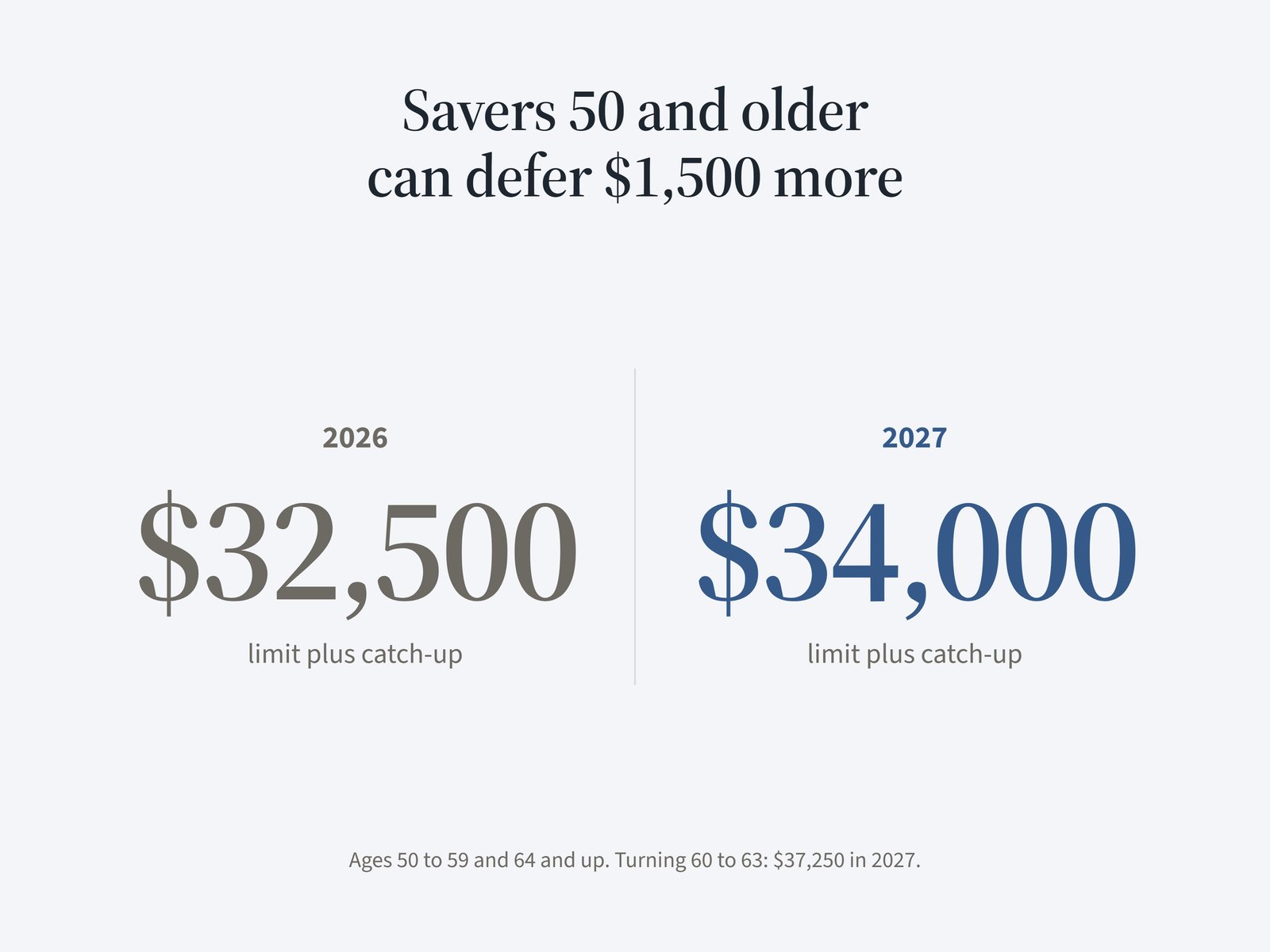
| Catch-up, age 50 and older | $8,000 | $8,500 |
| Super catch-up, turning 60 to 63 | $11,250 | $11,750 |
| Total employee and employer additions to a 401(k) | $72,000 | $75,000 |
| Roth catch-up wage test (prior-year wages) | $150,000 | $155,000 |
| SIMPLE IRA deferral | $17,000 | $17,500 |
| IRA and Roth IRA contribution | $7,500 | $7,500 (no change) |
| IRA catch-up, age 50 and older | $1,100 | $1,100 (no change) |
| Roth IRA income phase-out, married filing jointly | $242,000 to $252,000 | $250,000 to $260,000 |
| Roth IRA income phase-out, single | $153,000 to $168,000 | $158,000 to $173,000 |
| Qualified charitable distribution (QCD), per IRA owner | $111,000 | $114,000 |
| HSA, self-only / family | $4,400 / $8,750 | $4,500 / $9,000 |
| HSA catch-up, age 55 and older | $1,000 | $1,000 (no change) |
Two things jump out for people 50 and older:
- The 401(k) went up and the IRA didn't. A saver 50 or older can put $1,500 more into a 401(k) in 2027, but the IRA limit is the same $8,600 it was last year.
- The QCD limit went up $3,000. That one matters to retirees who give to charity, and almost nobody will talk about it this week.
2027 Catch-Up Contributions by Age
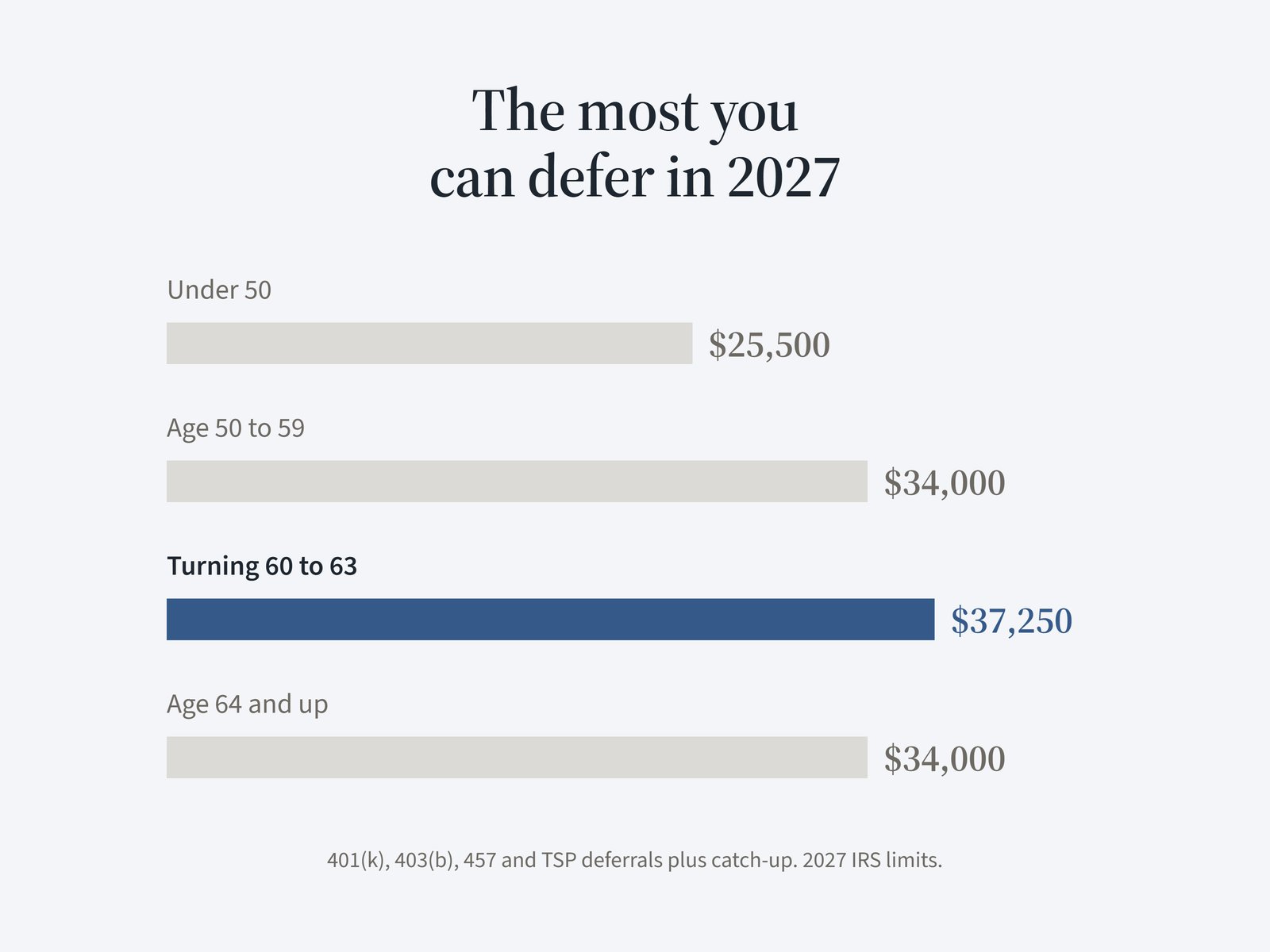
Catch-up contributions are the extra amount the IRS lets you add on top of the regular 401(k) limit once you turn 50. For 2027 there are three age bands, and the middle one is the most generous.
| Your age in 2027 | Regular limit | Catch-up | Total you can defer |
|---|---|---|---|
| 50 to 59 | $25,500 | $8,500 | $34,000 |
| Turning 60, 61, 62 or 63 | $25,500 | $11,750 | $37,250 |
| 64 and older | $25,500 | $8,500 | $34,000 |
The 60 to 63 window is the super catch-up that came out of the SECURE 2.0 law. It's based on the age you reach by December 31, so someone who turns 60 in November 2027 gets the full $37,250 for the whole year.
Now, it goes away at 64. The year you turn 64, you drop back to the regular $8,500 catch-up.
The Roth catch-up rule for higher earners
There's one more catch-up rule if you're still earning a good salary. If your Social Security wages from your employer were more than $155,000 in 2026, any catch-up you make in 2027 at that employer has to go in as Roth.
Here's how that plays out:
- The regular $25,500 is unaffected. You can still put that in pre-tax.
- Only the catch-up dollars have to be Roth. You pay tax on them now, and they come out tax-free later.
- It looks at last year's wages, not this year's. A big bonus in 2026 sets your 2027 rule.
For a lot of people in their early 60s, that Roth requirement is not a bad thing. You're building up tax-free money you can draw from later, which comes in handy once Social Security and required minimum distributions start stacking on your tax return.
Retired? Here's Which 2027 Limits Still Apply to You
So what if you've already retired? The rule that decides almost everything is simple: you can only contribute to a retirement account from earned income.
Earned income means money you're paid for working. It does not mean money your savings or your past work pays you.
| Counts as earned income | Does not count |
|---|---|
| Wages from a part-time job | Social Security |
| Net profit from consulting or freelancing | Pension payments |
| Self-employment income from a side business | IRA withdrawals and RMDs |
| Tips and commissions | Interest, dividends and capital gains |
| Board or director fees | Most rental income |
There's no age limit anymore. Since 2020, the IRS rules on IRA contributions let you contribute to a traditional IRA at 70, 75 or 80, as long as you have earned income that year.
So the only question that matters is whether you earned anything this year.
How Retirees With Part-Time Income Can Still Contribute
This is where we see a lot of retirees leave an easy opportunity on the table. Plenty of our clients have some consulting income or a side job bringing in $5,000, $10,000 or $14,000 a year, and they don't realize that money opens the door to Roth contributions for both spouses.
There are three ways to put part-time income to work.
1. Roth IRA contributions for you and your spouse
You can put up to $8,600 into a Roth IRA in 2027 if you're 50 or older. The cap is the lower of that limit or what you actually earned.
And here's the part most couples miss.
If you file a joint return, one spouse's earned income can fund a Roth IRA for the other spouse, even if that spouse has no income at all. That's called a spousal IRA.
The rules for a couple:
- Combined contributions can't be more than your combined earned income. $10,000 of wages can fund $10,000 of Roth contributions, split however you want.
- Each spouse still has their own $8,600 cap. To fill both accounts, the couple needs $17,200 of earned income.
- You must file married filing jointly.
- Your income has to be under the Roth limit. For 2027 the phase-out for couples starts at $250,000 of modified adjusted gross income, which most retired couples are well under.
2. A part-time job that offers a 401(k)
If your part-time job is with an employer that has a 401(k), you can contribute through payroll. Your age bands and the 2027 limits above apply, but you can't contribute more than you're paid.
Part-time workers used to get shut out of these plans.
Under SECURE 2.0, an employee who works at least 500 hours a year for two years in a row now has to be allowed to make 401(k) contributions. The employer doesn't have to match, but you can still save.
3. Consulting or self-employed income with a Solo 401(k) or SEP IRA
If you consult for your old employer or run a small side business, you're self-employed. That gives you two more options, and both can shelter more than an IRA when the income is bigger.
- Solo 401(k): You can defer up to 100% of your net self-employment earnings, up to the $25,500 limit plus your catch-up. Many providers offer a Roth version too.
- SEP IRA: Only "employer" contributions, roughly 20% of your net self-employment earnings. Simpler to run, but it shelters less on a small income.
One detail for consultants: the earned income that counts is your net profit after the deduction for half of your self-employment tax, not your gross billings. On a small consulting income that knocks off a few hundred dollars, so leave yourself a little room.
A Couple, a $14,000 Side Job, and Two Roth IRAs
We see this all the time.
Say you've got a couple, both 68, about $1.4 million saved, most of it in pre-tax IRAs. He retired from engineering a few years ago and doesn't want to work again.
She does. She took a part-time bookkeeping job a couple of days a week, mostly to get out of the house, and it pays about $14,000 a year in wages.
They figured that paycheck was just travel money. It is, but it's also something more useful.
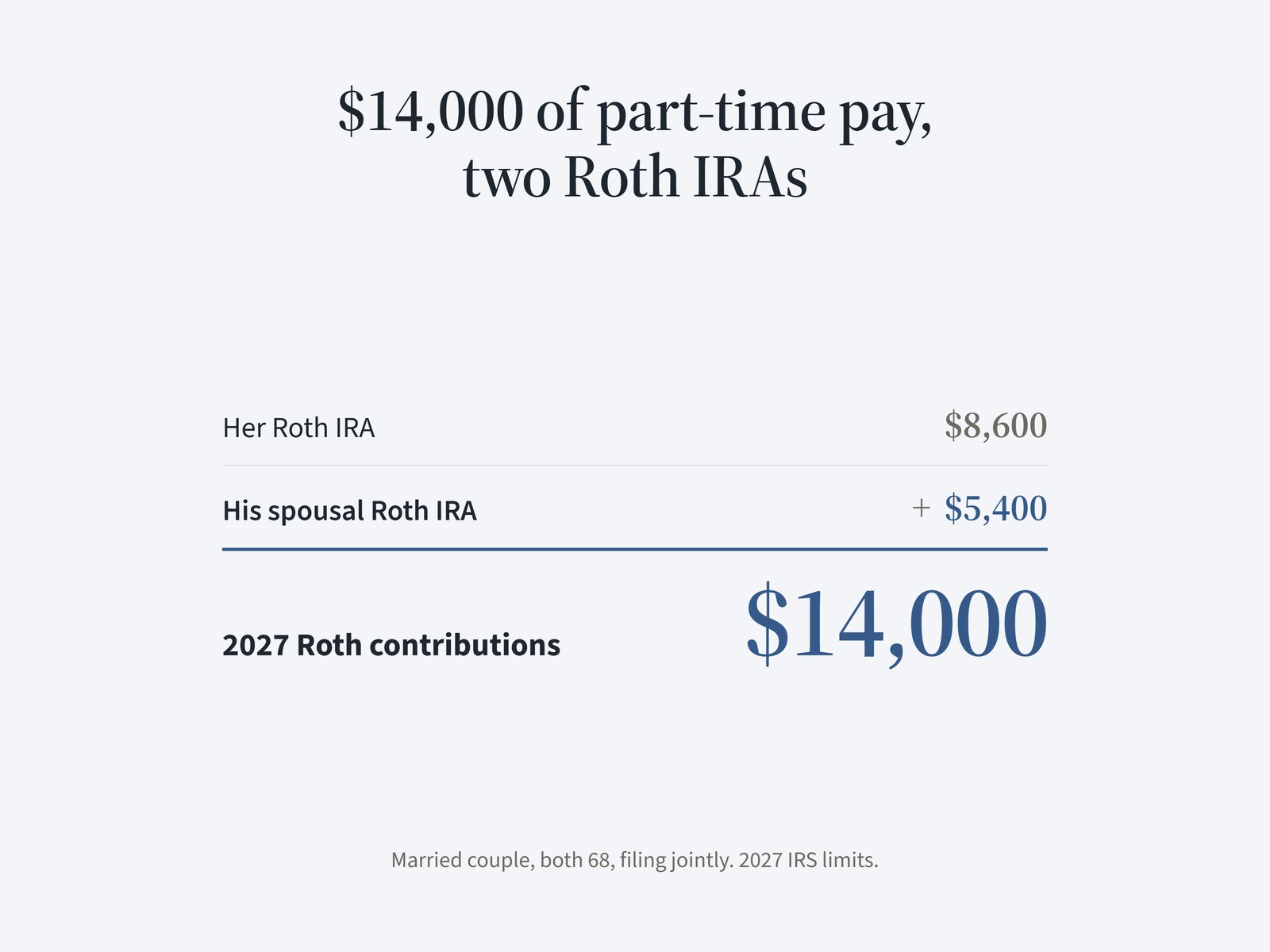
Because she has $14,000 of earned income and they file jointly, they can put $14,000 into Roth IRAs in 2027:
- $8,600 into her Roth IRA, the full 2027 limit for someone 50 or older.
- $5,400 into his spousal Roth IRA, the rest of her earned income.
The money doesn't have to come out of her actual paycheck. They can fund the Roth IRAs from savings or a brokerage account and keep spending her paycheck on travel.
They're 68, and their required minimum distributions don't start until 73. These are their gap years, the window between retiring and RMDs.
If she keeps working through age 72, that's five years of $14,000, or $70,000 of contributions moved into Roth accounts before any growth. Those dollars never face a required minimum distribution, and they come out tax-free.
Is that going to change their whole retirement? No.
But it's $70,000 that was going to sit in a taxable account, now growing tax-free, from a job she was doing anyway.
Roth or Traditional for Part-Time Income in Retirement
We think about every dollar in terms of what we call the three tax buckets: taxable, tax-deferred and tax-free. Most of the couples we work with have a heavy tax-deferred bucket and a light tax-free one.
That's why, for most of our retired clients with part-time income, we lean Roth. Three reasons:
- Your bracket is probably low right now. During the gap years, with no paycheck and no RMDs yet, many couples are in the lowest brackets they'll see for the rest of their lives, and a deduction is worth less in a low bracket.
- Your tax-deferred bucket is already big. Adding to it makes your future RMDs bigger, and RMDs plus Social Security are what push people into higher brackets in their 70s.
- Roth money has no RMDs. It grows tax-free for as long as you leave it, and it passes to your kids tax-free.
Now, there are times a traditional IRA deduction makes sense, like a year with an unusually high income or a large one-time gain. Everyone's situation is different, and that's just our opinion as a starting point.
One more reason to favor Roth if you give to charity: once you're past 70½, any deductible traditional IRA contribution you make reduces how much of your future QCDs are tax-free. Roth contributions don't have that problem.
If you're in your gap years and wondering how Roth contributions fit with Roth conversions, our post on the Roth conversion window between 60 and 70 walks through how the two work together.
Can You Keep Contributing After RMDs Start?
Yes. Taking required minimum distributions doesn't stop you from contributing, as long as you have earned income that year.
A few rules to keep straight:
- Your RMD itself can't go into a Roth IRA. You have to take the required distribution first, then convert or contribute other dollars.
- You can still contribute new money from earned income. A 75-year-old with $8,000 of wages from a part-time job can put up to $8,000 into a Roth IRA, even while taking RMDs.
- The still-working exception only covers a current employer's 401(k), not your IRAs. If you're still employed and don't own 5% or more of the company, you can usually delay RMDs from that plan.
The right way to sequence all of this depends on your brackets for the year. Our 2027 federal tax rates guide for retirees has the new brackets and deductions you'll be planning around.
The 2027 QCD Limit Rises to $114,000
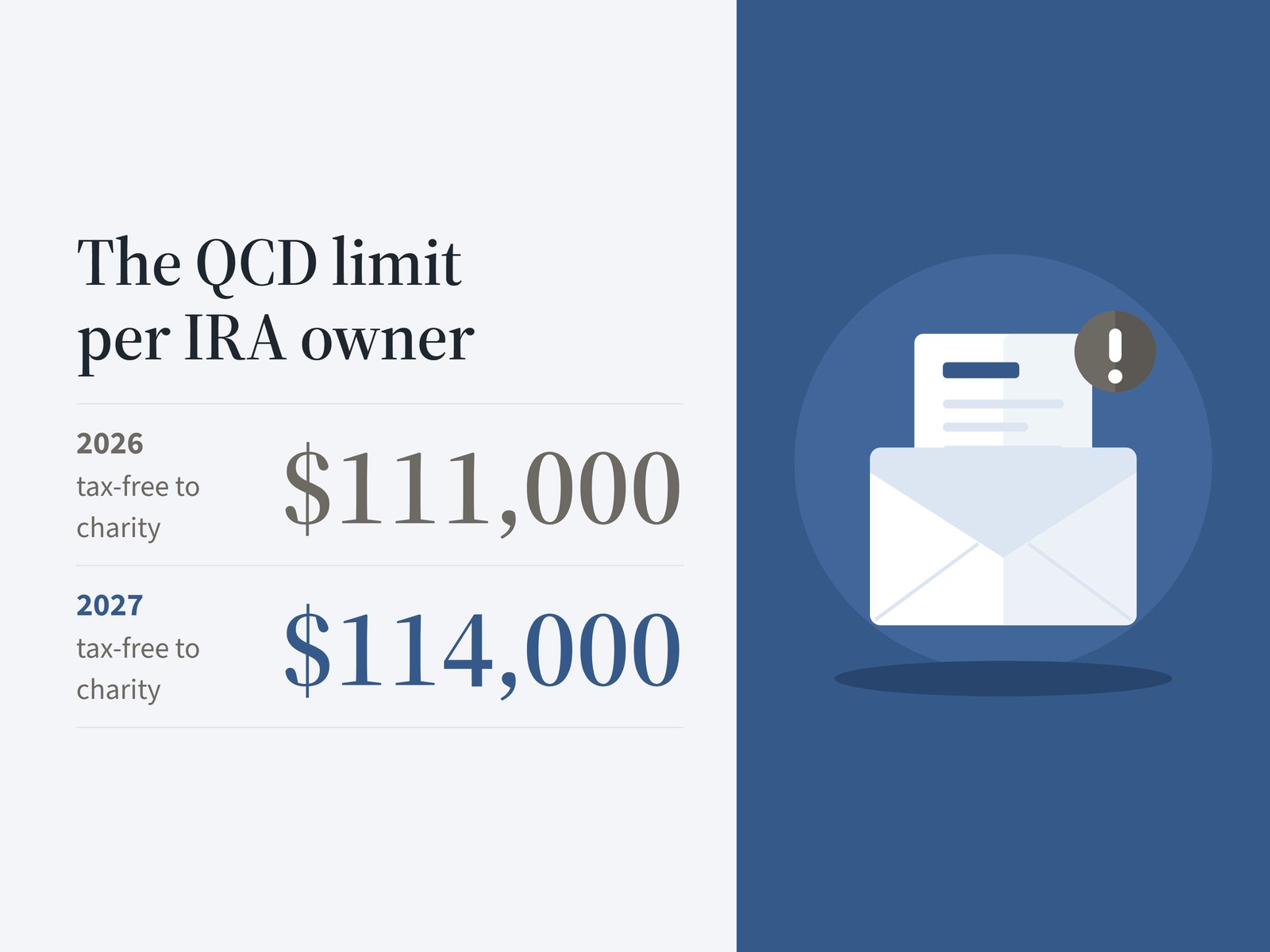
This is the 2027 number most retirees will actually use. A qualified charitable distribution, or QCD, lets you give money straight from your IRA to a charity, and it never shows up as taxable income.
Here's how it works:
- You must be 70½ or older on the day of the gift.
- The limit is $114,000 per IRA owner in 2027, up from $111,000. A married couple who both have IRAs can each give up to that amount.
- It counts toward your required minimum distribution. If your RMD is $40,000 and you give $15,000 through QCDs, only $25,000 hits your tax return.
- The money has to go directly from the IRA to the charity. If the custodian sends it to you first, it's just a taxable withdrawal.
That last rule is where most QCDs go wrong. For the full mechanics, our guide to qualified charitable distributions covers reporting and timing in detail.
How we handle QCDs with a QCD checkbook
For our clients who give regularly, we set up what we call a QCD checkbook. It's a checkbook tied directly to the IRA, so a client can write a check to their church or charity the same way they'd write any other check.
We do it this way for three reasons:
- The money goes straight from the IRA to the charity. No middle step where it lands in your checking account by accident.
- We can see which checks have been cashed before year-end. A QCD counts in the year the charity cashes the check, not the year you write it.
- It's much easier to track at tax time. Every QCD shows up on the IRA statement with the payee, so we have a clean list when we prepare the return.
That second point is the one that saves people. A check sitting in a church office drawer on December 31 doesn't count toward this year's RMD, so we watch for uncashed checks in the fall and follow up with the charity.
Mailed custodian checks go missing more than you'd think. The checkbook takes most of that guesswork away.
One more 2027 number for the record: the limit on a qualifying longevity annuity contract, or QLAC, goes to $220,000. We typically don't recommend QLACs for our clients, so we won't spend time on it here.
Four Watch-Outs for Retirees Working Part Time
Part-time income is mostly good news. But it touches a few other parts of your plan, and these are the four we check every time.
1. The Social Security earnings test
If you've claimed Social Security and haven't reached your full retirement age, Social Security can hold back part of your benefit when you earn too much. The 2027 Social Security earnings limits:
| Your situation in 2027 | Earnings limit | What happens above it |
|---|---|---|
| Under full retirement age all year | $25,560 | $1 withheld for every $2 over |
| Reaching full retirement age in 2027 | $67,920 (months before full retirement age) | $1 withheld for every $3 over |
| At or past full retirement age | No limit | Nothing withheld |
Withheld benefits aren't lost for good. Social Security recalculates your benefit at full retirement age to credit you for them.
But it can surprise you if you weren't expecting a smaller check.
2. HSA contributions stop when Medicare starts
The 2027 HSA limits are $4,500 for self-only coverage and $9,000 for family coverage, plus a $1,000 catch-up at 55, according to IRS Revenue Procedure 2026-24. Once you enroll in any part of Medicare, you can't contribute anymore.
Watch the timing if you sign up for Medicare after 65. Part A coverage can be backdated up to six months, and HSA contributions made during those months count as excess contributions.
3. Part-time income adds to your Medicare premium math
Every dollar you earn adds to your modified adjusted gross income. That number decides whether you pay IRMAA, the extra Medicare premium for higher earners, based on your tax return from two years earlier.
For most part-time incomes it won't matter. But if you're already close to a threshold, $14,000 of wages on top of Roth conversions can be what tips you over.
Our post on the Medicare IRMAA brackets and how to stay under them shows where those lines are.
4. The deadlines are different
- 401(k) at an employer: through payroll by December 31, 2027.
- IRA and Roth IRA for 2027: you have until the 2028 tax filing deadline in mid-April. April 15, 2028 falls on a Saturday, so check the IRS calendar for the exact date.
- SEP IRA and Solo 401(k) employer contributions: until your tax filing deadline, including extensions.
The IRA deadline is helpful for part-time workers. You can wait until you know exactly what you earned in 2027, then contribute the right amount.
Frequently Asked Questions
Can you contribute to an IRA after retirement?
Yes, as long as you have earned income that year from a job, consulting or self-employment.
Social Security, pensions and investment income don't count. There's no age limit, and if you're married and file jointly, one spouse's earned income can fund an IRA for both of you.
What is the 401(k) catch-up contribution limit for 2027?
The 2027 catch-up for anyone 50 or older is $8,500, for a total of $34,000. If you turn 60, 61, 62 or 63 during 2027, the super catch-up is $11,750, for a total of $37,250.
Can I contribute to a Roth IRA for my spouse if only I work part time?
Yes, through a spousal IRA, as long as you file jointly.
Your combined Roth contributions can't be more than your earned income, and each of you can put in up to $8,600 in 2027 if you're 50 or older.
Can I contribute to an IRA while taking required minimum distributions?
Yes. Starting RMDs doesn't stop you from contributing new money from earned income.
The one thing you can't do is put the RMD itself into a Roth IRA.
What is the QCD limit for 2027?
The 2027 qualified charitable distribution limit is $114,000 per IRA owner, up from $111,000 in 2026.
You must be 70½ or older, and the gift counts toward your required minimum distribution for the year.
Here's What Matters
- The 2027 401(k) limit is $25,500, with an $8,500 catch-up at 50 ($34,000 total) and an $11,750 super catch-up for anyone turning 60 to 63 ($37,250 total).
- The IRA limit didn't change: $7,500 plus a $1,100 catch-up, or $8,600 total at 50 and older.
- Retirees can keep contributing as long as they have earned income. A part-time job or consulting income can fund Roth IRAs for both spouses.
- For most retirees in their gap years, Roth contributions make more sense than deductible ones.
- The QCD limit rises to $114,000. A QCD checkbook makes it easier to get every gift cashed before year-end and tracked for tax time.
- If you work part time before full retirement age, check the Social Security earnings test before you take the job.
If you'd like help putting the 2027 numbers to work in your own plan, our retirement tax planning team looks at contributions, Roth conversions, QCDs and RMDs together every year.
You've got three options.
Hire us, take what we find and compare it against what you're doing now, or keep doing what you're doing. All three are fine.
Gudorf Financial Group is a fee-only, fiduciary retirement planning firm based in Dayton, Ohio. We serve clients locally and virtually nationwide.
Article References
- "401(k) limit increases to $25,500 for 2027, IRA limit remains $7,500." Internal Revenue Service. November 2026.
- "Notice 2026-66: 2027 Amounts Relating to Retirement Plans and IRAs." Internal Revenue Service. November 2026.
- "2027 Social Security Changes." Social Security Administration. October 2026.
- "Revenue Procedure 2026-24: 2027 HSA Limits." Internal Revenue Service. June 2026.
- "Retirement Topics: IRA Contribution Limits." Internal Revenue Service. Accessed November 2026.