

7 Strategies for Managing RMDs During a Bear Market
By Danny Gudorf | Founder, Gudorf Financial Group | Updated October 2026
You watched your accounts drop, and now the IRS wants its cut anyway. That is the spot a lot of retirees find themselves in when a required minimum distribution comes due in a down market.
Here is the thing.
You cannot wave off the withdrawal because stocks are down. But you have real control over how you take it, and a few of those choices can save you a meaningful amount of money.
So let me walk you through seven ways to take your RMDs when the market is down. None of these are exotic.
They are the same moves we run through with clients every time the market gives us one of these stretches.
Why RMDs Hurt More in a Down Market
An RMD is the minimum you have to pull out of your pretax retirement accounts each year once you hit RMD age. That age is 73 if you were born from 1951 through 1959, and 75 if you were born in 1960 or later, under the final IRS RMD regulations.
The amount is set by a formula. You take your account balance from December 31 of last year and divide it by a life expectancy factor the IRS publishes.
That timing is the whole problem. Your withdrawal for this year was locked in using last year's balance, before the market fell.
So a down market hits you two ways at once:
- You are selling at a low. The dollars you take out are shares sold at a discount, and those shares are not there to recover later.
- You are taking a bigger bite. The same dollar amount is now a larger slice of a smaller portfolio.
This is what we call sequence of returns risk. When you are forced to sell into a falling market, you do permanent damage, because you took out money that never got the chance to bounce back.
If you want the deeper version of this, we broke it down in how sequence of return risk impacts your retirement.
There is a tax layer on top of it too.
A big forced withdrawal can stack on your Social Security and a pension, push you into a higher bracket, and trip an IRMAA surcharge on your Medicare. We call that pileup the tax torpedo, and we wrote about the full version in RMDs meeting market crashes.
Now, none of this is a reason to panic. It is a reason to be intentional about the seven moves below.
Strategy 1: Control the Timing of Your RMD
You have more say over when you take the money than most people think. You just have to use it on purpose.
If this is your first RMD year, you have a delay option.
You can push your very first distribution to April 1 of the following year. If you reach your RMD age this year, you could wait until April 1 of next year to take it.
There is a catch, and it is a real one.
Delay the first one and you take two RMDs in that second year, which can shove you into a higher bracket. So this only helps if the delay lets a beaten-down account recover and the doubling up does not cost you more in taxes than it saves.
The second timing tool is spreading the withdrawal out. Instead of pulling the whole RMD in one shot, you take it in monthly or quarterly pieces across the year.
Think about it this way.
If your RMD is 12,000 dollars and you take 1,000 a month, you are not betting the whole thing on the price the day you happened to sell. You are averaging your sale price across twelve different market days instead of one.
Who this helps most:
- Anyone in their first RMD year weighing the delay
- Retirees who worry they will pick the exact wrong day to sell
- People who do not need the full amount as a lump and can spread it out
Strategy 2: Use the Still-Working Exception
If you are past your RMD age and still on the job, you may be able to hold off on some of these withdrawals entirely.
The IRS lets you delay RMDs from your current employer's plan, like a 401(k), as long as three things are true:
- You are still working there. Not retired, still employed.
- You do not own more than 5% of the company.
- Your plan actually allows it. Not every plan does, so you have to check with the plan administrator.
Here is why it matters in a down market. If your current 401(k) does not have to pay out yet, those dollars get more time to recover before you ever touch them.
One important limit.
This only covers your current employer's plan. It does nothing for your IRAs or for old 401(k)s from past jobs, and you still have to take RMDs from those.
Strategy 3: Pull From Your War Chest First
This is the one that matters most, and it is the reason we build a war chest into every retirement paycheck we design.
A war chest is your cash and bond reserve inside the portfolio. It is money that is not riding the stock market, so it is sitting there ready when you need to pull a withdrawal in a bad year.
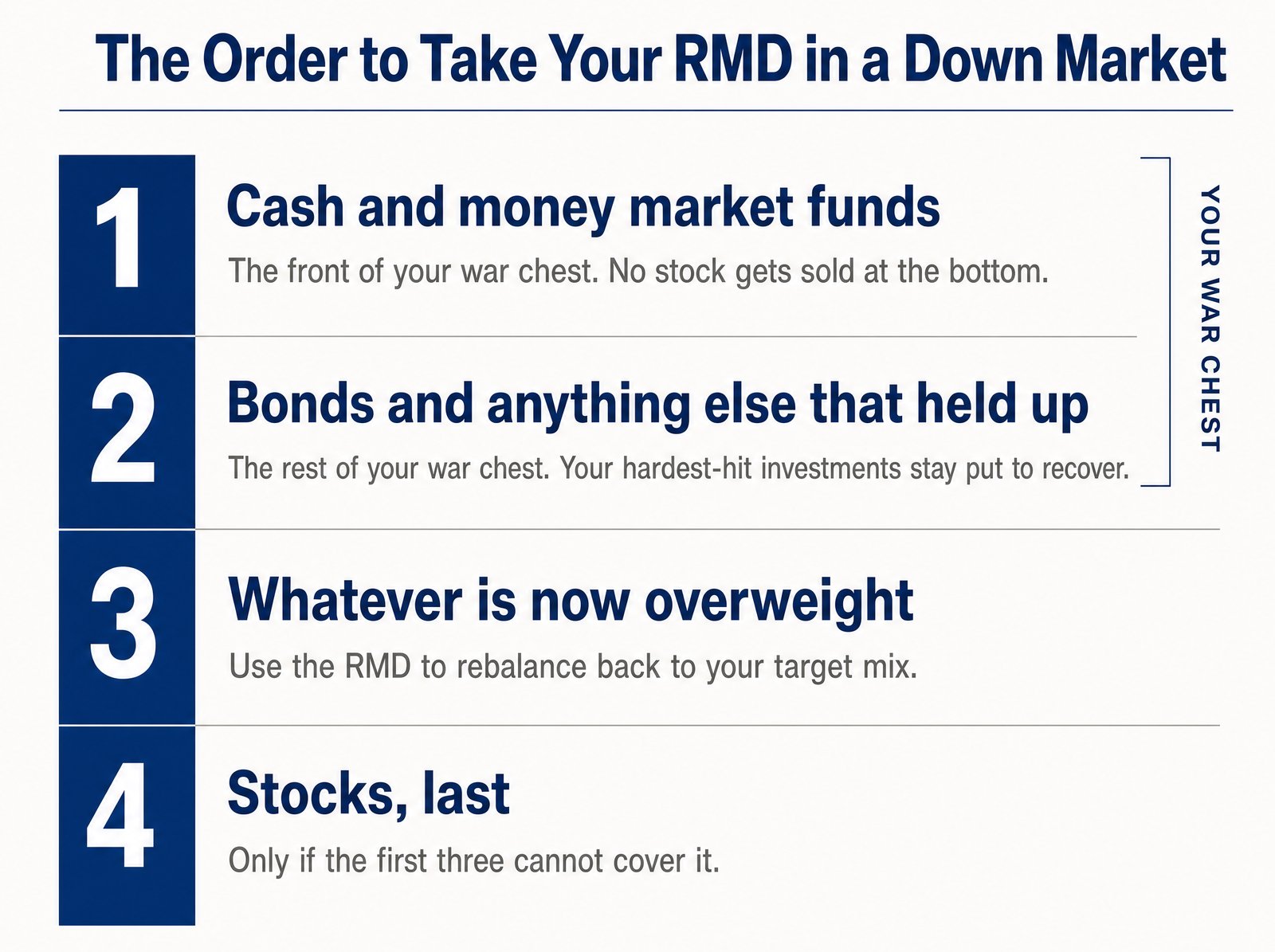
When the RMD comes due in a down market, the order you sell in makes all the difference:
- Cash and money market funds first. This is the front of the war chest. You satisfy the RMD without selling a single stock at the bottom.
- Then the bonds and anything else that held up. Bonds are the rest of the war chest, and in a lot of downturns they hold their value better than stocks. Selling those first leaves your hardest-hit investments alone to recover.
- Rebalance while you are at it. If the drop knocked your portfolio out of its target mix, you can use the RMD to sell from whatever is now overweight and get back in line.
Let me give you the picture. Say a downturn pushed your 60/40 portfolio to something like 52/48 because stocks fell and bonds held.
Taking the whole RMD from the bond side does two jobs at once. You satisfy the withdrawal, and you nudge the portfolio back toward its target without touching your stocks.
That is a war chest doing exactly what it was built to do, and it is a core piece of how we handle retirement income planning.
Strategy 4: Give Directly From Your IRA With a QCD
If you already give to charity, this is one of the cleanest tax moves available to a retiree, and it gets even better in a down market.
A qualified charitable distribution, or QCD, is a direct transfer from your IRA to a qualified charity. The money leaves your account and goes straight to the organization without ever passing through your hands.
That direct transfer detail is the whole point. Because the money never lands in your income, the distribution counts toward your RMD but is not added to your taxable income.
For 2026 you can give up to 111,000 dollars per person this way, and you can start at age 70 and a half even though RMDs do not begin until 73 or 75. Here is what a QCD does for you:
- It knocks out part or all of your RMD without adding a dollar to your income
- It works even if you take the standard deduction and never itemize
- It keeps you from selling investments at a low to fund a gift you were going to make anyway
One practical headache. Getting a check cut from the custodian to the charity on time can be a mess, and I cannot tell you how many QCD checks have been lost in the mail with how bad the mail is now.
That is why we set clients up with a QCD checkbook tied straight to the IRA, so the gift goes directly from the account the way the rules require. We laid out the full mechanics in our guide to tax-free charitable giving with QCDs.
Strategy 5: Take the RMD In-Kind Instead of Selling
What if you could satisfy the RMD without selling anything at a low?
You can. It is called an in-kind distribution.
Instead of selling shares inside the IRA and moving cash out, you move the actual shares. The securities transfer from your IRA to a regular taxable brokerage account, and that transfer satisfies your RMD at the value on the day it moves.
Now, be clear on one thing.
You still owe ordinary income tax on the value of what you moved, same as any RMD. This is not a tax dodge.
What it buys you is this.
You are not forced to sell your beaten-down shares at the bottom. They keep sitting in your account, still invested, ready to recover.
There is a nice tax wrinkle on the back end too:
- The shares get a new cost basis equal to their value on the transfer date
- When they recover and you eventually sell in the taxable account, you only owe capital gains on the growth from that date forward
- Hold them more than a year after the transfer and that growth is taxed at long-term capital gains rates, which are lower than the ordinary income rates on the RMD itself
One caution worth knowing.
Share prices can move while the transfer is processing, so it takes a little coordination to make sure the transfer fully covers your RMD amount. Morningstar walks through the same in-kind mechanics if you want a second read on it.
Strategy 6: Reinvest What You Do Not Need
Plenty of retirees are forced to take an RMD they do not actually need for living expenses. If that is you, do not let the money sit in cash.
You cannot put it back in the IRA. But nothing stops you from reinvesting it in a taxable brokerage account and keeping your market exposure.
The key is speed. Get it reinvested within a few days so you are not sitting out of the market during the exact stretch it might rebound.
When you reinvest, lean toward tax-efficient choices:
- Broad-market index funds or ETFs, which throw off very few surprise taxable distributions
- Municipal bonds, if tax-free income fits your situation
- Shares you plan to hold for the long haul, which pushes the tax down the road
I call this a good bad thing.
You did not want to be forced to take the money, but you took a down-market withdrawal and put it right back to work, and if it grows in the taxable account, it helped offset the tax you paid to pull it. That is a decent outcome from a bad starting point.
Strategy 7: Coordinate Across Your Accounts
If you have more than one retirement account, you have more flexibility than you realize, and a down market is when it pays off.
The rules are not the same for every account type:
| Account type | How the RMD works |
|---|---|
| Traditional IRAs | Calculate the RMD for each, but you can take the total from any one IRA or split it however you want |
| 401(k)s and other employer plans | No aggregating. You take the RMD from each plan separately. 403(b)s are the exception: you can total them and take it from any one 403(b) |
That IRA flexibility is a tool. It lets you choose which investments to protect.
So if you hold three IRAs, one conservative, one moderate, one aggressive, you can pull the whole RMD from the conservative one in a down year. That leaves the aggressive account alone to recover instead of selling it at the bottom.
A down market also opens a door on the Roth side. When values are low, converting part of a traditional IRA to a Roth means you pay tax on a smaller number, and all the recovery after that happens tax-free.
Two things to keep straight before you get excited about that:
- You have to take your RMD first. You cannot convert your RMD. The conversion is money on top of the required withdrawal.
- There is a sweet spot. You can convert too little and too much. Anyone telling you to convert everything or convert nothing is not doing the math.
Done in the right amount, a down-market conversion lowers your future RMDs by shrinking the traditional balance, and it chips away at the tax torpedo waiting for you and your spouse down the road. This is exactly the kind of thing we model inside tax planning, and we covered the decision in depth in Roth conversions: what you need to know.
How To Put This Together
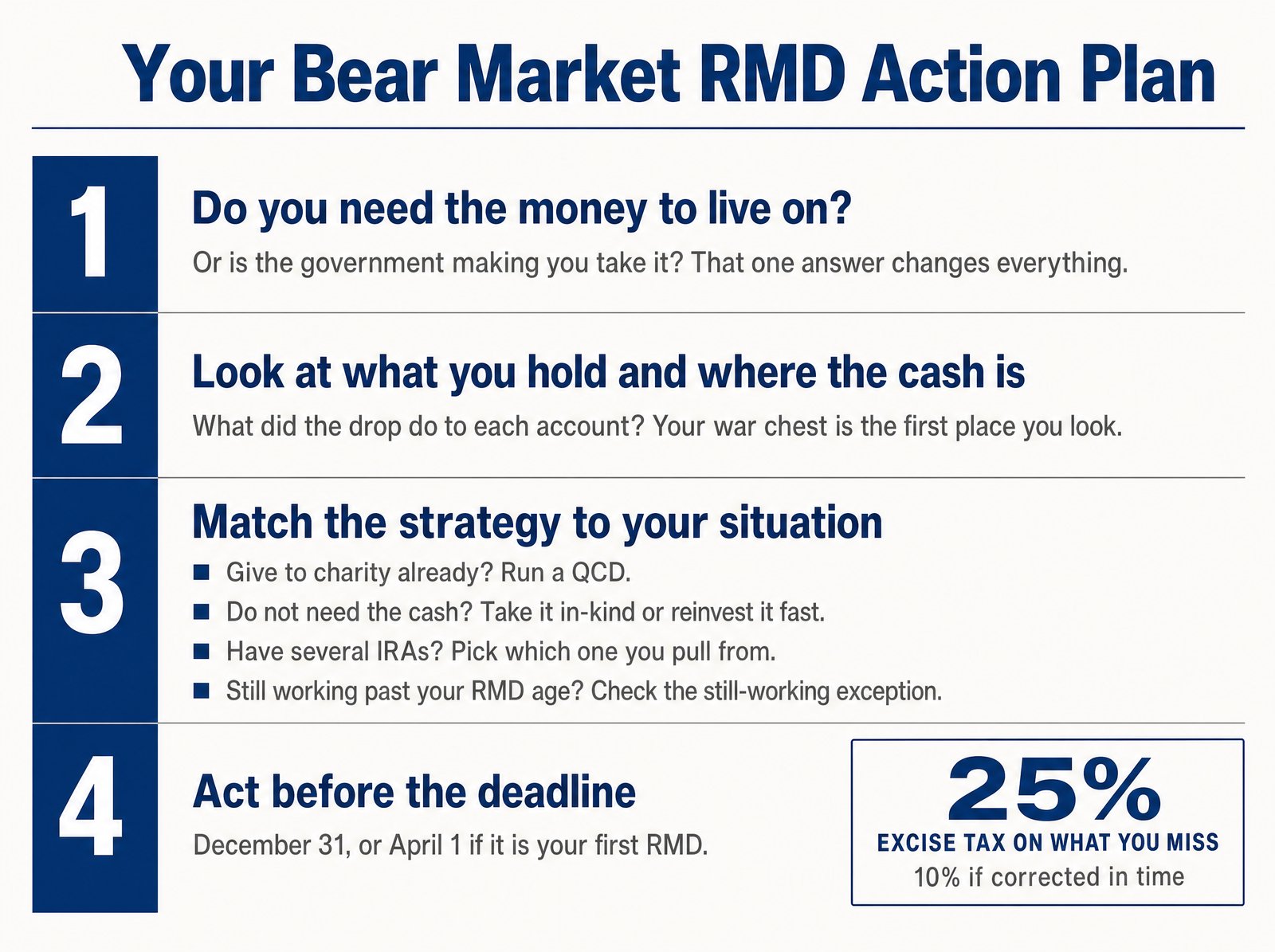
Seven strategies is a lot. So here is how we actually work through it with a client, in order.
First, figure out if you even need the money.
Do you need this RMD to live on, or is it money the government is making you take? That one answer changes everything downstream.
Second, look at what you are holding.
What accounts do you have, what did the drop do to each, and where is the cash. Your war chest is the first place you look.
Third, match the strategy to your situation:
- Give to charity already? Run a QCD.
- Do not need the cash? Take it in-kind or reinvest it fast.
- Have several IRAs? Coordinate which one you pull from.
- Still working past your RMD age? Check the still-working exception.
Fourth, act before the deadline.
Your RMD is due by December 31, or April 1 if it is your first one. Do not wait until the week before Christmas to think about this.
The point is to have a plan before the market forces your hand, not to scramble in December. And a fair bit of this comes down to not panicking in a down market, which is half of what good planning actually is.
Frequently Asked Questions
What happens if I do not take my RMD?
The penalty is steep. You owe 25% of the amount you failed to take, and that drops to 10% if you correct it in a timely way, within two years. Take the withdrawal by the deadline and this is a non-issue.
Can I convert my RMD to a Roth IRA?
No. You have to take your RMD first, and it cannot be converted. Once the RMD is satisfied, you can convert additional traditional IRA dollars to a Roth on top of it.
Do I have to take RMDs from my Roth IRA?
No. Roth IRAs do not require withdrawals during your lifetime, which is one of the reasons Roth money is so valuable late in retirement. That is part of why a down-market conversion can be worth a look.
If I have several IRAs, can I take the whole RMD from just one?
Yes for IRAs. You calculate the RMD on each account, but you can pull the total from any single IRA or any combination. That rule does not apply to 401(k)s, where each plan is taken separately.
If I give my RMD to charity with a QCD, do I still report it?
Yes, you report the distribution on your return, but it is not counted in your taxable income. Your custodian reports it as an IRA distribution, so you have to identify the QCD portion on the return yourself.
Here's What Matters
A down market does not have to wreck your RMD. It just means you take the withdrawal with intention instead of on autopilot.
- You cannot skip an RMD, but you fully control how you take it
- Pull from your war chest first so you are not selling stocks at the bottom
- A QCD satisfies the RMD and keeps it out of your income
- An in-kind transfer lets you keep the shares instead of selling low
- Reinvest what you do not need, fast, so the money stays working
- Coordinate across IRAs and consider a down-market Roth conversion in the sweet spot
Every situation is different.
What fits depends on your age, your bracket, whether you give to charity, and whether you actually need the money. The right move for your neighbor may be the wrong move for you.
Gudorf Financial Group is a fee-only, fiduciary retirement planning firm based in Dayton, Ohio. We serve clients locally and virtually nationwide.
Article References
- "Internal Revenue Bulletin: 2024-33 (T.D. 10001, Required Minimum Distributions)." Internal Revenue Service. August 2024. Accessed October 2026.
- "Retirement Plan and IRA Required Minimum Distributions FAQs." Internal Revenue Service. Accessed October 2026.
- "Notice 2025-67: 2026 Amounts Relating to Retirement Plans and IRAs, as Adjusted for Changes in Cost-of-Living." Internal Revenue Service. Accessed October 2026.
- "Qualified Charitable Distributions (QCDs) and Your IRA Withdrawal." Fidelity Investments. Accessed October 2026.
- "Should You Take Your Required Minimum Distributions In Kind?" Morningstar. Accessed October 2026.