

Retiring in Ohio: How Much Is Enough to Actually Retire Well?
By Danny Gudorf | Founder, Gudorf Financial Group | Updated October 2026
Most retirement articles give you a number. Some say $1 million. Some say $1.5 million.
Some run you through a calculator and spit out a figure with two decimal places, as if precision and accuracy are the same thing. They are not.
I work with retirees in the Dayton, Ohio area. The question I hear more than any other is some version of this: do we have enough to actually live well?
Not just survive. Not just cover the bills. Actually live the retirement we worked for.
So here is a real answer. Built for Ohio retirees, with the specific numbers, tax considerations, and planning realities that apply here.
Why Retiring in Dayton, Ohio Makes Strong Financial Sense
Ohio does not get the marketing that Florida and Arizona do when it comes to retirement. But when you run the actual numbers, it holds up well.
Overall prices in Ohio run about 7 percent below the national average, based on the Bureau of Economic Analysis's regional price data.
Housing is where the advantage is most visible. In September 2026, the median Dayton-area home sold for $271,500.
The national median was $417,500, and in many coastal markets it runs far higher.
Starting in 2026, Ohio moved to a flat 2.75 percent state income tax rate for income above $26,050. More importantly for retirees, Ohio does not tax Social Security benefits at the state level.
For a couple drawing $60,000 to $70,000 in combined Social Security income, that means paying zero Ohio state income tax on that money. That is not the case in every state.
There is one number people miss. Ohio's effective property tax rate is about 1.36 percent, eighth highest in the country, and Montgomery County, where Dayton sits, runs about 1.73 percent.
On a $300,000 home, that works out to roughly $4,100 to $5,200 a year. Budget for it.
On balance, the picture in Dayton makes your retirement dollar go further than it would in most places people consider for retirement.
What a Comfortable Retirement Budget Actually Looks Like in Dayton
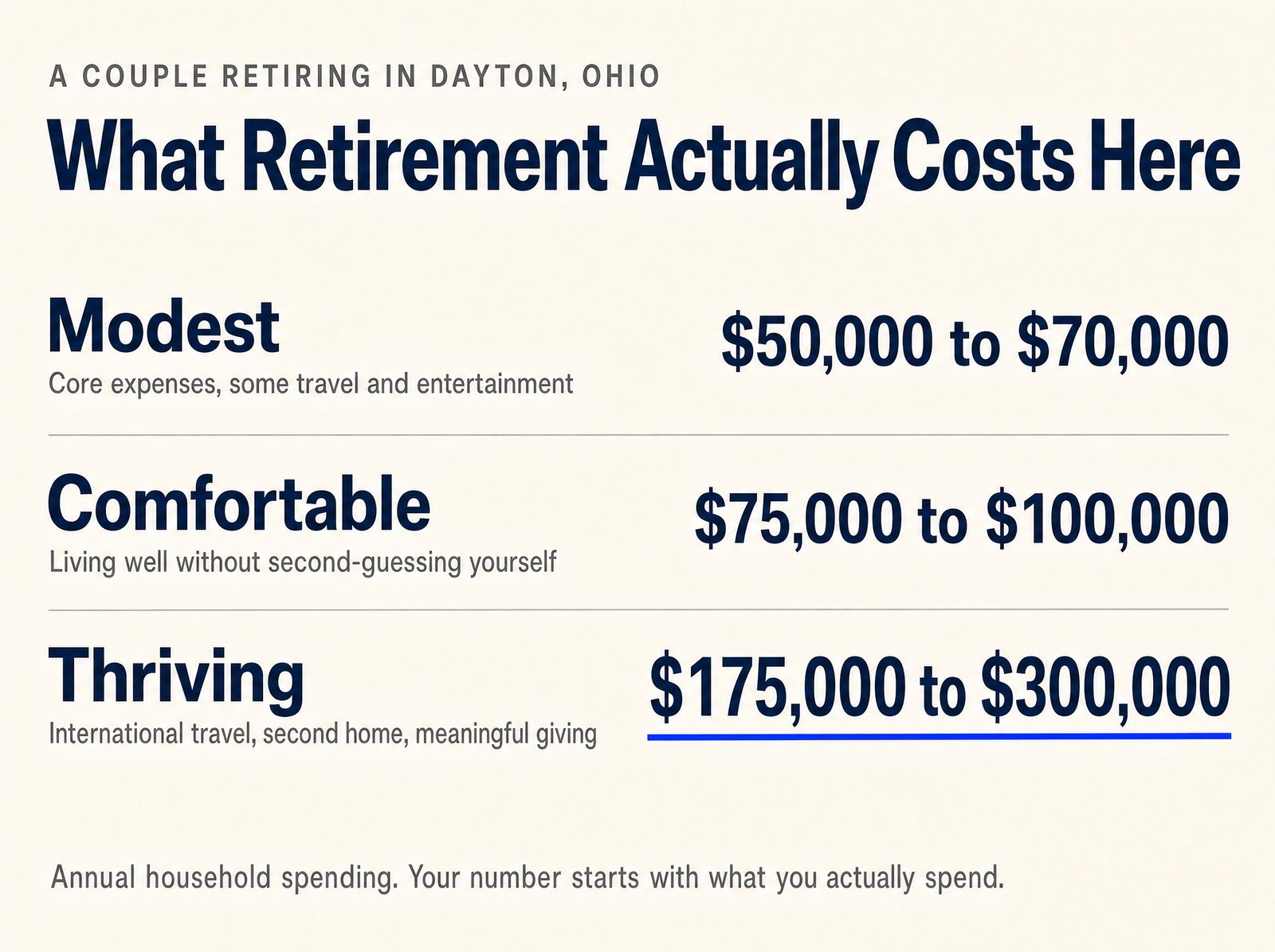
Say you've got a couple retiring in Dayton. Here is roughly what three different retirements cost them.
A modest retirement covers your core expenses, some travel, and some entertainment. That runs $50,000 to $70,000 per year for a couple in Dayton.
A comfortable retirement, where you are living well without second-guessing yourself, runs $75,000 to $100,000 per year. A thriving retirement runs $175,000 to $300,000 per year.
Think international travel, meaningful giving to kids and grandkids, extended trips, or a second home. Here is how each budget might break down.
| Category | Modest ($50K–$70K) | Comfortable ($75K–$100K) | Thriving ($175K–$300K) |
|---|---|---|---|
| Housing (taxes, maintenance, insurance) | $10,000–$12,000 | $14,000–$18,000 | $25,000–$40,000 |
| Healthcare (Medicare, supplements, out-of-pocket) | $12,000–$14,000 | $15,000–$20,000 | $22,000–$35,000 |
| Food and groceries | $8,000–$10,000 | $11,000–$14,000 | $16,000–$24,000 |
| Transportation | $5,000–$6,000 | $7,000–$10,000 | $12,000–$20,000 |
| Utilities | $5,000–$7,000 | $6,000–$8,000 | $8,000–$11,000 |
| Travel and entertainment | $8,000–$14,000 | $15,000–$20,000 | $70,000–$110,000 |
| Giving and gifts to family | $2,000–$7,000 | $7,000–$10,000 | $22,000–$60,000 |
| Total per year | $50,000–$70,000 | $75,000–$100,000 | $175,000–$300,000 |
The tiers come down to what life you actually want. Build your plan around that, not around a generic formula.
The First Step Nobody Takes Seriously: Tracking What You Actually Spend
Here is why most retirement budget estimates are wrong: people guess.
They estimate. They recall roughly what they spent last year. They fill in a spreadsheet with categories that seem about right.
Then they get into retirement and discover the actual number is different. Sometimes higher, sometimes lower, but rarely what they expected.
The 4 percent rule, the 25x savings target, the online calculators. Those are starting points, not plans.
The first step we take with every client is getting to their real spending number. Not estimated. Actual.
There is also a transition factor most people do not account for. It takes six to twelve months to really settle into retirement and understand what your life is going to look like.
It is Saturday every day. You are figuring out how you want to spend your time, what you actually want to do with the freedom you earned.
Travel. Grandkids. Golf. Home projects. It takes time for spending to find its level.
That first year is not a reliable number. Build your plan around what the second and third year look like, with room for the front-loaded spending most retirees do in their early, healthier years.
Why Dayton-Area Retirees Consistently Underspend, and What That Costs Them
This is what I see more than anything else working in this area: people who have done everything right, saved diligently for 30 or 40 years, and then get into retirement and cannot bring themselves to spend.
It is a Midwest thing. Dayton-area retirees are financially conservative by nature. They lived below their means for decades.
Saving felt right. Spending feels risky.
So they hold back. They take the modest vacation instead of the big one. They hesitate to help the kids when the kids could really use it.
They second-guess whether it is okay to spend. And then five years go by.
Here is the thing. The first five years of retirement are your healthiest and youngest years in retirement.
You are mobile. You have energy. You can do the things on your list. Those years are not renewable.
If you are 62 and in good health, you have a window you will not have at 75 or 80. For most of the clients we work with, the real risk is not running out of money.
It is running out of good years while the money sits there untouched.
Dying with a mattress stuffed full of money is not winning the retirement game.
The Retirement Income Guardrails Framework: How We Determine What You Can Actually Spend
The reason most people are either too conservative or too anxious in retirement is that they do not have a system. They are managing by feel.
And managing by feel leads to one of two outcomes: you underspend because you are scared, or you overspend because you are not watching.
We use a framework called the retirement income guardrails to solve this.
Think of it like driving up a winding mountain road. Some of those roads have guardrails on the edge. Some do not.
If you have ever driven one without guardrails, you know the feeling. Even at a cautious speed, it is hard to relax.
The guardrail does not slow you down. It just tells you where the edge is so you are not white-knuckling the whole drive.
Your retirement portfolio works the same way.
We put an upper guardrail and a lower guardrail around your portfolio value. As long as your portfolio stays between those two guardrails, you draw income at your target rate.
If the portfolio breaks below the lower guardrail for more than 90 days (a real market downturn, not just a rough quarter), you reduce spending by 10 percent until it recovers. If the portfolio grows above the upper guardrail, you increase spending.
Because you should be able to enjoy a portfolio that is performing well.
This is not a fixed 4 percent rule. It is a dynamic system that adjusts with what the market is actually doing.
It protects you on the downside without overcorrecting on the upside. Most importantly, it gives you permission to spend.
When clients can see their guardrails, they stop guessing. They know the boundaries. That clarity changes behavior in a real way.
How Ohio's Tax Picture Affects Your Retirement Budget
Ohio's tax story for retirees is not simple, but it is manageable if you plan around it.
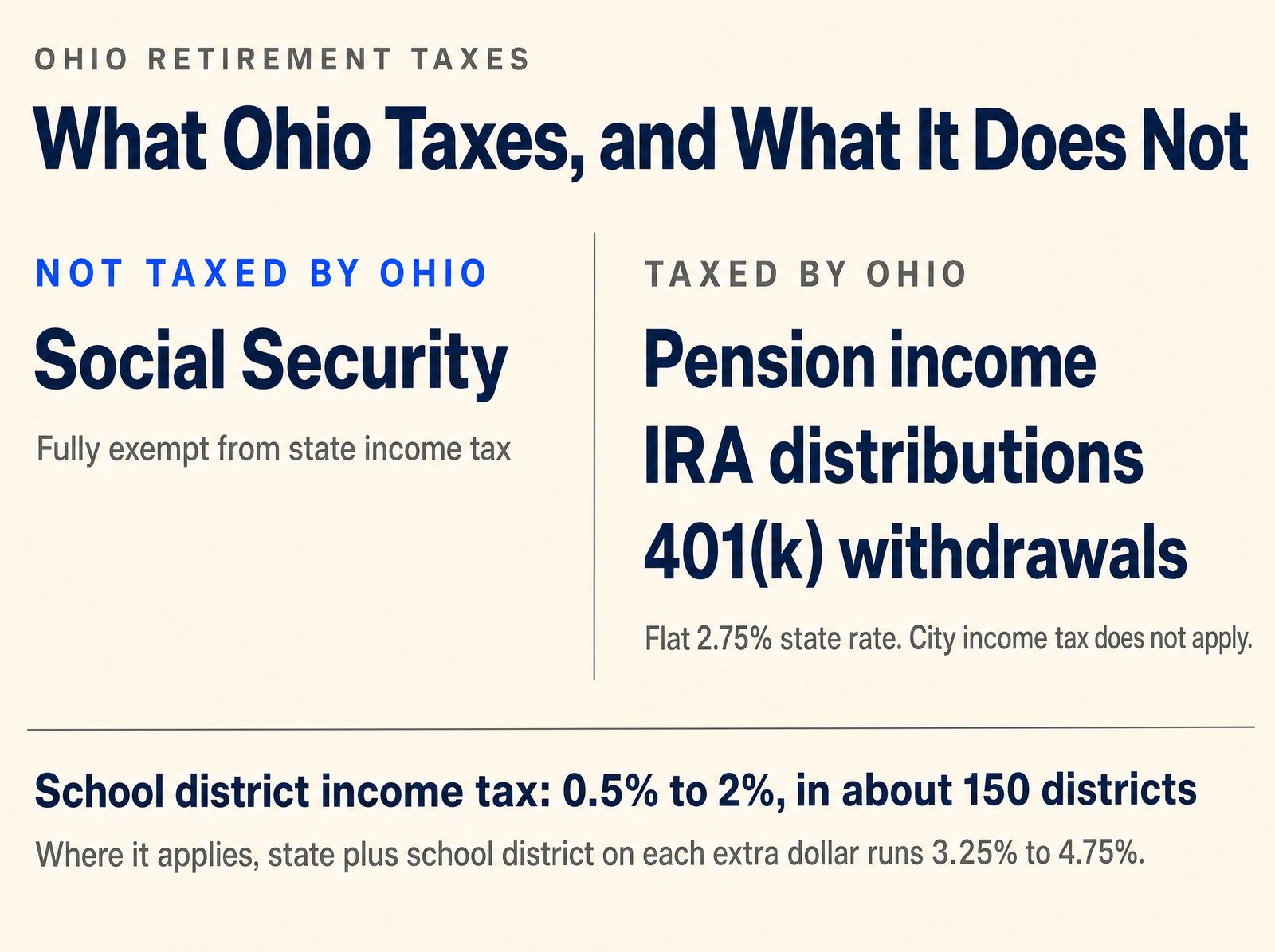
The good news first. Social Security is fully exempt from Ohio state income tax. The flat 2.75 percent state rate applies to other income.
For retirees whose income is weighted toward Social Security, Ohio looks quite favorable.
The part people miss: pension income, IRA distributions, and 401(k) withdrawals are all taxable at the state level. Your city income tax does not touch them, but about 150 Ohio school districts levy their own income tax on that same money, at 0.5 to 2 percent.
If you live in one of those districts and draw $80,000 to $100,000 a year from pre-tax accounts, the combined state and school district rate on each extra dollar runs 3.25 to 4.75 percent. That is meaningful and belongs in your plan.
You can review Ohio's annual income tax rates directly from the Ohio Department of Taxation.
Now here is what changes the picture even more.
Most retirees in Dayton who have significant IRA or 401(k) balances are going to face required minimum distributions starting at age 73, or 75 if you were born in 1960 or later. Those RMDs stack on top of Social Security.
At that point, every dollar of income is getting taxed: federal and state. What looked like a manageable tax bill at 65 can look very different at 73.
We call this the tax torpedo. And if you are married, there is a second problem waiting.
When one spouse dies, the survivor files as single. The tax brackets compress significantly. The same income that was taxed at a joint rate is now taxed at a higher single rate.
We call that the widow's tax trap.
Both of these are predictable. And both can be managed, but only if you use the gap years.
The gap years are the window between when you retire and when RMDs start. That is when you have the most control over your taxable income. It is when Roth conversions and tax planning strategies make the most difference.
The point is: your Ohio tax picture is not static. It changes over the course of retirement. Your plan needs to account for how it changes, not just what it looks like in year one.
How Much Do You Need Saved to Retire Well in Dayton?
So what is the actual savings number?
There is no single right answer. But here is how to think about it honestly.
Your retirement income comes from three places: Social Security, any pension income, and withdrawals from your investment portfolio. The portfolio is what most people fixate on, but your total income picture is what actually determines whether you can spend confidently.
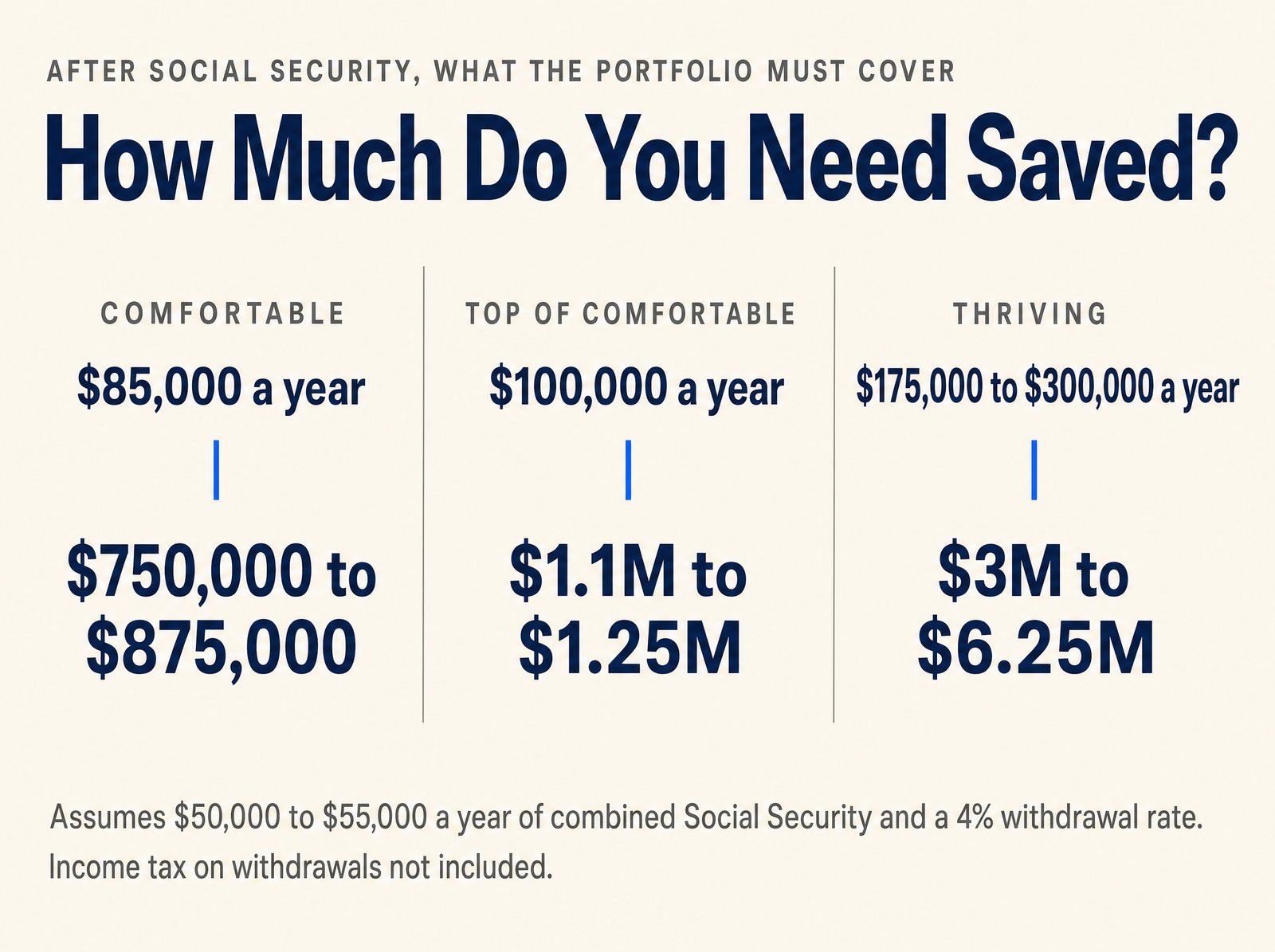
Say you've got a couple in Dayton drawing $50,000 to $55,000 a year in combined Social Security, and they want a comfortable budget of $85,000 a year. Their portfolio has to cover the other $30,000 to $35,000.
At a 4 percent withdrawal rate, a starting point rather than a plan, that takes a portfolio of roughly $750,000 to $875,000.
If they want $100,000 per year total, the portfolio needs to cover $45,000 to $50,000. At the same 4 percent, that takes roughly $1.1 million to $1.25 million.
For the thriving tier, $175,000 to $300,000 a year, the same couple needs the portfolio to cover $120,000 to $250,000. At 4 percent, that takes roughly $3 million to $6.25 million, less if a pension covers part of it.
Now, these numbers leave out income tax on what you withdraw. If the money comes out of a pre-tax IRA, you need to pull a little more to net the same budget.
What makes Dayton's cost-of-living advantage real: the same portfolio produces a higher quality of life here than it would in most other places. A couple with $1.5 million in Dayton is in a different position than a couple with $1.5 million in California, where prices run about 11 percent above the national average.
The dollars go further.
Two additional things belong in your plan that most rules of thumb miss entirely.
First, the war chest. You need five or more years of portfolio withdrawals sitting in cash or short-term bonds, not in the market. When the market drops, you pull from the war chest instead of selling investments at the bottom.
This is how sequence-of-returns risk gets managed in practice. The first ten to twelve years of retirement are when your portfolio is most vulnerable.
A bad sequence of returns in those early years can permanently change your long-term trajectory.
Second, spending is not flat across 30 years of retirement. It front-loads.
You will spend more in your 60s on travel and experiences. It dips in your 70s. It spikes again in your 80s as healthcare costs rise.
A fixed annual budget number misses all of that. A real plan accounts for it.
The Real Goal: A Running Start Into Retirement
When I sit down with a new client for the first time, they know they have done a good job saving. What they do not know is whether it is enough to actually live the way they want to live.
The plan answers that question. Not roughly. Specifically.
Our number one goal with clients is to make sure they get a running start into retirement. Not a cautious start. Not a "let's wait and see" start. A confident one.
Because here is what I know from working with retirees in this area: if someone wakes up three, five, or seven years into retirement wishing they had spent more, traveled more, or retired earlier, we have not done our job. Those years are gone.
You cannot get them back.
Clarity creates confidence. Confidence changes behavior.
A full plan shows you the numbers: what you have, what you can spend, what the guardrails are, and what the tax picture looks like in your 60s, 70s, and 80s. It gives you something no rule of thumb can.
Permission to live the retirement you actually worked for.
Frequently Asked Questions
How much do you need to retire comfortably in Ohio?
Most couples in the Dayton area need $75,000 to $100,000 per year to retire comfortably. The number depends on your actual spending, your income sources, and how you want to live. Generic benchmarks are a starting point, not a plan.
How much do Ohio taxes take from retirement income?
Ohio is moderately tax-friendly, depending on your income mix. Social Security is fully exempt from state income tax, and Ohio's flat 2.75 percent rate is low by national standards. But pension income, IRA distributions, and 401(k) withdrawals are taxable at the state level, and in school districts that levy an income tax on them, the combined rate can reach 3.25 to 4.75 percent.
Does Ohio tax Social Security income?
No. Ohio does not tax Social Security benefits at the state level. All Social Security income is fully exempt from Ohio state income tax, which is a meaningful advantage for retirees whose income is weighted toward Social Security rather than pensions or IRA distributions.
How does retiring in Dayton compare to retiring in Florida?
Florida has no state income tax, which benefits retirees drawing heavily from pensions and IRAs. Ohio taxes that income at 2.75 percent, plus school district income tax where it applies. For retirees whose income is primarily Social Security, the gap narrows considerably since Ohio fully exempts those benefits. Dayton also offers affordable home prices, strong healthcare infrastructure, and for most clients, family and community that matter more than the tax difference.
What is the biggest financial mistake Ohio retirees make?
The most common mistake is guessing at their spending number instead of tracking it. A retirement plan built on estimated spending fails the moment reality looks different than the estimate. The second most common mistake is underspending in the early years out of anxiety, and missing the healthiest window of retirement as a result.
Here's What Matters
- A comfortable retirement in Dayton, Ohio runs $75,000 to $100,000 per year for most couples. A thriving retirement runs $175,000 to $300,000. Your number starts with your actual spending, not a calculator.
- Overall prices in Ohio run about 7 percent below the national average. The median Dayton-area home sold for $271,500 in September 2026, against a national median of $417,500. That gap makes a real difference across 20 to 30 years of retirement.
- Ohio does not tax Social Security. Pension income, IRA distributions, and 401(k) withdrawals are taxable at the state level, and in some school districts. Plan for it, especially in your 70s when RMDs stack on top of other income.
- The tax torpedo and the widow's tax trap are real and predictable. Both are manageable if you use the gap years between retirement and RMD age to plan.
- Generic rules of thumb like the 4 percent rule and the 25x savings target are starting points, not plans. Get to your real spending number first.
- The first five years of retirement are your healthiest and most mobile. Do not save them for later.
- The retirement income guardrails framework gives you the clarity to spend confidently, pull back when you need to, and increase spending when you can.
Gudorf Financial Group is a fee-only, fiduciary retirement planning firm based in Dayton, Ohio. We serve clients locally and virtually nationwide.
Article References
- "Regional Price Parities by State and Metro Area." U.S. Bureau of Economic Analysis. February 2026.
- "Dayton Area Home Sales for September 2026." Dayton REALTORS. October 2026.
- "Existing-Home Sales Increased 1.5% in September, According to NAR Report." National Association of REALTORS. October 2026.
- "Ohio Moves to a Flat Tax in 2026: What It Means for You." Dark Horse CPA. July 2025.
- "Retirement Benefits." Social Security Administration. Accessed October 2026.
- "Property Taxes by State and County, 2026." Tax Foundation. March 2026.
- "Section 718.01: Definitions (Municipal Income Taxes)." Ohio Revised Code. Accessed October 2026.
- "School District Income Tax." Ohio Department of Taxation. Accessed October 2026.
- "School Districts With an Income Tax for 2026." Ohio Department of Taxation. 2026.
- "Annual Tax Rates." Ohio Department of Taxation. Accessed October 2026.
- "Retirement Topics: Required Minimum Distributions (RMDs)." IRS.gov. Accessed October 2026.
- "Internal Revenue Bulletin: 2024-33 (Final Required Minimum Distribution Regulations)." IRS.gov. Accessed October 2026.