

Inherited IRA RMD Table for 2027 and How to Use It
By Danny Gudorf | Founder, Gudorf Financial Group | Updated November 2026
So you inherited an IRA from a parent. The custodian sends a letter, and somewhere in it is a phrase like "you may be required to take annual distributions."
That is the inherited IRA RMD table at work. Below is the full 2027 table, how to use it, and the part most people miss: following the table alone can cost you six figures in extra tax.
Who Uses the Inherited IRA RMD Table
Whether you use the table, and for how long, depends on who you are to the person who died. The IRS sorts beneficiaries into three groups.
1. Eligible designated beneficiaries. These people can still stretch the IRA over their own life expectancy:
- A surviving spouse
- A minor child of the owner, until age 21
- Someone disabled or chronically ill
- Someone not more than 10 years younger than the owner, such as a sibling close in age
2. Designated beneficiaries. This is everyone else who is a person, which means most adult children and grandchildren. They fall under the 10-year rule.
3. Non-designated beneficiaries. An estate, a charity, or a trust that does not qualify as a see-through trust. These follow a five-year rule or the owner's remaining life expectancy, depending on when the owner died.
If you are an adult child who inherited from a parent, you are almost certainly in the second group. That is who most of this post is for.
The 10-Year Rule and Annual RMDs
The 10-year rule says the account has to be empty by December 31 of the 10th year after the year of death. If your father died in 2026, the deadline is December 31, 2036.
Whether you also take a minimum every year in between depends on one date. That date is the owner's required beginning date, April 1 of the year after they reached RMD age (73 for people born 1951 through 1959, 75 for people born in 1960 or later).
| When the owner died | What you have to do |
|---|---|
| Before their required beginning date | No annual minimum. Empty the account by the end of year 10 |
| On or after their required beginning date | Take an annual RMD in years 1 through 9 using the table, and empty the account by the end of year 10 |
That second row confused people for years. The IRS excused missed annual amounts for 2021 through 2024, with no penalty, while it finished the rules, the last time in Notice 2024-35.
The waiver is over. Under the final RMD regulations, annual RMDs are required starting in 2025, and you do not have to make up the years that were waived.
One more thing in the year of death. If your parent had not yet taken their own RMD for the year they died, that money still has to come out by December 31 of that year, and it comes out to you as the beneficiary.
The Inherited IRA RMD Table for 2027
This is the Single Life Expectancy Table the IRS uses for beneficiaries. It took effect in 2022 and has not changed since, so it is the table for 2026, 2027, and beyond until the IRS updates it.
Find your age in the year after the owner died. The number next to it is your starting factor.
| Age | Factor | Age | Factor | Age | Factor | Age | Factor |
|---|---|---|---|---|---|---|---|
| 0 | 84.6 | 31 | 54.4 | 62 | 25.4 | 93 | 4.6 |
| 1 | 83.7 | 32 | 53.4 | 63 | 24.5 | 94 | 4.3 |
| 2 | 82.8 | 33 | 52.5 | 64 | 23.7 | 95 | 4.0 |
| 3 | 81.8 | 34 | 51.5 | 65 | 22.9 | 96 | 3.7 |
| 4 | 80.8 | 35 | 50.5 | 66 | 22.0 | 97 | 3.4 |
| 5 | 79.8 | 36 | 49.6 | 67 | 21.2 | 98 | 3.2 |
| 6 | 78.8 | 37 | 48.6 | 68 | 20.4 | 99 | 3.0 |
| 7 | 77.9 | 38 | 47.7 | 69 | 19.6 | 100 | 2.8 |
| 8 | 76.9 | 39 | 46.7 | 70 | 18.8 | 101 | 2.6 |
| 9 | 75.9 | 40 | 45.7 | 71 | 18.0 | 102 | 2.5 |
| 10 | 74.9 | 41 | 44.8 | 72 | 17.2 | 103 | 2.3 |
| 11 | 73.9 | 42 | 43.8 | 73 | 16.4 | 104 | 2.2 |
| 12 | 72.9 | 43 | 42.9 | 74 | 15.6 | 105 | 2.1 |
| 13 | 71.9 | 44 | 41.9 | 75 | 14.8 | 106 | 2.1 |
| 14 | 70.9 | 45 | 41.0 | 76 | 14.1 | 107 | 2.1 |
| 15 | 69.9 | 46 | 40.0 | 77 | 13.3 | 108 | 2.0 |
| 16 | 69.0 | 47 | 39.0 | 78 | 12.6 | 109 | 2.0 |
| 17 | 68.0 | 48 | 38.1 | 79 | 11.9 | 110 | 2.0 |
| 18 | 67.0 | 49 | 37.1 | 80 | 11.2 | 111 | 2.0 |
| 19 | 66.0 | 50 | 36.2 | 81 | 10.5 | 112 | 2.0 |
| 20 | 65.0 | 51 | 35.3 | 82 | 9.9 | 113 | 1.9 |
| 21 | 64.1 | 52 | 34.3 | 83 | 9.3 | 114 | 1.9 |
| 22 | 63.1 | 53 | 33.4 | 84 | 8.7 | 115 | 1.8 |
| 23 | 62.1 | 54 | 32.5 | 85 | 8.1 | 116 | 1.8 |
| 24 | 61.1 | 55 | 31.6 | 86 | 7.6 | 117 | 1.6 |
| 25 | 60.2 | 56 | 30.6 | 87 | 7.1 | 118 | 1.4 |
| 26 | 59.2 | 57 | 29.8 | 88 | 6.6 | 119 | 1.1 |
| 27 | 58.2 | 58 | 28.9 | 89 | 6.1 | 120+ | 1.0 |
| 28 | 57.3 | 59 | 28.0 | 90 | 5.7 | ||
| 29 | 56.3 | 60 | 27.1 | 91 | 5.3 | ||
| 30 | 55.3 | 61 | 26.2 | 92 | 4.9 |
Source: IRS Publication 590-B, Table I, and Treasury Regulation 1.401(a)(9)-9.
How to Calculate Your Inherited IRA RMD
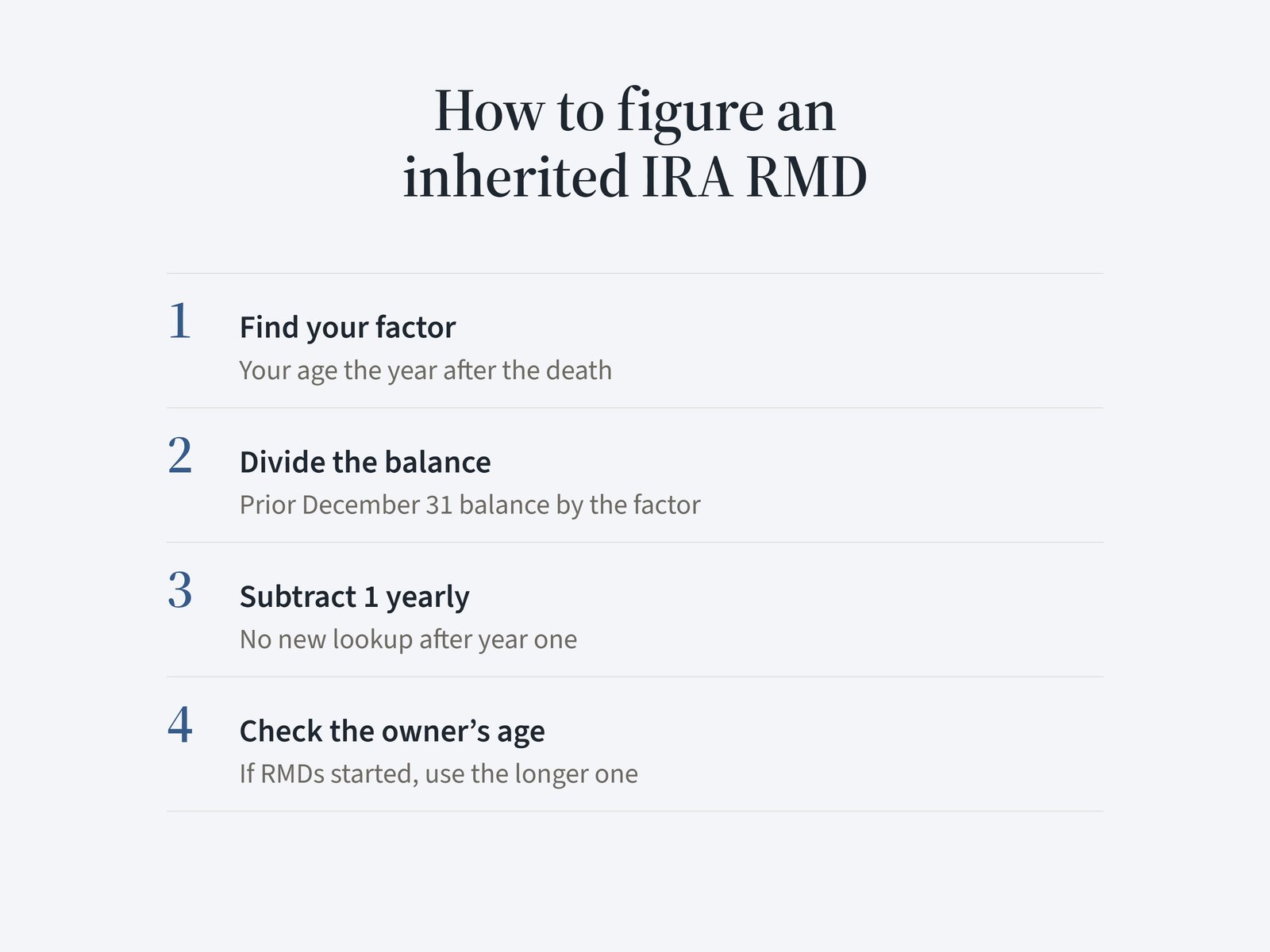
It can get a lot more complicated than that, but in its simplest form there are four steps:
- Find your starting factor. Look up your age in the year after the year of death. That number is your factor for the first year.
- Divide. Take the December 31 balance of the prior year and divide it by your factor.
- Subtract 1 each year after. You do not look the table up again. Year two uses the starting factor minus 1, year three minus 2, and so on.
- Check the owner's age if they died after RMDs started. Use the longer of your life expectancy or what was left of theirs, which gives you the smaller withdrawal.
Here is what that looks like in two common situations.
Example 1: An adult child inherits from a parent
Say your father died in 2026 at 88 and had already started his RMDs. You are 57 in 2027, and the IRA was worth $900,000 on December 31, 2026.
- Your factor at 57: 29.8
- What was left of your father's life expectancy: 6.6 at 88, minus 1 = 5.6
- Use the longer one: 29.8
- 2027 RMD: $900,000 ÷ 29.8 = $30,201
- 2028 factor: 28.8, then 27.8 in 2029, and so on
- By December 31, 2036, everything left has to come out
Example 2: A sibling inherits from a sibling
Say your brother died in 2026 and named you beneficiary. You are 67 in 2027, five years younger than he was, so you are an eligible designated beneficiary.
- Your factor at 67: 21.2
- On a $600,000 IRA: $600,000 ÷ 21.2 = $28,302 for 2027
- Subtract 1 each year after
- No 10-year deadline, so you can stretch it over your own life expectancy
The Tax Problem the Table Does Not Show You
Here's the thing. The table tells you the least you can take, and most people take exactly that.
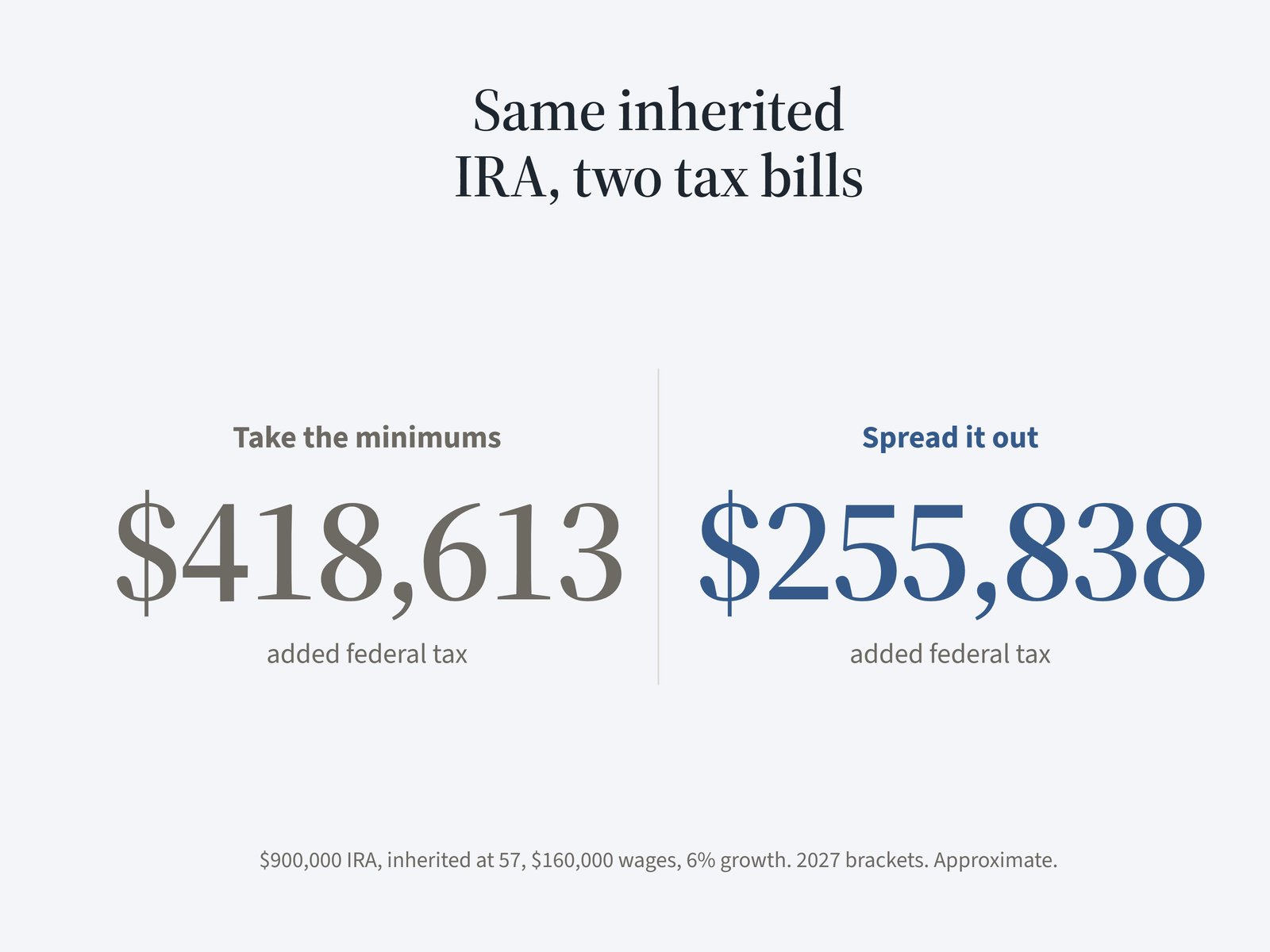
It feels safe. In the example below, it costs about $163,000 more in federal tax.
Take Example 1 a step further. You are 57, married, still working, and you and your spouse earn $160,000 a year.
You have two choices:
- Take the minimums from the table for nine years, then empty the account in year 10
- Spread it out across all 10 years, about $95,000 to $122,000 a year
Assume the account grows 6% a year and the 2027 federal brackets hold flat. Here is the added federal tax on the inherited money under each choice:
| Take the minimums | Spread it out | |
|---|---|---|
| 2027 withdrawal | $30,201 | $122,281 |
| Year 9 (2035) withdrawal | $48,136 | $107,434 |
| Year 10 (2036) withdrawal | $1,061,310 | $94,907 |
| Year 10 added federal tax | $342,262 | $20,949 |
| Total added federal tax over 10 years | $418,613 | $255,838 |
Same account, same growth, same family. Spreading it out saves about $163,000 in federal tax.
And the reason for that is the brackets. The spread-out withdrawals land in the 22% and 24% brackets every year.
The minimums keep the account growing to more than $1 million, then dump it into a single year. Most of that last year gets taxed at 32%, 35%, and 37%.
Make the low-tax years count
Spreading it out is a starting point, not the answer. The better plan looks at your own income over the 10 years.
- Retiring before year 10? The years after your paycheck stops are the cheapest years to take more out
- A big income year coming, like a bonus or a business sale? Take less that year
- Medicare on the horizon? Big inherited IRA withdrawals after 63 can raise your Medicare premiums two years later
This is the same thinking we use for tax planning on your own accounts. You decide how much to take each year based on what it costs, not on what the table says.
Inherited Roth IRAs
An inherited Roth IRA follows different rules than a traditional one. For an adult child:
- No annual RMD, even if your parent was older than 73, because the IRS treats Roth owners as if they died before their required beginning date
- The 10-year deadline still applies, so the account has to be empty by the end of the 10th year
- Withdrawals are tax-free as long as the Roth was open at least five years
So the usual move is the opposite of a traditional IRA. Leave the Roth alone as long as you can and take it all in year 10, so it grows tax-free the whole time.
What a Surviving Spouse Can Do
A spouse has more choices than anyone else. The two main ones:
| Option | How RMDs work | Best fit |
|---|---|---|
| Treat it as your own (or roll it into your IRA) | You use the Uniform Lifetime Table, the same one in our 2026 RMD table post, starting at your own RMD age | Most spouses who are 59½ or older |
| Stay the beneficiary | Single Life table, refigured each year. If your spouse died before their RMDs started, yours can wait until the year your spouse would have reached RMD age | A younger spouse who may need the money before 59½, since beneficiary withdrawals skip the 10% early withdrawal penalty |
Spousal rollovers are one of the places people trip up most. We cover the common ones in our top 10 IRA mistakes.
When the Joint Life table applies
You may see a third IRS table, the Joint Life and Last Survivor table. It is not for inherited IRAs.
It is only for an owner whose spouse is the sole beneficiary and more than 10 years younger. It lowers the owner's own RMDs while both are alive.
Missing an Inherited IRA RMD
If you miss an RMD, the IRS charges an excise tax on the amount you should have taken:
- 25% of the missed amount as the starting penalty
- 10% if you take the missed amount and file the return reporting it within the correction window
The custodian does not always calculate the inherited RMD for you. The number is your responsibility, so check it every January.
What to Do for Your Own Kids
A lot of the people we work with are on both sides of this. They have inherited from a parent, and their own IRA is the biggest thing their kids will inherit.
The 10-year rule will apply to your kids too, probably right in their peak earning years. Three things help:
- Keep your beneficiary forms current. The form controls the IRA, not your will. The per stirpes or per capita box matters more than most people think.
- Do not name your revocable living trust as the IRA beneficiary without checking. Depending on how it is drafted, it can shorten the payout and tax what stays in the trust at trust rates. More on that in our post on revocable living trusts for Ohio retirees.
- Look at an IRA trust if you want protection. An IRA trust is built to be the beneficiary of a retirement account, keeps the 10-year payout, and protects your kids' inheritance from divorce, bankruptcy, lawsuits, and Medicaid. Ted Gudorf, our estate planning attorney at Gudorf Law Group, drafts these as part of estate planning.
There is a tax side too. Every dollar you convert to a Roth in your own gap years, the years between retiring and your first RMD, is a dollar your kids will not pay tax on at their bracket.
Frequently Asked Questions
How do I calculate my RMD from an inherited IRA?
Find your age in the year after the owner died on the Single Life Expectancy Table. Divide the prior December 31 balance by that factor, and subtract 1 from the factor each following year.
Are there RMDs on inherited IRAs?
Yes. A spouse or other eligible designated beneficiary takes them every year.
An adult child takes them every year only if the owner died on or after their required beginning date, and has to empty the account by the end of year 10 either way.
How do I calculate my inherited IRA RMD for 2027?
Use your age in 2027 if the owner died in 2026, or your original factor minus 1 for each year since your first RMD if they died earlier. Divide the December 31, 2026 balance by that number.
What is the tax rate on an RMD from an inherited IRA?
Withdrawals from an inherited traditional IRA are taxed as ordinary income at your own federal bracket, which runs from 10% to 37%, plus state tax. There is no 10% early withdrawal penalty at any age, and qualified withdrawals from an inherited Roth are tax-free.
Do I have to take an RMD in the year my parent died?
Only if your parent had already reached their required beginning date and had not taken their full RMD for that year. Your own first RMD is due the following year.
Here's What Matters
- The inherited IRA RMD table for 2027 is the Single Life Expectancy Table, unchanged since 2022
- Use your age in the year after the death, then subtract 1 each year
- Adult children who inherit after the owner's RMDs started take annual RMDs and empty the account by the end of year 10
- The minimums are the floor, not the plan; in our example, spreading the withdrawals saved about $163,000 of federal tax
- Inherited Roth IRAs have no annual RMDs, so let them grow until year 10
- For your own kids: current beneficiary forms, and an IRA trust if you want their inheritance protected
Gudorf Financial Group is a fee-only, fiduciary retirement planning firm based in Dayton, Ohio. We serve clients locally and virtually nationwide.
Article References
- "Publication 590-B, Distributions from Individual Retirement Arrangements (IRAs)." Internal Revenue Service. Accessed November 2026.
- "26 CFR 1.401(a)(9)-9, Life Expectancy and Distribution Period Tables." Electronic Code of Federal Regulations. Accessed November 2026.
- "Required Minimum Distributions (final regulations, T.D. 10001)." Federal Register. July 2024.
- "Notice 2024-35, Certain Required Minimum Distributions for 2024." Internal Revenue Service. April 2024.