

When a Revocable Living Trust Beats a Will for Ohio Retirees
By Danny Gudorf | Founder, Gudorf Financial Group | Updated October 2026
So let's talk about the question I get across the desk more than almost any other in the estate part of a plan. Do I need a revocable living trust, or is a will good enough?
Most of the people I work with in the Dayton area already have a will. They did the responsible thing 15 or 20 years ago, put it in a drawer, and have not looked at it since.
You've done well by having one. But a will and a revocable living trust are not the same tool doing the same job, and the gap between them shows up at the worst possible time.
Ohio is getting older, fast. The Census Bureau puts about one in five Ohioans at age 65 or older.
As more people move into retirement, more of them are looking at that old will and asking whether it actually does what they think it does. A lot of the time, the honest answer is no.
Let me walk you through it the way I would if you were sitting in my office.
Will vs. Revocable Living Trust: What Each One Actually Does
Before you can decide, you need to know what each document is built to do. They are not interchangeable.
What a Will Does
A will is a document that says where your stuff goes after you die. To be valid in Ohio, it has to check a few boxes.
- You are at least 18 and of sound mind
- Your wishes are in writing
- You sign it in front of two witnesses who also sign
A will is fine for a simple situation. It also has two limits that catch people off guard.
First, it only works after you die. It does nothing for you while you are alive but unable to manage your own money, which is exactly the moment a family gets into trouble.
Second, anything that passes under your will has to go through Ohio probate court first. That is the part people do not feel until they watch a friend's family live through it.
What a Revocable Living Trust Does
A revocable living trust works differently. Think of it as a bucket you build while you are alive and control completely.
There are three roles, and while you are healthy you play all of them:
- The grantor. You, the person who creates it and puts assets in.
- The trustee. You, the person who manages it, for as long as you are able.
- The beneficiaries. The people who receive what is in the bucket, on the terms you set.
Revocable means you keep control.
You can change it, add to it, or tear it up as long as you are alive and competent. Nothing about your day to day changes.
The difference shows up in two moments a will cannot cover. If you become incapacitated, someone you named can step in without going to court.
And when you die, what is in the trust passes to your family without probate.
The Two Side by Side
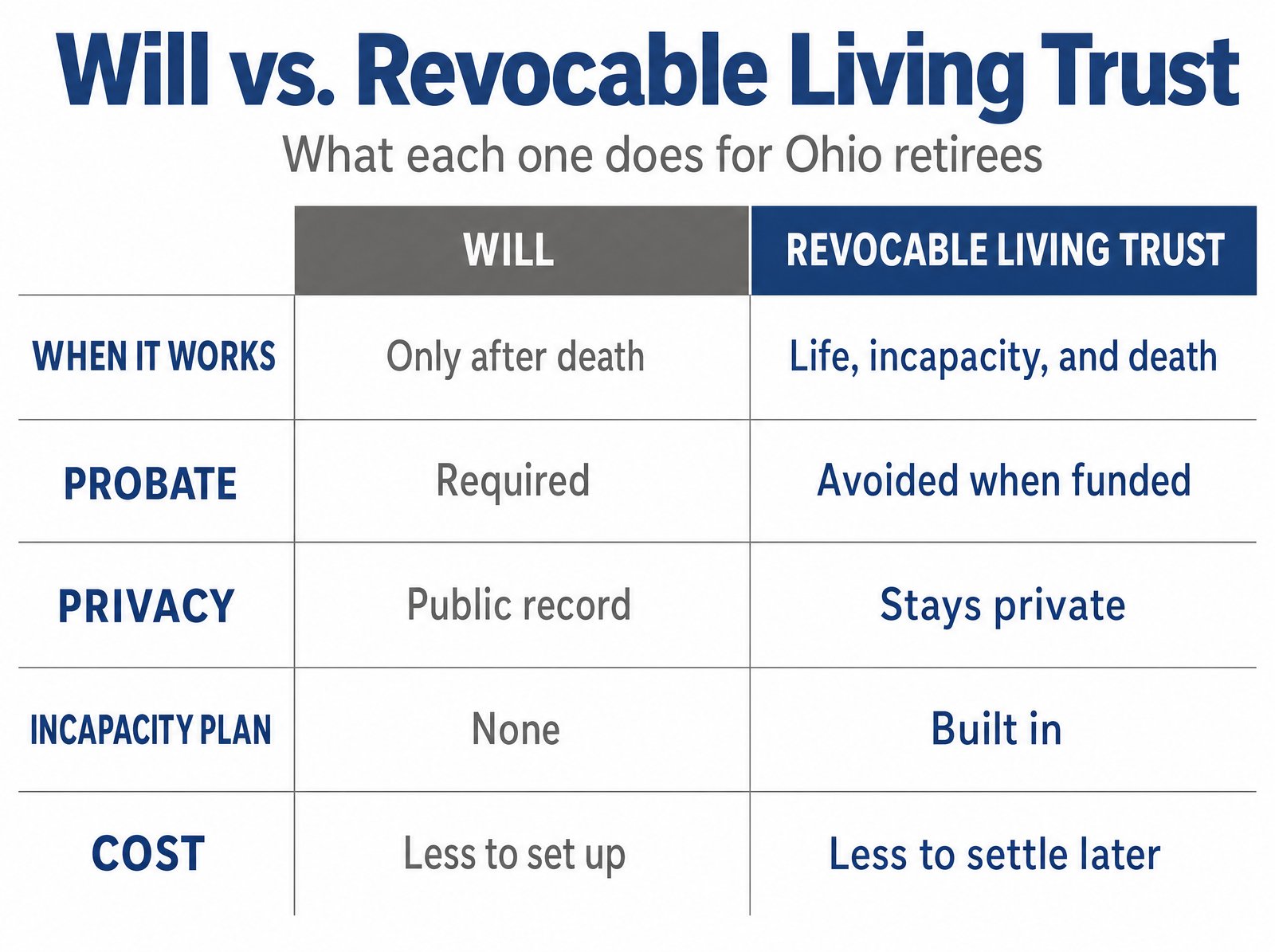
Here is how they line up on the things that actually matter to a retiree.
| Factor | Will | Revocable Living Trust |
|---|---|---|
| When it works | Only after death | While alive, during incapacity, and after death |
| Probate | Required for anything passing under it | Avoided for assets titled in the trust |
| Privacy | Public court record | Stays private |
| Incapacity plan | None | Built in through a successor trustee |
| Cost | Lower to set up | More to set up, less to settle later |
You can read more about the full document set on our estate planning page. For now, the point is simple.
The will is a one-moment tool. The trust covers three moments.
Why Probate Is the Real Headache in Ohio
Probate avoidance gets all the attention, so let me be specific about what Ohio probate actually does to a family.
Probate is the court process of proving your will, paying your debts, and handing out what is left. In Ohio, figure six months to a year for a normal estate, and longer if anything is complicated.
What It Costs
The dollars stack up in ways people do not plan for. Ohio probate brings in a few layers of cost.
- Court filing fees, which change by county
- Attorney fees to handle the estate
- Executor fees for the person doing the work
- Appraisals on real estate and valuables
Put it together and you are looking at a few percent of the estate's value, sometimes more. On a larger estate, that can run into the tens of thousands of dollars that never reach your kids.
The Out-of-State Trap
Here is where it gets worse. If you own property in another state, your family can face a second probate in that state, called ancillary probate.
I see this all the time with Dayton-area retirees who bought a place in Florida. Two states, two courts, two sets of fees, two timelines.
Say you've got a couple, both 68, with a house here and a condo in Florida. After the first spouse dies, both properties end up in the survivor's name alone.
When the survivor dies, the kids can spend close to two years and thousands of dollars settling probate in both states. Had both properties been titled in a revocable living trust, the family would have skipped both probate proceedings entirely.
That is the whole point of the trust owning your assets instead of you owning them personally. When you die, there is nothing sitting in your name for a court to process.
Your successor trustee follows your written instructions and distributes the assets. No probate.
When a Revocable Living Trust Beats a Will
There is no magic age where everyone should switch. Your situation usually makes the call for you.
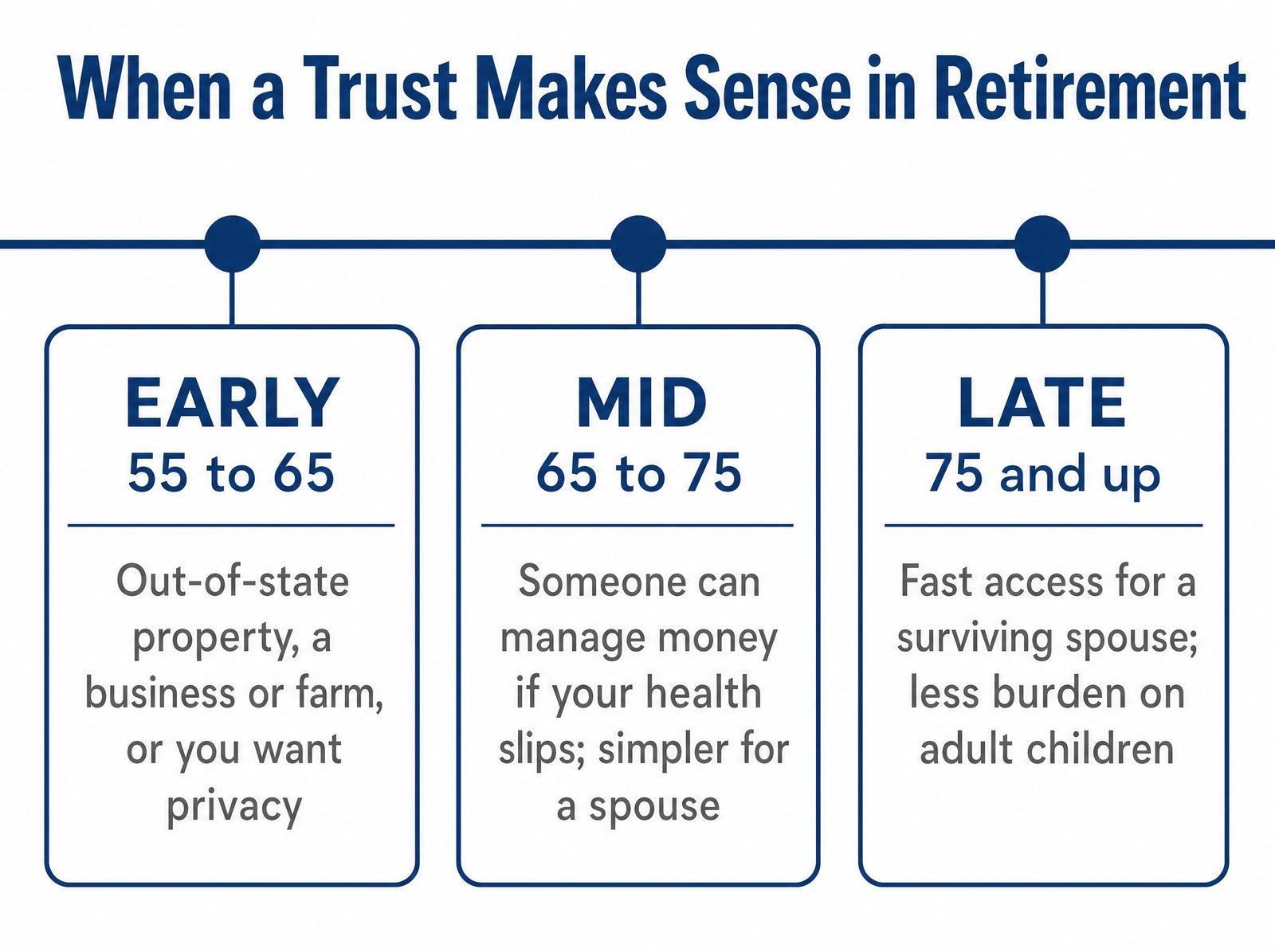
I think about it in three stages.
First, early retirement, call it 55 to 65.
You are active and healthy and planning for a stretch that could run 30 years. A trust earns its keep here if you own property in more than one state, you have a business or a farm, privacy matters to you, or your estate is big enough that probate cost would sting.
The second stage is mid retirement, roughly 65 to 75. Now health starts entering the conversation.
A trust is worth it if you want a clean way for someone to manage your money if your health slips, or you want to make life simple for your spouse if you go first.
And third, later retirement, 75 and up.
Speed and simplicity move to the front. A surviving spouse should not wait on a probate court to get at the money for the mortgage and the monthly bills, and adult children who are already stretched should not inherit a court process on top of their grief.
A Quick Gut Check
Run yourself through these. If you answer yes to more than one or two, a trust deserves a serious look.
- Do you own real estate in more than one state?
- Is your estate worth more than a few hundred thousand dollars?
- Do you want your financial affairs kept private?
- Do you want your spouse or family to get at the money quickly if you are sick or gone?
- Do you want to keep the court out of your family's business?
The Part Everyone Misses: Incapacity Planning
Probate is about what happens after you die. The trust does something a will can never do while you are still alive.
Picture a stroke, or a slide into dementia. You are here, but you can no longer manage the accounts.
Without a plan, your family has to go to an Ohio court and ask to be named your guardian. That is public, it costs money, it takes time, and now a judge is supervising decisions your spouse should be making at the kitchen table.
With a revocable living trust, you already named a successor trustee. That person steps in and pays the bills, manages the investments, and follows the instructions you wrote, with no court permission needed.
I tell clients this all the time.
Even if you do not have a big estate, the trust earns its cost right here. The incapacity piece helps most in the times of real trouble.
The Trust Is Just a Bucket Until You Fund It
Now here is the mistake I see more than any other, and it is the reason a lot of expensive plans fail. People sign the trust, feel protected, and never fund it.
Think of your trust as a bucket. Right now the only thing in it might be your house, because the estate planning attorney does the deed and moves the house in when the plan is signed.
Everything else is sitting outside the bucket. Your bank accounts, your brokerage account, your vehicle titles, all still in your personal name.
Funding the trust means going around and retitling those assets from your name into the name of the trust.
It is not hard. It is just work that has to actually get done.
- Change real estate deeds to the trust
- Retitle bank and non-retirement investment accounts
- Move business interests in
- Line up beneficiary designations so they match the plan
I have lost count of the trusts I have seen that were signed years ago and never funded. The family finds out at the exact moment they needed it to work, and by then it is too late.
The funding is the plan.
A trust with nothing in it is a bucket with nothing in it. Obviously the document still cost the same either way.
The Mistakes That Trip People Up
Watch for these:
- Signing the trust and never funding it
- Naming a successor trustee who is not up to the job
- Buying a new account or property later and forgetting to title it in the trust
- Letting beneficiary designations drift out of sync with the plan
- Never looking at any of it again as life and the law change
What a Revocable Trust Will Not Do
Let me clear up the single biggest misconception I hear. People believe a revocable living trust protects their assets from a nursing home or from Medicaid.
It does not.
The reason is simple. You still control everything in a revocable trust, so Medicaid still counts it as your money.
Protecting assets from long-term care costs is a different job that calls for different tools, and it has to be set up well before a health event. This is estate and elder law work, and it is worth getting a real answer on rather than assuming the trust you have already handles it.
Your IRA Is the Big One, So Handle It Right
Here is where I earn my keep as your planner, because this is the place a good estate plan and a good tax plan have to talk to each other.
For most of my clients, the largest thing their kids inherit is not the house. It is the IRA.
And retirement accounts do not pass through your will or your trust. They pass by beneficiary designation, on the form at the custodian.
That is why coordinating those forms with the rest of your plan matters so much. Our tax planning work lives right here.
Now, a mistake I see people make with a trust. They name their revocable living trust as the beneficiary of the IRA, thinking they are being careful.
Here is what that actually does.
It can force the IRA to pay out fast, and it can tax those distributions at trust tax rates, which are far higher than what your kids would pay on their own. You took a tax-smart account and made it worse.
When your kids inherit, there are two ways it can happen. They can inherit outright, meaning the money drops straight into their personal name with no protection.
Or they can inherit in trust, in what we call sub trusts or continuing trusts.
Inheriting in trust gives your children four protections they would not have otherwise.
First is divorce, so a future ex does not walk off with it. Second is bankruptcy.
Third is a lawsuit. And fourth is Medicaid, if a child ever needs long-term care of their own.
For the IRA specifically, there is a separate tool called an IRA trust, built to be the beneficiary of a retirement account. It keeps the 10-year payout window your kids would get inheriting directly, and what it pays out to them is taxed at their own rate, while still giving them those same four protections.
That is the difference between a plan that just names a beneficiary and one that actually protects the money.
If you want the deeper version of the beneficiary side, we wrote about a common and expensive slip in per stirpes vs. per capita beneficiary decisions.
The Hybrid Setup Most Retirees Actually Use
A trust does not mean you throw the will away. You still need one, and it is called a pour-over will.
The pour-over will is your safety net.
If you forget to move an asset into the trust, it catches that asset at your death and pours it into the trust. It is the backstop, not the main event.
Most of my clients end up using more than one tool together:
- A revocable trust for the home and the taxable investment accounts
- Beneficiary designations for retirement accounts, coordinated with the plan
- Pay on Death designations on bank accounts
- Transfer on Death for certain assets
Ohio also has a Transfer on Death Designation Affidavit for real estate, which lets a house pass to a named person without probate. It is useful, and it has a real limit.
It does nothing to help manage the property if you become incapacitated, and that is the whole reason a lot of people wanted a trust in the first place.
The right mix depends on what you own and what your family looks like. The goal is the same for everyone.
Every asset should pass by a method that avoids probate and matches your wishes.
Keeping the Plan Working
Signing the documents is the start, not the finish. A plan you never look at again slowly stops matching your life.
Look at yours every three to five years, and any time something big happens:
- A spouse passes away
- You move to another state
- Your health changes in a real way
- A new grandchild arrives
- You buy or sell a major asset
- The tax law shifts
And remember the trust is one piece of a bigger set. It should sit next to a financial power of attorney, a healthcare power of attorney, a living will, and a HIPAA authorization.
Those handle the decisions the trust does not. We laid out the full list in 10 essential documents for a secure retirement.
Where a Planner Fits In All This
I am a financial advisor, not an attorney. The trust, the will, and the powers of attorney get drafted by an estate planning attorney, and in our family office that is Ted Gudorf, J.D., LL.M., of Gudorf Law Group.
So why am I, the money guy, the one talking to you about it?
Because this is exactly where retirements come apart.
Your attorney draws up a beautiful trust. Your CPA is looking backward at last year's return.
Your advisor manages the investments and never touches the beneficiary forms. Nobody is connecting the three.
You end up being the orchestrator, spending your retirement making sure three professionals who never talk to each other are on the same page. That is not what you saved for 40 years to do.
The way we solve that is our family office model. The financial planning, the tax work, and the estate planning sit under one roof and one plan, so your IRA beneficiary form and your trust and your tax strategy are actually built to fit together.
That coordination is the difference between a folder full of documents and a plan that works.
Frequently Asked Questions
Do I need a trust, or is a will enough in Ohio?
A will is enough if your estate is simple, everything you own is in Ohio, and you are fine with your family going through probate. Once probate cost, privacy, out-of-state property, or planning for your own incapacity matters to you, a revocable living trust is the stronger tool.
Does a revocable living trust avoid probate in Ohio?
Yes, for any asset you actually title in the trust. Anything you leave out can still land in probate, which is why funding the trust is the step that makes or breaks the whole thing.
Will a revocable living trust protect my house from a nursing home?
No. Because you keep control of the assets, Medicaid still counts them. Protecting assets from long-term care costs takes different planning, and it has to be done well before a health event, not during one.
Should I name my trust as the beneficiary of my IRA?
Usually not your revocable living trust, because it can force a faster payout and tax the money at high trust rates. If you want your kids to inherit the IRA with protection, that is a job for a purpose-built IRA trust. Coordinate the beneficiary form with your planner before you sign anything.
How much does a revocable living trust cost in Ohio?
More up front than a simple will. For most families that cost is made back by skipping probate later and by the incapacity protection a will cannot give you. The document is only worth it if you fund it.
Here's What Matters
- A will only works after you die and still runs through Ohio probate. A funded revocable living trust avoids probate, stays private, and plans for your incapacity while you are alive.
- Probate in Ohio runs six months to a year and carries real cost, worse if you own property in another state.
- A trust earns its keep when you own out-of-state property, want privacy, want a smooth handoff to your spouse, or want protection if your health fails.
- The trust only works if you fund it. A trust with nothing in it is a bucket with nothing in it.
- A revocable trust does not protect your assets from a nursing home. That takes different planning.
- Your IRA is the big inheritance. Naming your revocable trust as its beneficiary can force a fast payout at trust tax rates. Coordinate the beneficiary form, and use an IRA trust if you want your kids protected.
Gudorf Financial Group is a fee-only, fiduciary retirement planning firm based in Dayton, Ohio. We serve clients locally and virtually nationwide.
This article is educational and is not legal or tax advice. Estate documents are drafted by a licensed estate planning attorney. Talk with the right professional about your own situation before you act.
Article References
- "QuickFacts: Ohio." U.S. Census Bureau. July 1, 2025 population estimates. Accessed October 2026.
- "Ohio Revised Code Section 2109.301: Administrator or executor rendering account." Ohio Laws. Accessed October 2026.
- "Ohio Revised Code Section 2113.35: Commissions." Ohio Laws. Accessed October 2026.
- "Ohio Administrative Code Rule 5160:1-3-05.2: Medicaid: trusts." Ohio Department of Medicaid. Accessed October 2026.
- "Required Minimum Distributions for IRA Beneficiaries." Internal Revenue Service. Accessed October 2026.
- "Publication 590-B (2025), Distributions from Individual Retirement Arrangements (IRAs)." Internal Revenue Service. Accessed October 2026.
- "Ohio Revised Code Section 5302.22: Transfer on death deed form." Ohio Laws. Accessed October 2026.