

The Midwest Retirement Guide: Best Cities, State Taxes, and What It Really Costs
By Danny Gudorf | Founder, Gudorf Financial Group | Updated October 2026
The Midwest does not come up first when most people think about where to retire. Florida does.
So does Arizona, and so do the Carolinas.
But the rankings tell a different story.
In 2026, Midland, Michigan took the number one spot on U.S. News and World Report's Best Places to Retire list. Midwest cities claimed nearly a third of the top 30 spots.
That is not an accident.
The best places to retire in the Midwest offer something the Sun Belt does not always deliver: real affordability combined with world-class healthcare, genuine community, and in several states, a tax structure that works in your favor once you understand it.
So here is a practical look at what the Midwest actually offers, which cities are worth considering, how each state taxes retirees, and what it really costs to retire here.
Why the Midwest Is Worth a Serious Look
The retirement press has spent decades focused on Florida and Arizona. Those states have real advantages: warm weather, no state income tax in Florida's case, and purpose-built retirement communities.
That is a real package. But the math has shifted.
Florida's median single-family sale price was $415,000 in September 2026, and coastal markets run considerably higher. In five of the eight Midwest states in this guide, the typical home value (Zillow's index, a different measure than a sale price) sits between $200,000 and $270,000.
That gap changes how much your portfolio actually has to generate each month to cover your expenses.
Healthcare is the other factor most guides underweight. Cleveland Clinic consistently ranks among the top cardiac care centers in the world.
Ohio State University Wexner Medical Center, Mayo Clinic in Rochester, Minnesota, and major health systems across Indiana and Iowa mean that retiring in the Midwest does not mean settling for limited access to specialists.
In your 70s and 80s, being within 30 minutes of world-class care is not a small thing.
And then there is the pull of home. Say you've got a couple, both 66, with the grandkids 20 minutes away and the same church for 30 years.
Leaving was never really on the table for them.
For a lot of people, the real question is whether Ohio, Indiana, or wherever they have built their life actually makes financial sense.
In my experience, when we run the numbers, the answer is yes.
The Best Places to Retire in the Midwest
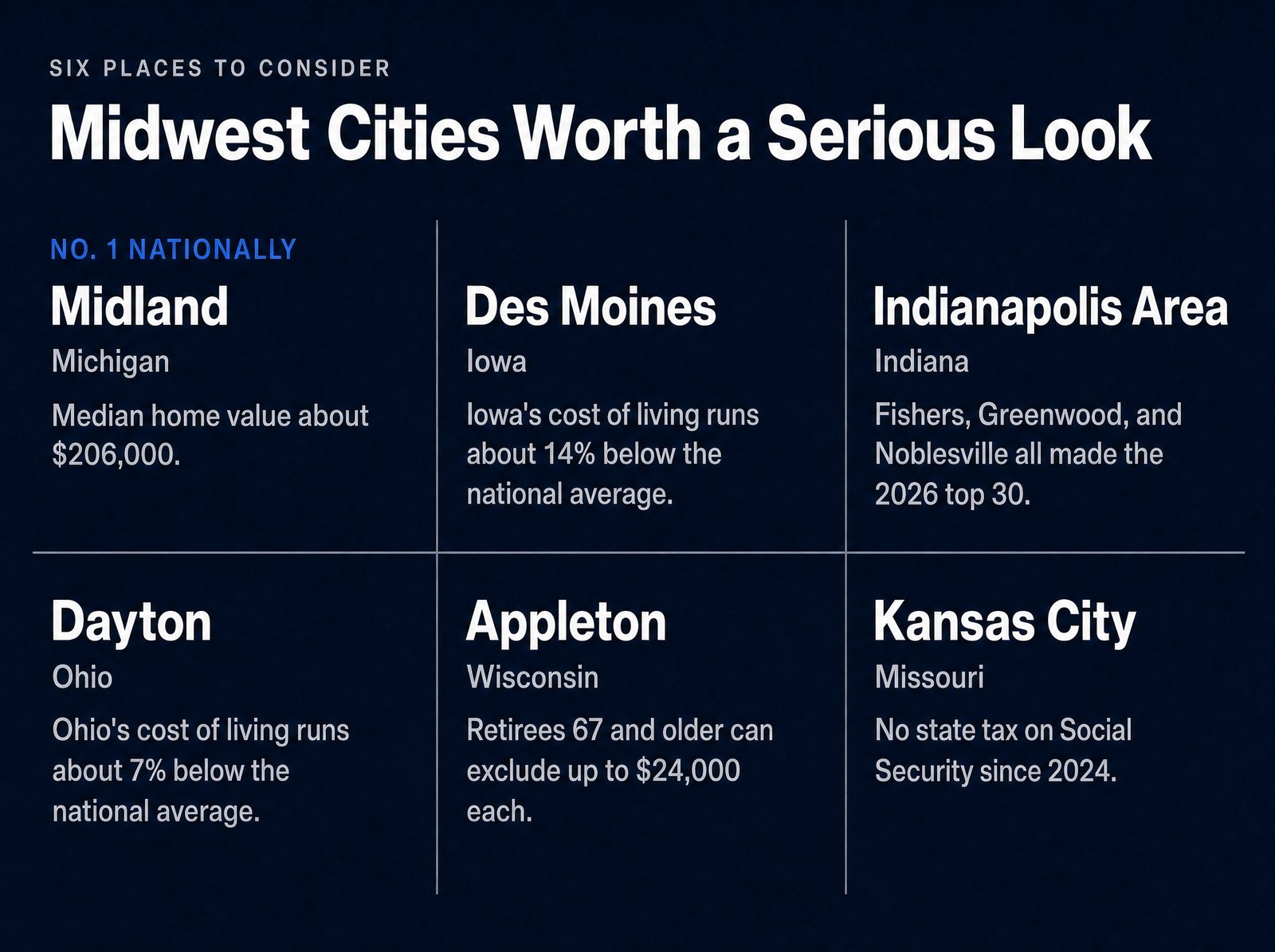
Rankings vary based on what they measure. Here are the cities and metro areas that score consistently well across affordability, healthcare, and quality of life.
Midland, Michigan
Midland took the top spot in the 2026 U.S. News Best Places to Retire rankings. The median home value is around $206,000, well below the national average.
Michigan exempts Social Security from state income tax. Starting with tax year 2026, Public Act 4 of 2023 lets retirees born in any year deduct pension, IRA, and 401(k) income up to $135,220 on a joint return ($67,610 single), which covers all of it for most couples.
Midland is a smaller city with a strong community character and lower day-to-day costs than most Midwest metros.
Indianapolis Area (Fishers, Noblesville, Greenwood), Indiana
Three Indianapolis suburbs landed in the 2026 top 30: Fishers, Greenwood, and Noblesville. Indiana exempts Social Security, but IRA and pension income is taxed at a flat 2.95% plus a county income tax, 1.10% in Hamilton County (Fishers and Noblesville) and 1.40% in Johnson County (Greenwood).
Property taxes are the offset: Indiana's average effective rate is about 0.76%, the lowest of the eight states in this guide. The Indianapolis area offers solid healthcare access, reasonable housing costs, and the kind of suburban infrastructure that works well for active retirees who want amenities without city-center prices.
Dayton, Ohio
Dayton offers strong healthcare access at Ohio prices, and Ohio's overall cost of living runs about 7% below the national average.
Dayton sits along the I-75 corridor with access to other major Ohio markets. Ohio exempts Social Security from state income tax and has no estate tax.
Local tax is the part people miss. Ohio cities can't tax pension or IRA income, but school districts that use the traditional income tax base do, so check the school district, not just the city, before you land on a number.
Des Moines, Iowa
Iowa made significant changes to its retirement tax laws starting in 2023. Once you're 55 or older, retirement income, including IRA distributions, 401(k) withdrawals, and pension payments, is fully exempt from Iowa state income tax, and Social Security is exempt at any age.
Iowa's cost of living runs about 14% below the national average, the lowest of the eight states in this guide, and Des Moines has strong access to healthcare through Iowa Methodist Medical Center and UnityPoint Health. For retirees drawing heavily from pre-tax accounts, Iowa is one of the better Midwest states from a pure tax standpoint.
Appleton, Wisconsin
Appleton has a smaller-city feel with solid healthcare access, and Wisconsin's cost of living runs about 4% below the national average. Wisconsin's tax on retirement income used to be the tradeoff, and a 2025 law changed that for older retirees.
Starting with tax year 2025, each spouse 67 or older can exclude up to $24,000 of IRA and pension income, or $48,000 for a couple. Before 67, that income is taxed at Wisconsin's graduated rates (3.5% to 7.65%), so the timing of your withdrawals matters more here than in most of the region.
Kansas City, Missouri
Missouri eliminated its tax on Social Security benefits in 2024, which made the state more competitive for retirees. Kansas City offers an affordable housing market, a strong arts scene, and solid healthcare access.
State income tax on IRA and pension income runs up to 4.70%, with some deductions available depending on income level.
How Each Midwest State Taxes Retirees
This is where most retirement guides fall short.
Cost of living tells you part of the story. How each state taxes your retirement income tells you another part.
For a retiree with a significant IRA balance, the difference between states can add up to tens of thousands of dollars over a 20 to 30-year retirement.
Here is a side-by-side look at the key tax factors across major Midwest states.
| State | Social Security | IRA / Pension Income | Property Tax Rate | Estate Tax |
|---|---|---|---|---|
| Ohio | Exempt | Taxable (2.75% above $26,050, plus school district tax in some districts) | ~1.36% | None |
| Indiana | Exempt | Taxable (2.95% flat + county tax) | ~0.76% | None |
| Michigan | Exempt | Exempt up to $135,220 joint (2026) | ~1.19% | None |
| Illinois | Exempt | Fully exempt (pensions, IRA, 401k all exempt) | ~1.88% | Yes (estates over $4M) |
| Iowa | Exempt | Exempt at age 55+ (since 2023) | ~1.33% | None |
| Missouri | Exempt (as of 2024) | Taxable up to 4.70% | ~0.89% | None |
| Wisconsin | Exempt | Taxable up to 7.65%; age 67+ excludes up to $24,000 each | ~1.32% | None |
| Minnesota | Partially taxable | Taxable (5.35% to 9.85%) | ~1.00% | Yes (estates over $3M) |
A few things worth pulling out from this table.
Michigan made a significant change in 2026. Under Public Act 4 of 2023, retirees born in any year can now deduct pension income, IRA distributions, and 401(k) withdrawals up to $135,220 on a joint return.
For most couples, that covers every dollar, which moves Michigan from the middle of the pack to one of the most favorable states in the Midwest for retirees drawing from pre-tax accounts.
Illinois looks unfavorable at first glance because of its flat 4.95% income tax rate and the highest property taxes in the Midwest, around 1.9%. But here is what most people miss.
Illinois fully exempts pensions, IRA distributions, and 401(k) withdrawals from state income tax. The 4.95% rate applies to earned income, not retirement distributions.
For a retiree drawing $100,000 a year from pre-tax accounts, the Illinois income tax bill on that money is zero. The property tax is a real cost to budget for, but from a retirement income standpoint, Illinois is significantly more favorable than its reputation suggests.
Iowa made a substantial shift starting in 2023. Once you're 55 or older, IRA and 401(k) distributions and pension payments are fully exempt from Iowa state income tax, and Social Security is exempt at any age.
Other income is taxed at a flat 3.8%.
For retirees drawing from pre-tax accounts, this puts Iowa among the most favorable states in the region.
Wisconsin changed the math in 2025. Each spouse 67 or older can now exclude up to $24,000 of IRA and pension income, and before 67 that income is taxed at graduated rates up to 7.65%.
Minnesota and Indiana cost the most in this group for a couple living on IRA and pension income, along with Wisconsin before 67. Minnesota's rates run from 5.35% to 9.85%, and it starts taxing part of Social Security once a married couple's income passes $110,780 in 2026.
Indiana's flat 2.95% plus county tax applies to nearly every dollar of IRA and pension income above small exemptions. Two states here also have an estate tax: Minnesota on estates over $3 million and Illinois on estates over $4 million.
For a couple in their late 60s living on $80,000 to $120,000 a year, with $35,000 to $45,000 of it from Social Security, Minnesota and Indiana both cost more than Ohio or Missouri. Illinois, Iowa, and Michigan take nothing from that income, and Wisconsin takes nothing either once both spouses are 67.
You can review current state-by-state retirement tax treatment at Kiplinger's retirement tax guide and verify property tax rates through the Tax Foundation's annual property tax data.
What It Really Costs to Retire in the Midwest
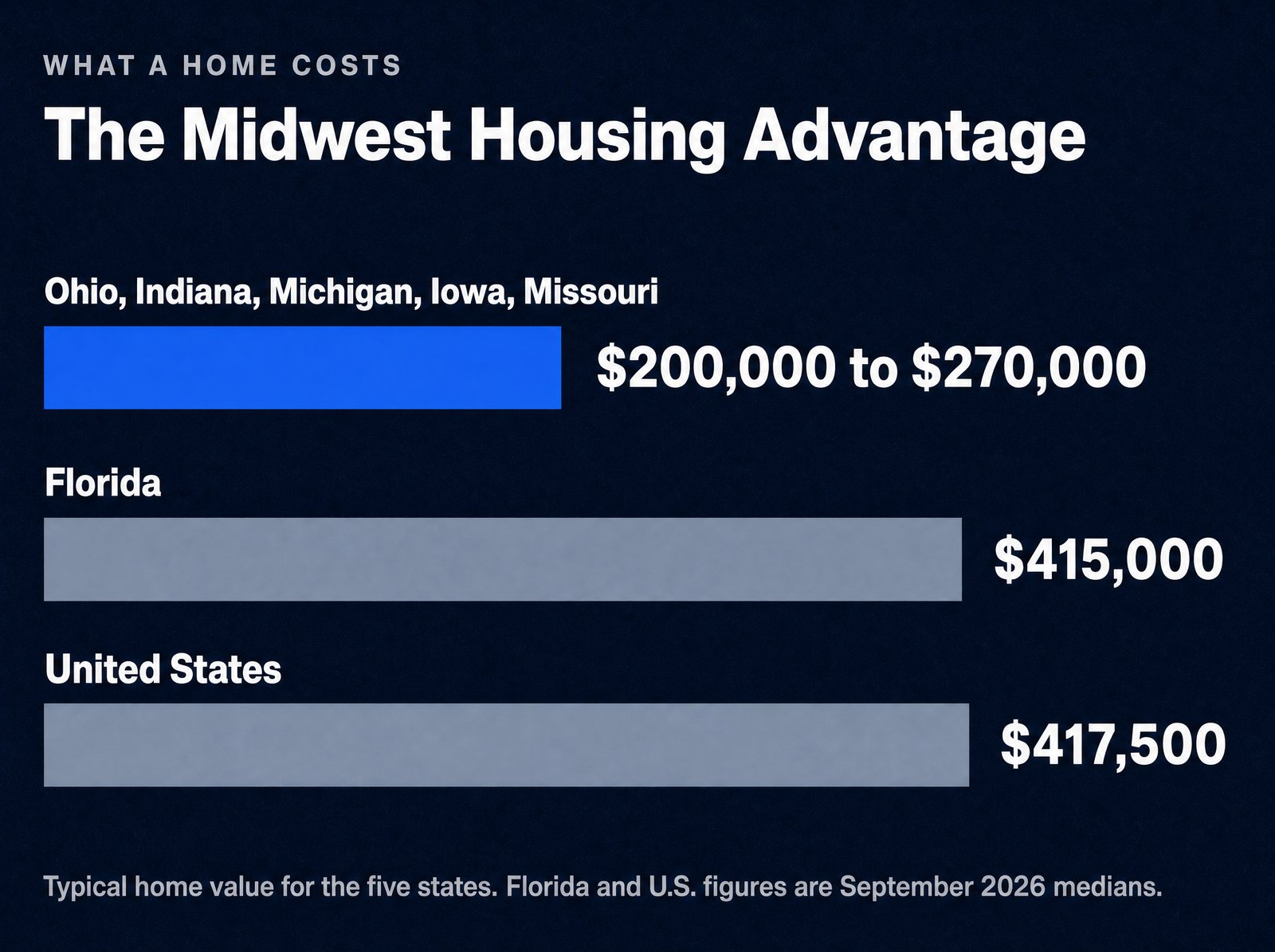
Housing is the clearest cost advantage the Midwest offers. In Ohio, Indiana, Michigan, Iowa, and Missouri, the typical home value runs $200,000 to $270,000.
Nationally, the median existing-home price was $417,500 in September 2026.
If you already own a home in Ohio, Indiana, or Michigan and plan to stay in it, that housing cost is settled. Your portfolio does not have to cover a $3,500 monthly rent payment or a $450,000 mortgage.
That frees up retirement income for everything else.
Overall cost of living in these eight states runs about 4% to 14% below the national average, based on the Missouri Economic Research and Information Center's cost of living index for the second quarter of 2026. Iowa is the lowest at about 14% below, and Ohio is about 7% below.
Healthcare is a real cost regardless of where you live. Our usual recommendation is original Medicare with a Medicare supplement plan rather than Medicare Advantage.
With original Medicare, you can see almost any physician in the country who accepts it. In the Midwest, that means access to Cleveland Clinic, Ohio State Wexner Medical Center, Mayo Clinic, and other top-tier systems without network restrictions.
The cost is usually $125 to $250 per month more than an Advantage plan, but the coverage is broader. For someone who has spent 30 or 40 years building significant wealth, the better coverage is worth the cost.
You can review Medicare options through Medicare.gov.
Federal Consumer Expenditure Survey data puts average spending for households headed by someone 65 to 74 at $65,354 a year (2024). For a retired couple in the Midwest, $60,000 to $90,000 a year covers housing, healthcare, food, transportation, and a reasonable travel budget.
Couples with a paid-off home and meaningful Social Security income are in a strong position across these states. The range that works is $750,000 to $1.5 million in investable assets, depending on income needs and what other sources they have coming in.
The Social Security Administration's retirement planner can help you estimate your benefit if you have not done that recently.
The Part Most Retirement Guides Skip
Most rankings and retirement guides focus on city-level data: home prices, weather, and walkability scores. That is useful context.
But it does not tell you what you will actually pay in taxes.
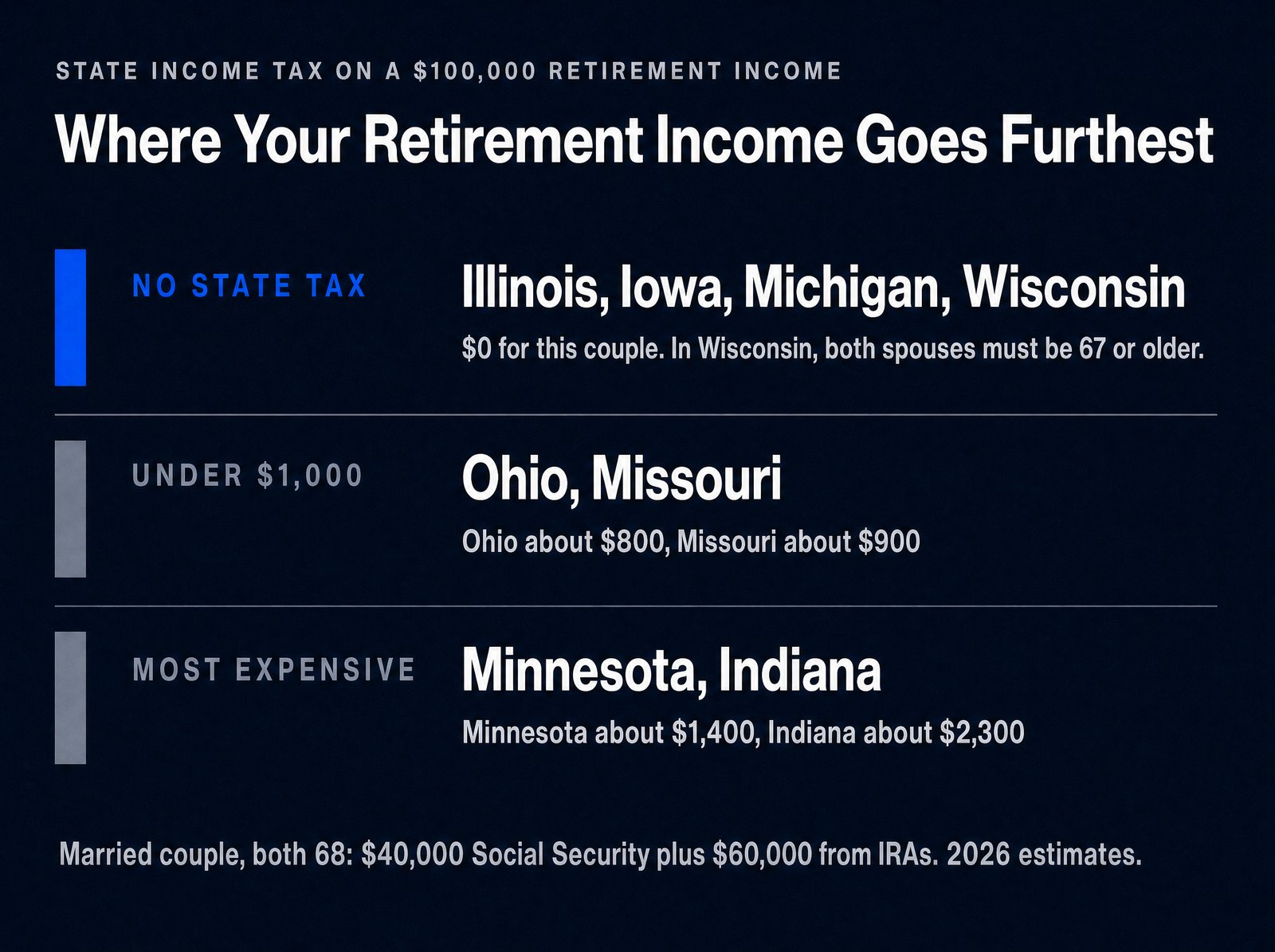
Here is what I mean. Say you've got a couple, both 68, with $1.5 million in traditional IRAs and $40,000 a year of Social Security.
They take $60,000 a year from the IRAs, so they live on about $100,000. Here is roughly what each state's income tax takes from them in 2026:
- Illinois, Iowa, and Michigan: $0
- Wisconsin: $0 once both are 67 or older, about $1,500 a year before that
- Ohio: about $800, before any school district income tax
- Missouri: about $900
- Minnesota: about $1,400
- Indiana: about $2,300 in Hamilton County (Fishers and Noblesville), about $2,800 in Marion County (Indianapolis)
We're making some assumptions here: 2026 rules, no other income, and the standard deduction everywhere. But over 20 years, the Indiana bill alone comes to about $45,000 before any growth, and no city ranking shows you that.
Run the same math at $80,000 or $120,000 of total income and the order holds. Illinois, Iowa, Michigan, and Wisconsin (67 and older) stay at zero, Ohio and Missouri sit in the middle, and Minnesota, Indiana, and Wisconsin before 67 cost the most.
In my experience, taxes rarely decide where people around here retire, though. A more common setup is splitting the year: winters in Florida or Georgia, with the Midwest home still the primary residence.
That is a reasonable approach. But if you go that route, there is a detail worth knowing.
Florida doesn't require a minimum number of days before it becomes your legal home. You make it your permanent home, move your driver's license, voter registration, and tax filings there, and you can file a sworn Declaration of Domicile with the county clerk.
Leaving Ohio is the harder part. The main conditions in Ohio's domicile test are no more than 212 contact periods in Ohio (roughly, overnight stays), a home outside Ohio all year, no Ohio driver's license or owner-occupancy property tax break, and a signed statement to the state saying it's all true.
Spending a few months in Florida without doing those things does not change your Ohio tax liability. The state you are paying taxes in is determined by where you actually live, not where you prefer the weather.
For retirees in those early years before required minimum distributions begin, the state tax picture also connects to Roth conversion strategy. Those gap years, the window between when you retire and when RMDs kick in, are the best window to convert pre-tax IRA money to Roth.
Understanding how retirement income is taxed at both the federal and state level helps you do that conversion work as efficiently as possible. The state you are in affects the math, and Ohio tax planning in retirement covers how these pieces fit together for clients in this region.
What to Think Through Before You Decide
Three things are worth working through before you settle on a city or state.
First, look at your income mix.
How much of your retirement income is Social Security? How much comes from IRAs, 401(k)s, or a pension?
That answer determines which states work in your favor and which ones are more expensive than the headline suggests. If you are drawing primarily from Social Security, nearly every Midwest state treats you well.
If you are drawing heavily from pre-tax accounts, Illinois, Iowa (55 and older), and Michigan (up to its cap) now have a significant tax advantage over Indiana and Minnesota.
Second, check healthcare access in the specific metro area you are considering. Not the state, the city.
A top-ranked hospital 90 minutes away is not the same as one 20 minutes from your house.
Access matters more as you get older.
Third, think through the residency question honestly. If you plan to spend winters somewhere else, are you willing to formally change your domicile?
In my experience, most people are not.
If you are not, then the tax rates in your primary Midwest state are the ones that count.
The retirement paycheck your portfolio can generate looks different in Iowa than in Indiana. That difference is worth understanding before you pick a city off a ranking list.
Frequently Asked Questions
Which Midwest state is best for retirement taxes?
Illinois, Iowa, and Michigan are the strongest for retirees drawing from IRAs, 401(k)s, and pensions. Illinois exempts that income outright, Iowa exempts it once you're 55, and Michigan exempts it up to $135,220 for a married couple in 2026. Wisconsin comes close for couples who are both 67 or older, since each spouse can exclude up to $24,000 of retirement income. Minnesota and Indiana are the most expensive in this group for a couple living on retirement income, along with Wisconsin for anyone under 67.
Which Midwest states do not tax Social Security?
Every Midwest state covered in this guide fully exempts Social Security from state income tax except Minnesota, which taxes a portion of it. Ohio, Indiana, Michigan, Illinois, Iowa, Missouri, and Wisconsin all fully exempt Social Security benefits at the state level.
Does Michigan still tax retirement income?
For most couples, no. Starting with tax year 2026, Public Act 4 of 2023 lets retirees born in any year deduct IRA distributions, 401(k) withdrawals, and pension payments up to $135,220 on a joint return or $67,610 single. Only retirement income above that cap is taxed, which makes Michigan considerably more attractive for retirees drawing from pre-tax accounts.
How does the Midwest compare to Florida for retirement?
Florida has no state income tax, which is a clear advantage for retirees drawing from pensions and IRAs. Ohio and Indiana tax that income, while Illinois, Iowa (55 and older), and Michigan (up to its cap) do not. Florida's median single-family sale price was $415,000 in September 2026, while typical home values in five of the eight Midwest states here run $200,000 to $270,000. For retirees with roots in the Midwest and income weighted toward Social Security, the numbers are competitive.
What is the best city to retire in the Midwest in 2026?
It depends on what you are optimizing for. Midland, Michigan ranked No. 1 on the 2026 U.S. News list and pairs a median home value around $206,000 with Michigan's new retirement income deduction. Des Moines pairs Iowa's low cost of living with no state tax on retirement income after 55, and Dayton offers strong healthcare at Ohio prices. Fishers and Noblesville offer suburban amenities in the state with the lowest property taxes in this guide, but Indiana taxes IRA and pension income from nearly the first dollar.
Here's What Matters
- Midwest cities took nearly a third of the top 30 spots in the 2026 best places to retire rankings, and the value case is real. Home prices, healthcare access, and cost of living make it competitive with any retirement destination in the country.
- State tax treatment varies more than most guides show. Illinois, Iowa (55 and older), and Michigan (up to its cap) take nothing from most couples' IRA and pension income, while Minnesota, Indiana, and Wisconsin before 67 take the most.
- Two recent changes moved the rankings. Michigan now lets retirees deduct IRA, 401(k), and pension income up to $135,220 on a joint return, and Wisconsin lets each spouse 67 or older exclude up to $24,000.
- Every Midwest state covered here fully exempts Social Security from state income tax except Minnesota, which taxes a portion of it.
- The dual-residency snowbird strategy is common. It only saves on taxes if you formally establish domicile in the lower-tax state. Spending a few months in Florida does not change your Midwest state tax liability.
- In my experience, staying in the Midwest holds up for most retirees with roots here once you run the numbers. The people who do move tend to go for the weather or to be near kids who moved away, not for the tax math.
- Run your actual numbers before you draw any conclusions. The answer depends entirely on your income mix, and "the Midwest is affordable" and "your state taxes your retirement income" can both be true at the same time.
Gudorf Financial Group is a fee-only, fiduciary retirement planning firm based in Dayton, Ohio. We serve clients locally and virtually nationwide.
Article References
- "Fla.'s Housing Market Continues Recent Trends in Sept. and 3Q 2026." Florida Realtors. October 2026.
- "Best Places to Retire 2026." U.S. News and World Report. Accessed October 2026.
- "Retirement and Pension Benefits." Michigan Department of Treasury. Accessed October 2026.
- "2026 Michigan Income Tax Withholding Guide." Michigan Department of Treasury. 2026.
- "Departmental Notice #1: How to Compute Withholding for State and County Income Tax." Indiana Department of Revenue. October 2026.
- "Property Taxes by State and County, 2026." Tax Foundation. March 2026.
- "Cost of Living Data Series." Missouri Economic Research and Information Center. Second quarter 2026.
- "Section 718.01." Ohio Revised Code. Accessed October 2026.
- "Guide to Ohio's School District Income Tax for School District Administrators." Ohio Department of Taxation. January 2026.
- "Retirement Income Tax Guidance." Iowa Department of Revenue. Accessed October 2026.
- "Publication 106, Wisconsin Tax Information for Retirees." Wisconsin Department of Revenue. Accessed October 2026.
- "Publication 120, Retirement Income." Illinois Department of Revenue. December 2025.
- "Section 5747.02." Ohio Revised Code (2026 income tax rate). Accessed October 2026.
- "2026 Form MO-1040ES." Missouri Department of Revenue. Accessed October 2026.
- "Inflation-Adjusted Amounts, Tax Year 2026." Minnesota Department of Revenue. December 2025.
- "States That Won't Tax Your Retirement Income in 2026." Kiplinger. Updated July 2026.
- "Housing Data: Zillow Home Value Index, State Level." Zillow Research. September 2026 data.
- "Existing-Home Sales Increased 1.5% in September, According to NAR Report." National Association of Realtors. October 2026.
- "Medicare." U.S. Centers for Medicare and Medicaid Services. Accessed October 2026.
- "Total Average Annual Expenditures by Age: from Age 65 to 74." U.S. Bureau of Labor Statistics, via FRED. 2024 data, accessed October 2026.
- "Retirement Benefits." Social Security Administration. Accessed October 2026.
- "Section 5747.24." Ohio Revised Code. Accessed October 2026.
- "Section 222.17, Manifesting and Evidencing Domicile in Florida." Florida Statutes. Accessed October 2026.