


Should You Give Your Kids Money Now or Leave It in Your Estate?
By Danny Gudorf | Founder, Gudorf Financial Group | Updated July 2026
Nobody grows up dreaming about this moment. You turn 60, you lose a parent, and a bundle of money lands in your lap that you no longer need.
By then the mortgage is paid off. The career is set, the kids are raised, and the money is nice. But it is not transformative.
Now run the same math from the other side of the table. You hand your 55-year-old son a $500,000 pre-tax IRA when you pass away.
That gift probably will not change his life. It arrives late, and because it is pre-tax, a big share goes to taxes as he draws it down.
That is the least efficient gift in the entire scenario. And it is the one most families end up making, simply by waiting.
So this post is about a different approach. I call it giving with warm hands, and it comes down to one idea: with family money, timing matters as much as the amount.
To be clear, the goal is not to give recklessly. The goal is giving money to your adult children from the surplus you can prove you do not need, at the moments it does the most good.
The Decade That Matters Most
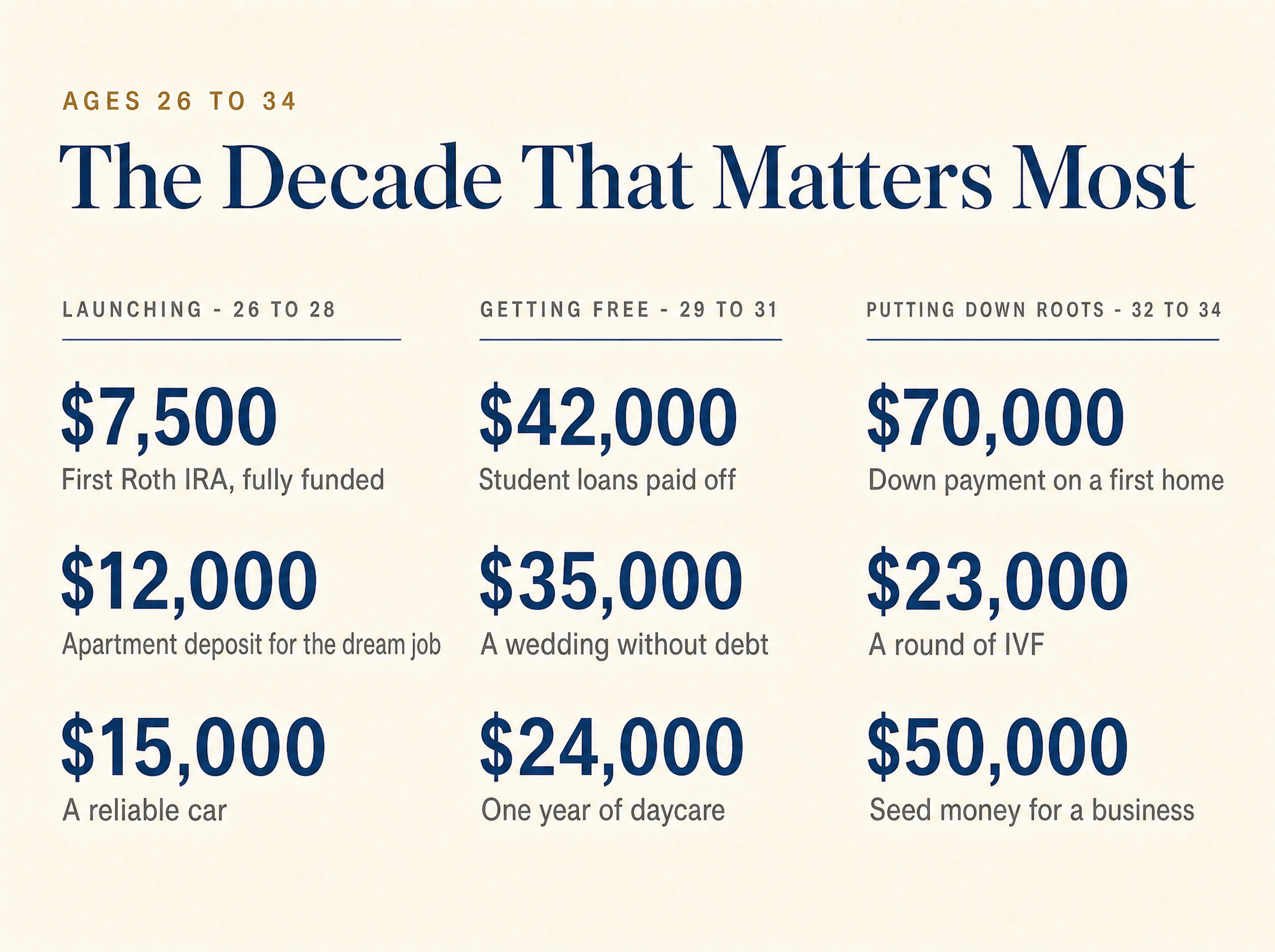
Think about it this way. Somewhere between age 26 and 34, your kids make almost every decision that shapes the rest of their lives. Careers, marriages, homes, children, businesses.
That is the window where a gift compounds into a changed life. Let me walk you through what that actually looks like, in three phases.
Phase One: Launching (Ages 26 to 28)
$7,500 to your 26-year-old daughter to max out her first Roth IRA. This is the single highest-leverage gift on the whole list. Those dollars have four decades of tax-free growth ahead of them.
$12,000 to your 27-year-old son for first, last, and security on an apartment. It is in the city where his dream job is. The gift is not the apartment. It is the career that apartment makes possible.
$15,000 to your 28-year-old son to replace the car that breaks down every other month. Reliability at the start of a career is worth more than the sticker price suggests. He stops burning money on repairs and stops missing work.
Phase Two: Getting Free and Starting a Family (Ages 29 to 31)
$42,000 to your 29-year-old daughter to wipe out her student loans. Freeing up her monthly cash flow now reshapes a decade of decisions. Every choice she makes for the next ten years starts from a stronger position.
$35,000 to your 30-year-old son for his wedding. The marriage does not start in debt. That is the whole point.
$24,000 to your 31-year-old son for a year of daycare. Ask any young family what expense strains them most, and daycare is the answer. One year of breathing room changes how that household runs.
Phase Three: Putting Down Roots and Building (Ages 32 to 34)
$70,000 to your 32-year-old daughter for the down payment on her first home. This is the gift that moves a family from renting to owning years earlier than they could alone. Home equity starts compounding in their early 30s instead of their early 40s.
$23,000 to your 33-year-old daughter for a round of IVF. Some windows are measured in biology, not budgets. There is no version of this gift that works better later.
$50,000 to your 34-year-old son to finally start the business he has been talking about for years. He has the experience now and the idea. What he does not have is the seed capital, and you do.
The Number That Reframes the Whole Conversation
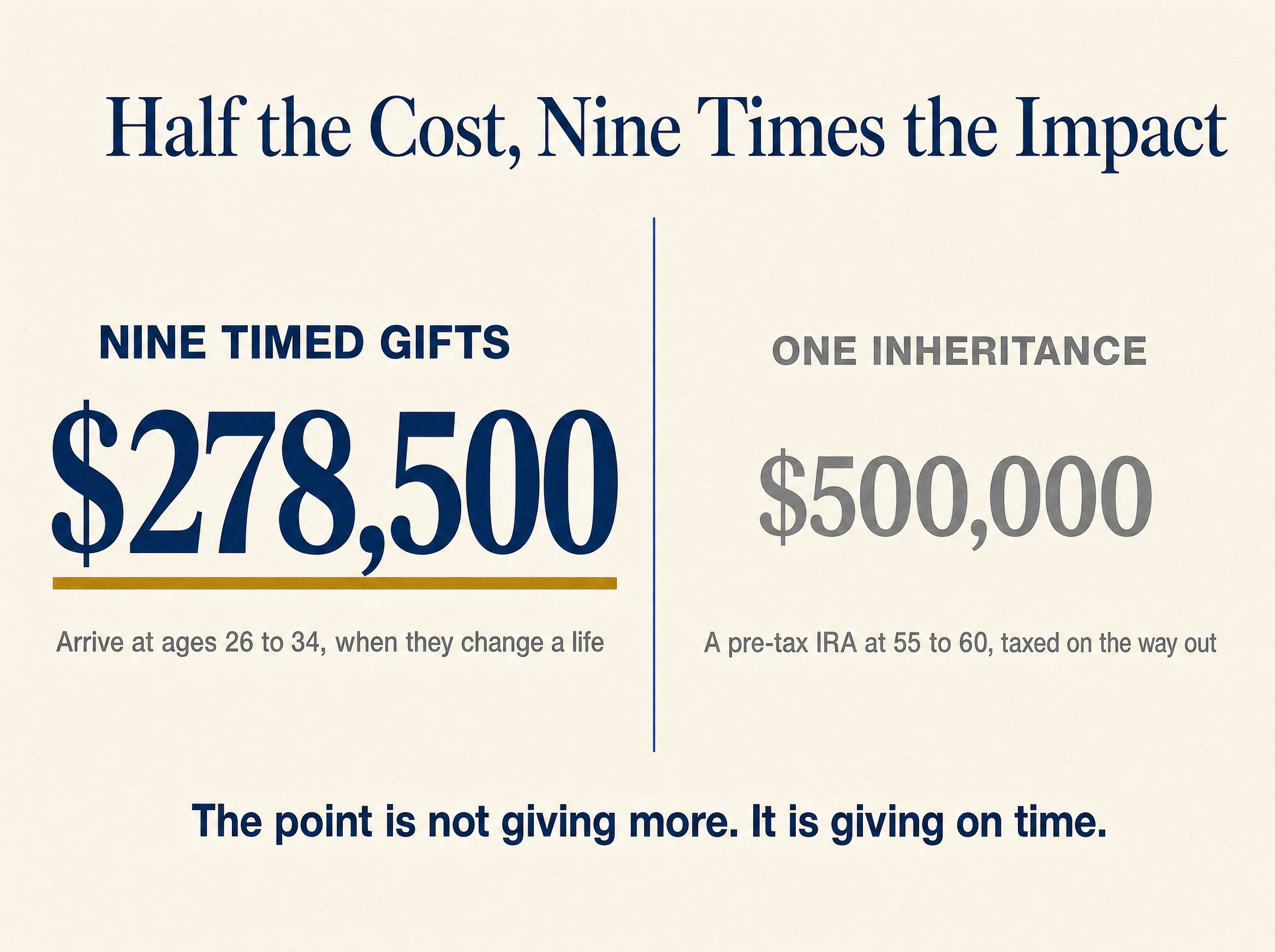
Now add up all nine of those gifts.
| Age | Gift | Amount |
|---|---|---|
| 26 | First Roth IRA, fully funded | $7,500 |
| 27 | Apartment deposit for the dream job | $12,000 |
| 28 | Reliable car | $15,000 |
| 29 | Student loans paid off | $42,000 |
| 30 | Wedding without debt | $35,000 |
| 31 | One year of daycare | $24,000 |
| 32 | Down payment on a first home | $70,000 |
| 33 | A round of IVF | $23,000 |
| 34 | Seed money for a business | $50,000 |
| Total | $278,500 |
That is $278,500. Compare it to the $500,000 pre-tax IRA from the opening.
For a little more than half the cost of one late inheritance, a family could show up at nine different life-changing moments. That could be one child helped nine times, or several children helped across a decade. Either way, the timed dollars simply do more work.
The point is not giving more. The point is giving on time.
Which Dollars You Give Matters as Much as How Much
Here is where most families make their second mistake. They think about the amount and never think about the source.
Remember the three tax buckets: taxable, tax-deferred, and tax-free. Which bucket a gift comes from changes how much of it actually reaches your child.
So let me rank the options.
| Source | What Your Child Actually Gets | Best Use |
|---|---|---|
| Pre-tax IRA (inherited) | Every dollar taxed as ordinary income, drained within 10 years | The default, and the worst option |
| Cash or taxable brokerage | Full value, simple, no strings | Most lifetime gifts |
| Roth dollars | Completely tax-free to your child | High-value gifts and inheritance |
| Appreciated stock | Full value, but your cost basis comes with it | Depends on the situation |
A few notes on that table.
First, the $500,000 pre-tax IRA is the least efficient gift because those dollars are fully taxable to whoever withdraws them. A chunk of your gift never reaches your child at all. It goes to the IRS.
Second, cash and taxable brokerage dollars are the workhorses of lifetime giving. Simple, clean, and available now.
Third, Roth dollars arrive completely tax-free to your child. That is why a Roth conversion strategy and a giving strategy belong in the same conversation.
Now, appreciated stock deserves a caveat. If you gift stock during your lifetime, your original cost basis carries over to your child, and they pay capital gains tax on all that growth when they sell. Assets you hold until death get a step-up in basis instead, which erases that built-in gain.
So highly appreciated stock is one of the few assets where waiting can beat giving. Cash for the gifts, appreciated stock for the estate. That is the general shape of it.
And one more move worth naming. If your adult child has earned income, you can fund their Roth IRA contribution directly, up to the annual limit or their earned income, whichever is smaller. That is exactly how the $7,500 gift to the 26-year-old gets supercharged.
The Tax Rules Are Simpler Than People Fear
I hear the same worry in almost every one of these conversations: "Won't I owe gift tax?" For nearly every Dayton family, the answer is no.
Here is how the rules actually work in 2026:
- The annual exclusion is $19,000 per recipient. You can give up to that amount to as many people as you want, with no gift tax return and no reduction of your lifetime exemption.
- A married couple can give $38,000 per recipient by splitting gifts. That covers most of the nine gifts on the list outright.
- Bigger gifts still are almost never taxable. The $70,000 down payment or the $50,000 business seed just requires filing Form 709 to track the excess against your lifetime exemption. Filing the form is not the same as owing tax.
- The lifetime gift and estate tax exemption is $15 million per individual in 2026, made permanent and indexed to inflation going forward. Federal gift tax is not the real concern most families assume it is.
And there is a bonus lever most people have never heard of. Tuition paid directly to a school and medical bills paid directly to a provider are unlimited, and they do not count against the annual exclusion at all.
That round of IVF? Pay the clinic directly and it does not touch your $19,000 exclusion. Same with a grandchild's tuition paid straight to the school.
The Gap Years Advantage
If you have read my work on Roth conversions, you know about the gap years. That is the window between when you retire and when required minimum distributions begin, when your income and your tax bracket both drop.
Most people know the gap years as prime Roth conversion territory. Here is the thing: they are prime giving territory too.
The same years when your own tax bracket is lowest are the years it costs you the least to free up dollars for your children. Selling appreciated assets to raise gift cash, converting to Roth, and managing your bracket all interact.
So giving and conversion strategy should be planned together, not in isolation. A tax planning process that looks at both on one screen will beat two separate decisions every time.
Give the Surplus, Never the Safety Net

Now let me address the honest question sitting under all of this. The reason most retirees never give during life is not selfishness.
It is a fair and reasonable fear: will I have enough?
I will tell you what I see in our office. Most Dayton-area clients are more overfunded than they realize. They have been so focused on saving that they have never given themselves permission to spend, let alone give.
The data on the old 4% rule backs this up. Around 70% of people who follow it die with three to six times more money than they started with. They skipped the trips, and they did not give to the kids when the kids could actually use it.
That is where retirement income guardrails come in. We put an upper guardrail and a lower guardrail around your portfolio value. As long as you stay between them, your income holds at the target rate, and if the portfolio keeps growing, you can spend and give more.
What that system produces is a specific number. Not a feeling, not a guess. A dollar amount you can give this year without threatening your own income for life.
That number is the difference between generosity and guesswork. So the sequence matters: plan first, then give. You cannot know your safe giving number until you know your own plan is on track.
Building a Giving Rhythm
Once you know your number, giving stops being a one-time event and becomes part of how your household runs. Treat it like an annual operating rhythm.
Three steps:
- Set your recipient list and amounts for the year. Decide in January who gets what, the same way you would set any other line in your plan.
- Fund gifts earlier in the year rather than later. The money starts working for your kids sooner, and you never lose an exclusion year to bad timing or bad health.
- Revisit the plan annually. Your children's needs change, and so does your own picture. A daycare year ends. A down payment year arrives. The rhythm stays, and the targets move.
That is it. No complicated structure, no trust department required for most of it. Just intention, applied every year.
Frequently Asked Questions
How much money can I give my adult child in 2026 without paying gift tax?
You can give $19,000 per child in 2026 with no gift tax return and no effect on your lifetime exemption. A married couple can give $38,000 per child by splitting gifts. Those limits apply per recipient, so gifts to a child's spouse or your grandchildren each get their own exclusion.
What happens if I give my child more than the annual exclusion?
You file Form 709 with your tax return, and the excess counts against your $15 million lifetime exemption. For nearly every family, no tax is owed. The form is a tracking mechanism, not a bill.
Is it better to give my kids money now or leave them an inheritance?
The same dollars do more good during your children's late 20s and early 30s than they do arriving at age 55 or 60. Gifts made during life can fund a home, erase debt, or start a business at the moment those moves change a trajectory. The exception is highly appreciated stock, which gets a step-up in basis at death and can be worth holding.
Can I pay for my grandchild's tuition or my child's medical bills without it counting as a gift?
Yes, as long as you pay the school or the medical provider directly. Direct payments for tuition and medical care are unlimited and do not count against your $19,000 annual exclusion. Money given to your child to pay those same bills does count, so the payment path matters.
Can I contribute to my adult child's Roth IRA?
You can give your child money to fund their Roth IRA as long as they have earned income of at least the contribution amount. The contribution counts against the normal IRA limits, and your gift counts against your annual exclusion. For a child in their 20s, this is one of the highest-leverage gifts available because of the decades of tax-free growth ahead.
Here's What Matters
- The same dollars do far more arriving at 26 to 34 than at 55 or 60. Nine timed gifts totaling $278,500 beat one $500,000 pre-tax IRA at death.
- The source of the gift matters as much as the size. Cash and Roth dollars are efficient to give. A pre-tax IRA is the least efficient gift there is.
- The 2026 rules make this easier than people fear: $19,000 per recipient ($38,000 for couples), a $15 million lifetime exemption, and unlimited direct payments for tuition and medical care.
- Your gap years are prime territory for tax-smart giving, and giving should be coordinated with your Roth conversion plan.
- Give the surplus, never the safety net. Retirement income guardrails turn "can I afford this" into a specific annual number.
Before you decide whether to help a child this year, start by confirming your own plan can support it. That is exactly what our free retirement assessment is built to show you.
Gudorf Financial Group is a fee-only, fiduciary retirement planning firm based in Dayton, Ohio. We work with clients in the Dayton and Cincinnati area and virtually nationwide.
Article References
- "Frequently Asked Questions on Gift Taxes." IRS.gov. Accessed July 2026.
- "About Form 709, United States Gift (and Generation-Skipping Transfer) Tax Return." IRS.gov. Accessed July 2026.
- "What's New: Estate and Gift Tax." IRS.gov. Accessed July 2026.
- "Retirement Topics: IRA Contribution Limits." IRS.gov. Accessed July 2026.