


Fidelity Says Retirees Need $185,500 for Health Care in 2026
By Danny Gudorf | Founder, Gudorf Financial Group | Updated November 2026
Every summer, Fidelity puts out one number that ends up in a lot of retirement headlines. This year it is $185,500.
That is Fidelity's 2026 retiree health care cost estimate for a single 65-year-old. Here is what the number covers, what it leaves out, and what we tell clients to actually budget.
The Fidelity 2026 Retiree Health Care Cost Estimate
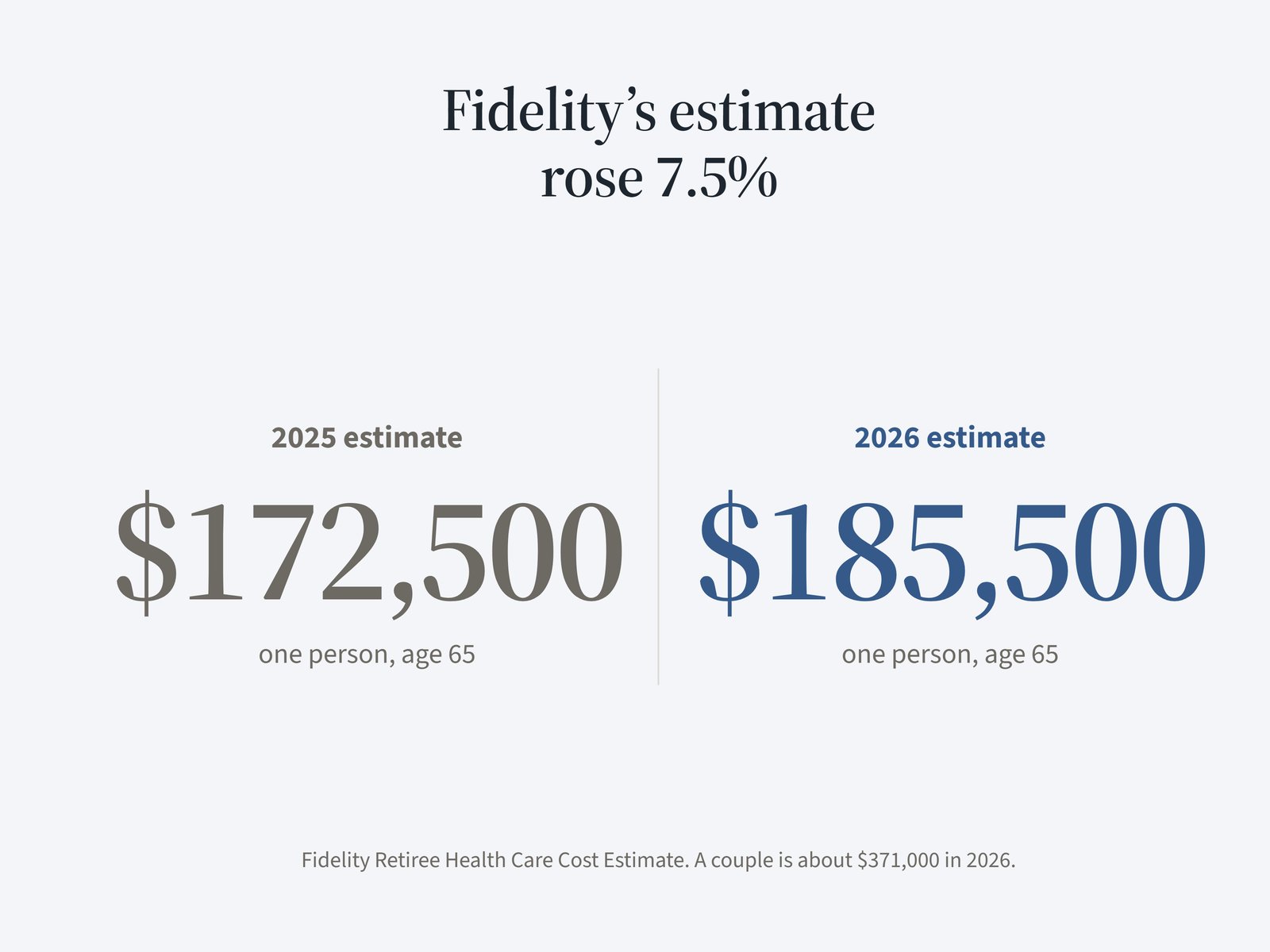
Fidelity released its 25th annual retiree health care cost estimate on July 21, 2026. A 65-year-old retiring in 2026 can expect to spend an average of $185,500 on health care and medical expenses through retirement.
| Fidelity estimate | One person, age 65 | Married couple (two times the single figure) |
|---|---|---|
| 2025 | $172,500 | $345,000 |
| 2026 | $185,500 | $371,000 |
| Change | Up 7.5% | Up $26,000 |
Fidelity reports the number for one person. The couple column is simply the single figure doubled, which is how most planners use it.
Fidelity gives three reasons for the jump:
- Rising prices for care
- People using more care
- Growing costs tied to chronic conditions
What the $185,500 Covers and What It Leaves Out
So what is actually inside that number? It is narrower than most headlines make it sound.
| Included | Not included |
|---|---|
| Medicare Part B and Part D premiums | Long-term care |
| Copays, deductibles, and other out-of-pocket medical costs | Most dental care |
| Out-of-pocket prescription drug costs | Over-the-counter medications |
| Medigap supplement premiums |
Fidelity also assumes three things that may not match your situation:
- Original Medicare, not Medicare Advantage
- No retiree health coverage from a former employer
- A single person, with the cost figured after taxes
The point is that $185,500 is the Medicare bill, not the whole health care bill. Long-term care is the biggest piece missing, and we will get to it.
What That Looks Like Each Year
A lifetime number is hard to plan around. So let me show you what it looks like year by year.
When clients first go on Medicare, we tell them to budget $4,000 to $6,000 a year per person for everything Medicare-related. That covers Part B, Part D, a supplement plan, and out-of-pocket costs.
Here is where the 2027 Medicare costs start:
| 2027 Medicare cost, per person | Amount |
|---|---|
| Part B premium ($209.40 a month) | $2,513 a year |
| Part B deductible | $292 |
| Part D deductible (standard plan) | Up to $700 |
| Part D out-of-pocket cap on drugs | $2,400 |
| Medigap supplement premium | Varies by plan, age, and where you live |
Part B alone is about $2,800 a year once you add the deductible. A supplement and a drug plan take most people into that $4,000 to $6,000 range.
Now, our range is per person. A married couple should budget $8,000 to $12,000 a year in their first years on Medicare.
Why our number looks lower than Fidelity's
Spread over 20 years, a round number we use here, $185,500 works out to about $9,275 a year per person. That is higher than our starting range, and the reason for that is time.
Health care costs climb faster than most of your other expenses, and they climb as you age. Your first years on Medicare are the cheapest ones you will have.
Say a couple starts at $10,000 a year and their costs rise 5% a year. Over 20 years they spend about $330,000, which is close to Fidelity's $371,000 for a couple.
So the two numbers tell the same story. Ours is what the first year costs, and Fidelity's is where a full retirement of rising costs ends up, based on life expectancy tables.
How Your Medicare Choices Change the Number
Two decisions at 65 move your health care costs more than anything else.
Original Medicare versus Medicare Advantage
We recommend original Medicare over Medicare Advantage for our clients. With original Medicare you can see almost any doctor who takes Medicare, and the claims process is much better because you are not fighting a private insurer's network.
Yes, it usually costs more each month. For people who have spent 30 or 40 years building what you have built, we think the broader coverage is worth it.
Which supplement plan
We point clients to the most complete Medigap plan they can buy. For anyone turning 65 today, that is Plan G.
Plan F used to be the top plan, but no one who became eligible for Medicare on or after January 1, 2020 can buy it. Plan G covers everything Plan F did except the Part B deductible, which is $292 in 2027.
You can compare the plans on Medicare.gov's Medigap comparison chart.
IRMAA can add thousands
If your income runs high, Medicare charges more for Parts B and D. These surcharges are called IRMAA.
For 2027, a married couple whose 2025 income was just over $224,000 pays about $2,378 more a year for the two of them. Our post on the 2027 IRMAA brackets walks through every tier and how to stay under the lines.
Fidelity's estimate does not include IRMAA. If you are in the surcharge brackets, add it on top.
The Cost Fidelity Leaves Out: Long-Term Care
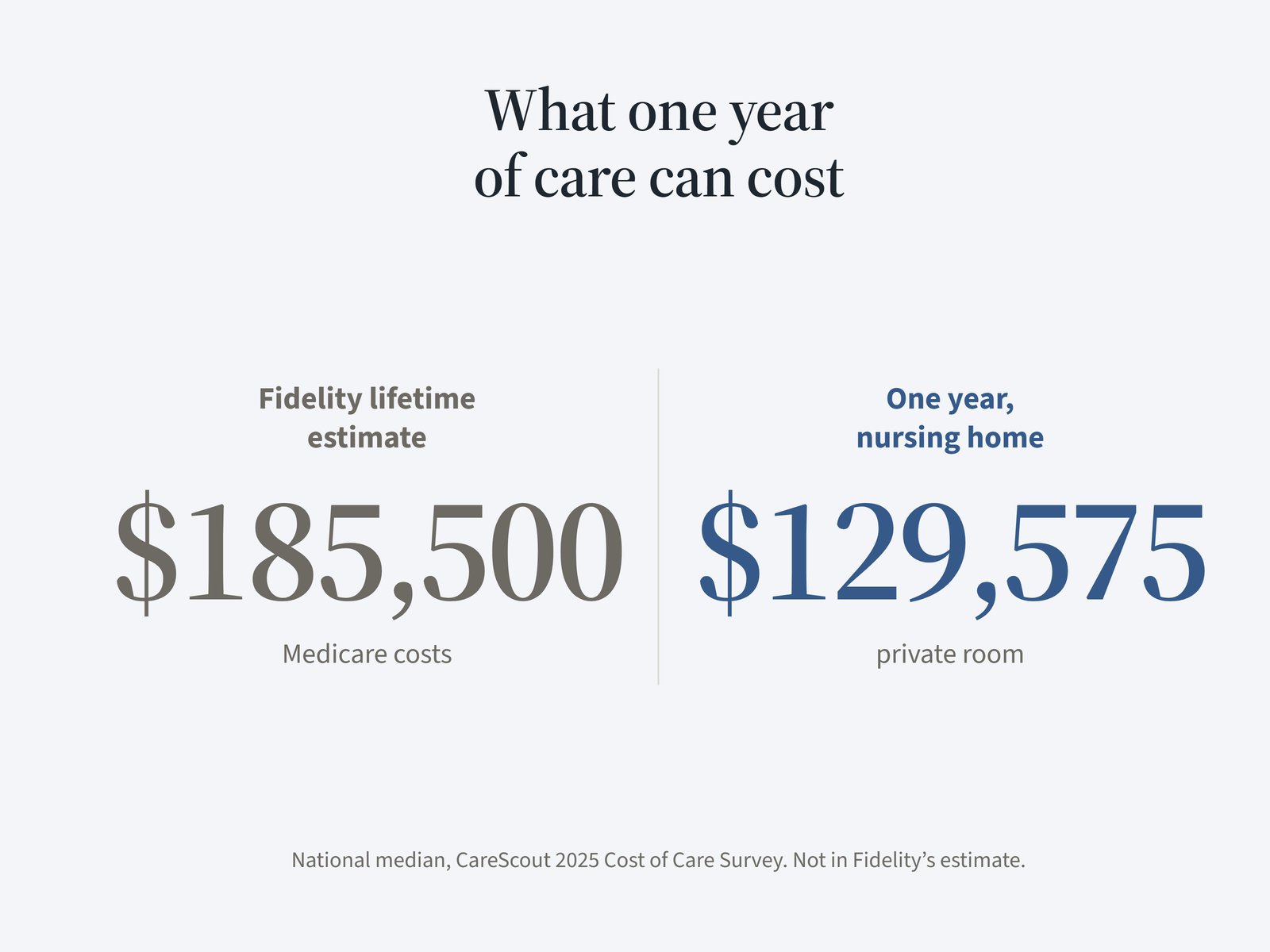
Medicare does not pay for long-term care, meaning help with daily living over months or years. That is the gap in the Fidelity number that worries me most.
Here are the national median costs from CareScout's 2025 Cost of Care Survey:
| Type of care | National median | Per year |
|---|---|---|
| Assisted living | $6,200 a month | $74,400 |
| Nursing home, semi-private room | $315 a day | $114,975 |
| Nursing home, private room | $355 a day | $129,575 |
| In-home caregiver | $35 an hour | Depends on hours |
One year in a private nursing home room costs about 70% of Fidelity's entire lifetime estimate. Three years of assisted living costs $223,200.
Not everyone needs long-term care, and nobody knows in advance who will. That is exactly why it needs its own plan.
How we plan for long-term care
There's no one answer, and it depends on how much you have:
| Your investable assets | What we usually recommend |
|---|---|
| About $1 million to $4 million | An asset-based long-term care policy: life insurance or an annuity with a long-term care benefit built in |
| More than $4 million | It depends on the client. Some self-insure out of the portfolio, and some still prefer insurance |
| Strong income, fewer assets | Traditional long-term care insurance can fit. We use it rarely |
Asset-based policies are the middle ground. If you need care, the policy pays for it, and if you never do, the money still goes to your family.
We don't sell insurance. We help you decide what fits, and the policy itself is bought separately.
Pay for Health Care Before Medicare and With Your HSA
Two more pieces fill in the picture.
Retiring before 65. Fidelity's estimate starts at 65. If you retire at 62, you need coverage for three years first, through COBRA, the ACA marketplace, or a spouse's plan. Our post on health insurance before Medicare compares the options.
Your HSA. A health savings account is one of the best ways to pay for retirement health care, because the money goes in tax-free and comes out tax-free for medical costs.
- 2027 limits: $4,500 for single coverage, $9,000 for family coverage, plus $1,000 more if you are 55 or older
- Medicare premiums: you can pay Part B, Part D, and Medicare Advantage premiums from an HSA tax-free, but not Medigap premiums
- The catch: you cannot contribute once you are enrolled in any part of Medicare
More on building one up in our HSA guide for retirement.
Putting It Together
Say you're a couple, both 64, retiring next year with about $1.8 million saved. Here is how we would build health care into your plan.
- Medicare at 65: original Medicare, Plan G, and a Part D plan for each of you. Budget $8,000 to $12,000 a year together, and plan for it to rise faster than your other costs.
- IRMAA: keep your income under the first line in the years that count, or budget for the surcharge.
- Long-term care: with $1.8 million, an asset-based policy for each of you is usually where we start.
That is a full plan for the cost Fidelity counts and the cost it leaves out. It's also why health care is one of the five areas we cover in every plan, along with taxes, income, legacy, and investments.
For a deeper look at how costs change from your 60s to your 80s, see our full guide to how much health care will cost in retirement.
And if you want help choosing plans, our Medicare planning service is advice only. We do not sell Medicare plans.
Frequently Asked Questions
Is Fidelity's $185,500 per person or per couple?
Per person. Fidelity's 2026 estimate is for one 65-year-old retiring in 2026, so a married couple doubles it to about $371,000.
What does the Fidelity retiree health care cost estimate include?
It includes Medicare Part B and Part D premiums, copays, deductibles, and out-of-pocket prescription costs under original Medicare. It leaves out long-term care, most dental care, and over-the-counter medications.
How much should a retired couple budget for health care each year?
We tell clients to budget $4,000 to $6,000 a year per person for all Medicare costs in their first years on Medicare, so $8,000 to $12,000 for a couple. Add IRMAA if your income is high, and plan for costs to rise as you age.
Does Medicare pay for long-term care?
No. Medicare covers short skilled nursing stays after a hospital visit, but not ongoing help with daily living in a nursing home, assisted living, or at home.
Was the Fidelity estimate $172,500 or $185,500?
Both, in different years. The 2025 estimate was $172,500 per person, and the 2026 estimate, released in July 2026, is $185,500.
Here's What Matters
- Fidelity's 2026 estimate is $185,500 for one 65-year-old, up 7.5%, or about $371,000 for a couple
- It covers Medicare premiums and out-of-pocket costs, not long-term care or most dental
- We tell clients to budget $4,000 to $6,000 a year per person on Medicare, more as they age
- Original Medicare with Plan G and a Part D plan is what we recommend for most clients
- Long-term care is the biggest missing piece, and an asset-based policy is usually where we start for $1 million to $4 million
Gudorf Financial Group is a fee-only, fiduciary retirement planning firm based in Dayton, Ohio. We serve clients locally and virtually nationwide.
Article References
- "Fidelity Investments Shares 25th Annual Retiree Health Care Cost Estimate." Fidelity Investments. July 2026.
- "2027 Medicare Parts A & B Premiums and Deductibles." Centers for Medicare & Medicaid Services. November 2026.
- "CY 2027 Rate Announcement." Centers for Medicare & Medicaid Services. April 2026.
- "Compare Medigap Plan Benefits." Medicare.gov. Accessed November 2026.
- "CareScout 2025 Cost of Care Survey." Genworth Financial. March 2026.
- "Rev. Proc. 2026-24, 2027 HSA Limits." Internal Revenue Service. May 2026.
- "Publication 969, Health Savings Accounts." Internal Revenue Service. Accessed November 2026.