

Does Ohio Tax Retirement Income and What Retirees Actually Pay
By Danny Gudorf | Founder, Gudorf Financial Group | Updated November 2026
People hear "Ohio doesn't tax Social Security" and assume Ohio is easy on retirees. That is half right.
Ohio does not touch your Social Security. But it does tax almost every other dollar of retirement income, and a few of the rules changed in 2026.
So let me walk through what Ohio taxes, what it does not, the credits most people miss, and what a typical retired couple in the Dayton area pays.
What Ohio Taxes and What It Does Not
Ohio starts with your federal adjusted gross income (AGI) and then subtracts a few things. Anything that is in your federal AGI and not on that short list gets taxed.
| Type of income | Taxed by Ohio? |
|---|---|
| Social Security | No |
| Military retirement pay | No |
| Pensions (STRS, OPERS, private company plans) | Yes |
| Federal civil service pensions (FERS, CSRS) | Yes, except the part earned through military service |
| Traditional IRA, 401(k), 403(b), and TSP withdrawals | Yes, including RMDs |
| Roth conversions | Yes, in the year you convert |
| Qualified Roth IRA withdrawals | No |
| Annuity income | Yes, the taxable part |
| Interest, dividends, and capital gains | Yes |
The pattern is simple. If it shows up in your federal AGI, Ohio taxes it, unless it is Social Security or military retirement.
Ohio's 2026 Income Tax Rate on Retirement Income
Starting with 2026, Ohio has one flat rate. The old top bracket of 3.125% is gone.
Here is how the 2026 schedule works on your Ohio taxable income:
- Up to $26,050: no tax
- Above $26,050: $332 plus 2.75% of the amount over $26,050
Now, notice that $332. Ohio does not just tax the dollars above $26,050 at 2.75%.
Once you are over the line, you owe a flat $332 on top.
Married couples use the same schedule as single filers. The $26,050 line does not double.
The same flat rate carries into 2027. The dollar figures, the $26,050 line and the exemption amounts, adjust for inflation each August, so the 2027 numbers will run a little higher than the ones in this post.
Personal exemptions
Before the rate applies, Ohio lets you subtract a personal exemption for yourself and your spouse. For 2026 the amount depends on your Ohio modified adjusted gross income (MAGI), which for most retirees is the same as your Ohio AGI:
| Ohio modified adjusted gross income (MAGI) | Exemption per person |
|---|---|
| $40,000 or less | $2,400 |
| $40,001 to $80,000 | $2,150 |
| $80,001 to $499,999 | $1,900 |
| $500,000 or more | $0 |
That last row is new. The exemption used to disappear at $750,000, and starting in 2026 it disappears at $500,000.
Does Ohio Tax Pensions?
Yes. Ohio taxes pensions from STRS, OPERS, SERS, private employers, and the federal government.
The one exception is military. Military retirement pay is fully deductible in Ohio.
If you have a federal civil service pension and you also served in the military, you can deduct the part of the pension that comes from your military years. The rest is taxed like any other pension.
Does Ohio Tax 401(k) and IRA Withdrawals?
Yes. Traditional IRA, 401(k), 403(b), and TSP withdrawals are all taxed by Ohio, and that includes your required minimum distributions.
Roth accounts are the exception:
- Qualified Roth withdrawals are not in your federal AGI, so Ohio does not tax them
- Roth conversions are in your federal AGI the year you convert, so Ohio does tax them
That second point matters for planning, and we will come back to it.
The Ohio Retirement Income Credit and Senior Credit
Ohio has two small credits for retirees. Both have the same catch: your Ohio income after exemptions has to be under $100,000.
The retirement income credit is based on how much retirement income is on your Ohio return:
| Retirement income on your Ohio return | Credit |
|---|---|
| $500 or less | $0 |
| $501 to $1,500 | $25 |
| $1,501 to $3,000 | $50 |
| $3,001 to $5,000 | $80 |
| $5,001 to $8,000 | $130 |
| $8,001 or more | $200 |
The senior citizen credit is $50 per return if you are 65 or older.
So most retired couples under the $100,000 line get $250 off their Ohio tax. Cross that line by one dollar and both credits disappear.
The joint filing credit
Married couples filing jointly can also get the joint filing credit. It is a percentage of your Ohio tax, up to $650:
| Ohio income after exemptions | Credit |
|---|---|
| $25,000 or less | 20% of your tax |
| $25,001 to $50,000 | 15% |
| $50,001 to $75,000 | 10% |
| Over $75,000 | 5% |
To get it, each spouse needs at least $500 of income that counts. Pension, IRA, and 401(k) income counts, and Social Security does not.
That trips up a lot of couples. If one spouse's only income is Social Security, the couple loses the credit, even if the other spouse has plenty of pension income.
Does Your School District Tax Retirement Income?
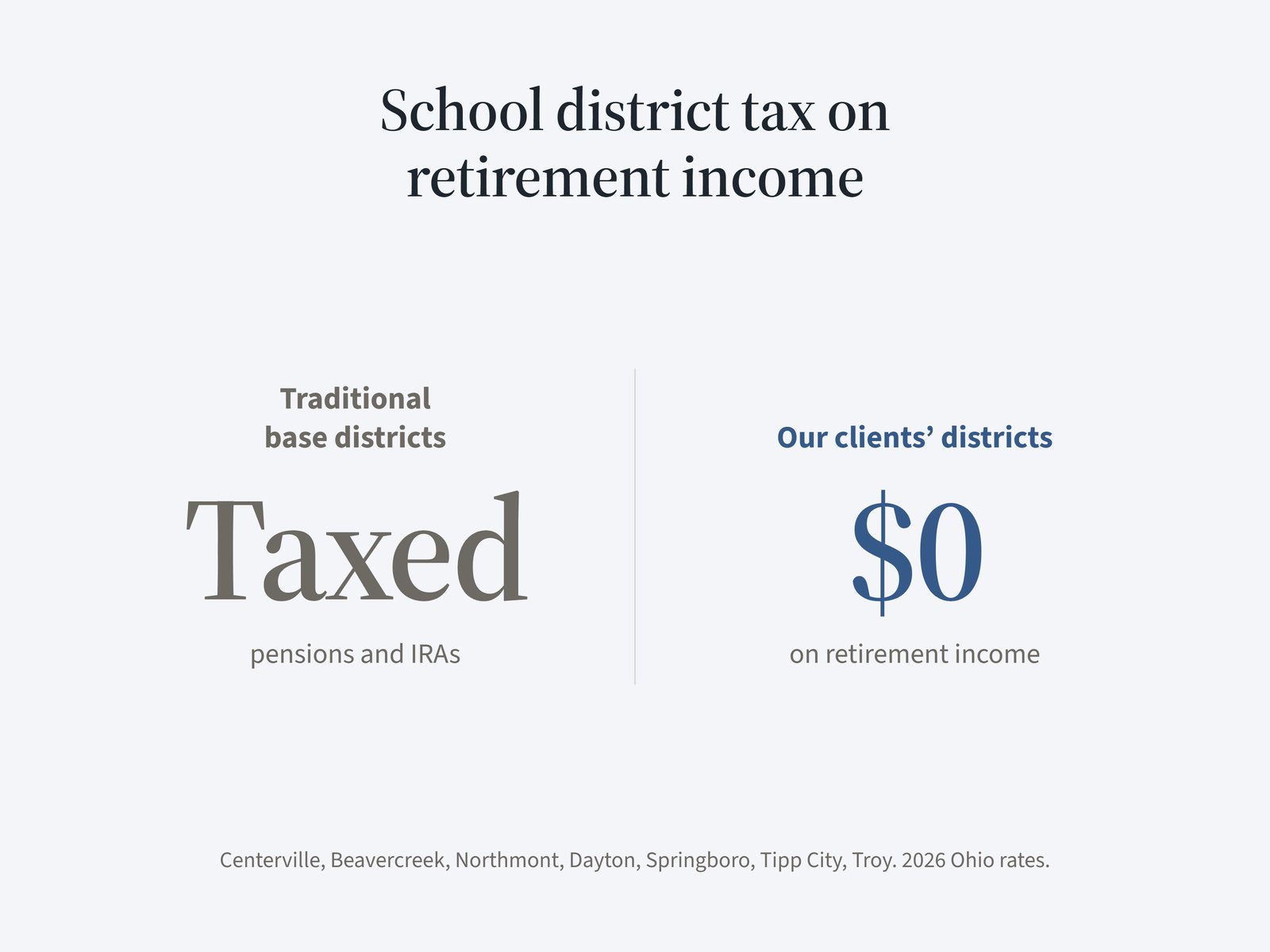
This is the part most Ohio retirement articles skip. Many Ohio school districts charge their own income tax on top of the state tax.
Those districts use one of two bases:
- Traditional base: taxes most of your Ohio income, including pensions and IRA withdrawals
- Earned income base: taxes only wages and self-employment income, so retirement income is not taxed
Here is the good news for the Dayton area. In the school districts where most of our clients live, retirees owe no school district tax on their retirement income:
| Community | School district | School district income tax (2026) |
|---|---|---|
| Centerville and Washington Township | Centerville City | None |
| Beavercreek | Beavercreek City | None |
| Clayton and Englewood | Northmont City | None |
| Dayton | Dayton City | None |
| Springboro | Springboro Community City | None |
| Tipp City | Tipp City Exempted Village | None |
| Troy | Troy City | 1.5%, earned income only, so retirement income is not taxed |
City lines and school district lines do not always match. Before you buy a house, look up the exact address with the Ohio Department of Taxation's Finder tool.
And if you are moving to another part of Ohio, check whether that district uses the traditional base. In those districts your pension and IRA withdrawals are taxed a second time.
What about city income tax?
Ohio cities cannot tax Social Security, pensions, annuities, or retirement plan payments. So your Dayton or Kettering city income tax stops when your paycheck stops.
What a Dayton-Area Couple Actually Pays
Let me show you how this adds up. We see this setup all the time.
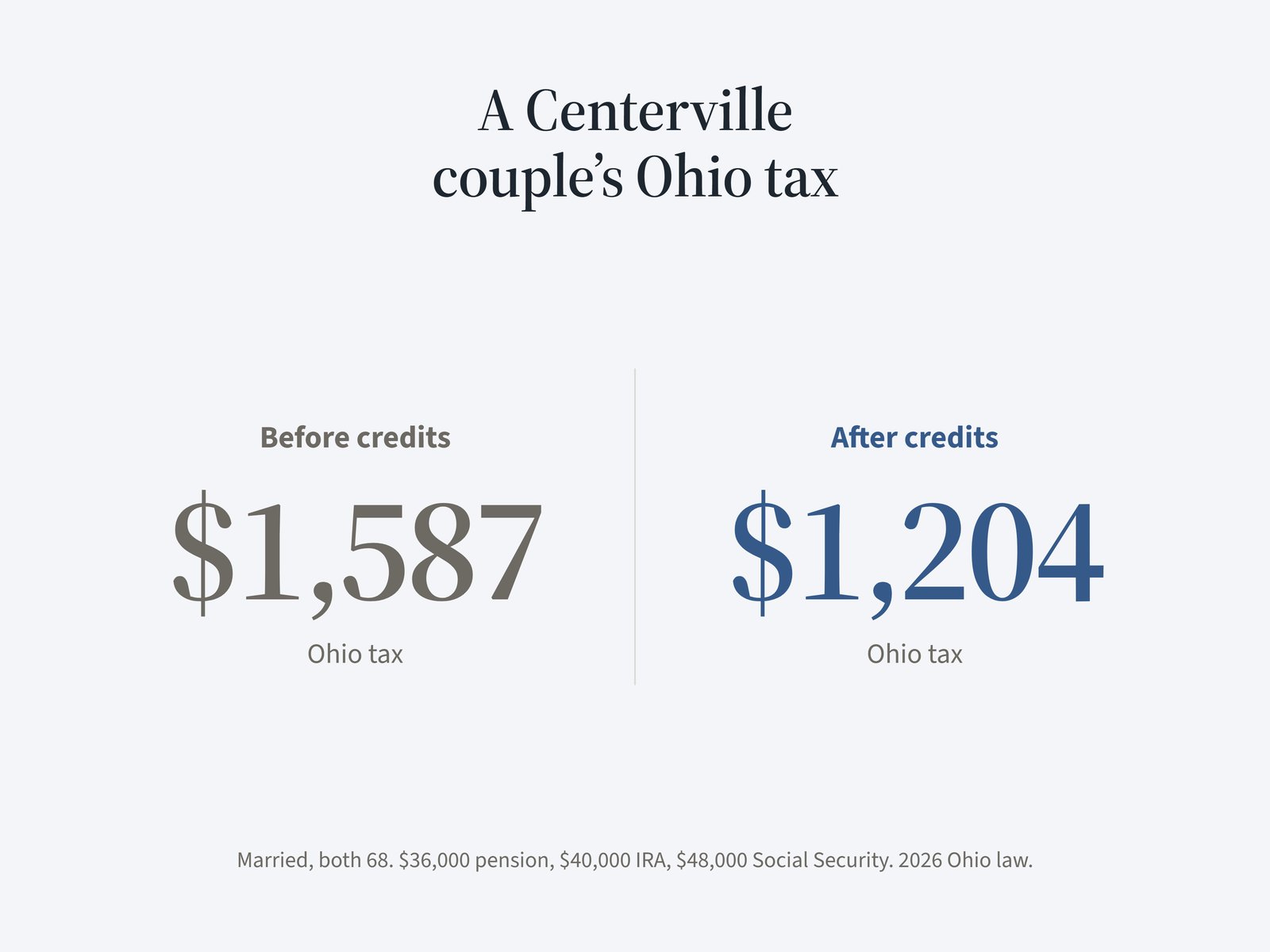
Say you live in Centerville and you are both 68. She is a retired teacher with a $36,000 STRS pension, he draws $40,000 a year from his IRA, and together you get $48,000 of Social Security.
Here is how Ohio gets to your tax, using the 2026 figures:
| Step | Amount |
|---|---|
| Federal AGI (includes $40,800 of taxable Social Security) | $116,800 |
| Subtract the taxable Social Security | ($40,800) |
| Ohio AGI | $76,000 |
| Subtract two exemptions at $2,150 | ($4,300) |
| Ohio taxable income | $71,700 |
| Tax: $332 plus 2.75% of $45,650 | $1,587.38 |
| Retirement income credit and senior credit | ($250.00) |
| Joint filing credit at 10% | ($133.74) |
| Ohio income tax | $1,203.64 |
That is about 1.6% of their $76,000 of pension and IRA income. Their school district adds nothing, and the city adds nothing.
For most of our clients, Ohio tax is real but small. The federal side is where the big money is, which is why every tax plan we build starts there.
How Ohio Tax Changes the Roth Conversion Math
So should Ohio tax change whether you convert to a Roth? A little, and in a way most people do not expect.
Ohio's rate is flat, so a dollar you convert today and a dollar you withdraw at 80 are both taxed at about 2.75%. On its own, Ohio tax is close to a wash.
The catch is the credits. Say that same Centerville couple converts $30,000 to a Roth:
- Their Ohio income after exemptions goes over $100,000, so they lose the $250 in credits
- Their joint filing credit drops from 10% to 5%
- Their Ohio tax goes from $1,204 to $2,305
That is $1,101 of Ohio tax on a $30,000 conversion, about 3.7%, not 2.75%. It is still small next to the federal savings a conversion in your gap years can produce, but it is worth knowing which side of the $100,000 line you land on.
There is one situation where Ohio tax should change the plan. If you are planning to move to Florida, wait to do your big conversions until you are a Florida resident, because Florida has no income tax.
More on sizing conversions in our guide to Roth conversions.
How to Lower Your Ohio Tax in Retirement
Ohio starts from your federal AGI, so most moves that lower your federal tax lower your Ohio tax too. The three that matter most:
- Give with QCDs. A qualified charitable distribution never enters your AGI, so it is invisible to Ohio. Our post on the 2027 QCD rules covers how.
- Watch the $100,000 line. Staying under it keeps the $250 of retiree credits.
- Make sure both spouses have $500 of qualifying income. If one spouse only has Social Security, a small IRA withdrawal in that spouse's name can bring back the joint filing credit.
Splitting Time With Florida
A lot of Dayton retirees spend the winter in Florida. If you want to be taxed as a Florida resident, Ohio has a test you can pass, and it changed recently.
Under Ohio's current rules, you can claim to be a non-Ohio resident if all five of these are true:
- Contact periods: you had no more than 212 contact periods in Ohio during the year
- Home elsewhere: you have a home outside Ohio that is not a vacation home or rental
- Driver's license: you did not hold an Ohio driver's license or state ID, surrendered before the year began
- Property tax: you did not claim Ohio's homestead exemption or owner-occupied credit
- Tuition: you did not get in-state tuition at an Ohio school
A contact period is any time you spend parts of two days in a row in Ohio and are away from your other home overnight.
The old affidavit form is gone. You now claim it by checking the Presumption of Non-Ohio Residency box on your Ohio return.
The detail people get wrong is the license. If you are still carrying an Ohio license on January 1, you do not qualify for that year.
Frequently Asked Questions
Does Ohio tax pensions and Social Security?
Ohio taxes pensions but not Social Security. Pensions from STRS, OPERS, private employers, and federal civil service are taxed, while Social Security and military retirement pay are not.
Does Ohio tax 401(k) withdrawals?
Yes. Traditional 401(k), 403(b), IRA, and TSP withdrawals are taxed by Ohio, including required minimum distributions. Qualified Roth withdrawals are not.
Is Ohio a tax-friendly state for retirees?
It is in the middle. Ohio does not tax Social Security and has no estate or inheritance tax, but it taxes pensions and IRA withdrawals at $332 plus 2.75% of taxable income above $26,050.
How much is Ohio state tax on $100,000?
For 2026, on $100,000 of Ohio taxable income the tax is $332 plus 2.75% of $73,950, or about $2,366 before credits. At that level the retiree credits are gone, so most couples would only see a small joint filing credit.
Does Ohio tax federal pensions?
Yes. FERS and CSRS pensions are taxed by Ohio, except the part attributable to military service, which you can deduct.
Here's What Matters
- Ohio does not tax Social Security or military retirement, but it taxes pensions, IRA and 401(k) withdrawals, and Roth conversions
- Starting in 2026 the rate is flat: no tax up to $26,050 of taxable income, then $332 plus 2.75% of the rest
- Stay under $100,000 of Ohio income after exemptions to keep $250 of retiree credits
- Each spouse needs $500 of pension or IRA income for the joint filing credit; Social Security does not count
- In the Dayton-area school districts where most of our clients live, retirement income is not taxed by the school district or the city
- Florida movers: surrender the Ohio license before January 1 and convert to Roth after the move
Gudorf Financial Group is a fee-only, fiduciary retirement planning firm based in Dayton, Ohio. We serve clients locally and virtually nationwide.
Article References
- "2026 Ohio IT 1040 / SD 100 Instructions (draft)." Ohio Department of Taxation. Accessed November 2026.
- "Ohio Revised Code 5747.02, Tax Rates." Ohio Legislature. Accessed November 2026.
- "Ohio Revised Code 5747.05, Credits." Ohio Legislature. Accessed November 2026.
- "Ohio Revised Code 5747.055, Retirement and Senior Credits." Ohio Legislature. Accessed November 2026.
- "Ohio Revised Code 5747.24, Domicile Presumptions." Ohio Legislature. Accessed November 2026.
- "Updated School Districts, Effective January 1, 2026." Ohio Department of Taxation. 2026.
- "The Finder." Ohio Department of Taxation. Accessed November 2026.
- "Ohio Revised Code 718.01, Municipal Income Tax Definitions." Ohio Legislature. Accessed November 2026.