

Charitable Remainder Trust: How to Turn an Appreciated Asset Into Income and a Gift
By Danny Gudorf | Founder, Gudorf Financial Group | Updated October 2026
So you own something that is worth a lot more than you paid for it. Maybe it is a block of company stock. Maybe it is a rental property you bought 30 years ago. Maybe it is a chunk of a business you are getting ready to sell.
You would like to sell it. The problem is the tax bill that shows up the day you do.
A charitable remainder trust is one way around that problem. It lets you sell the asset inside a trust, avoid the immediate capital gains hit, pay yourself income from the proceeds, and eventually leave what is left to a cause you care about.
Here is the honest part most articles skip. This is a real tool, but it is not for everyone. It only makes sense if you actually want to give to charity, you need income, and you have an asset big enough to justify the cost and the paperwork.
Let me walk you through how it works, who it fits, and where the traps are.
What a Charitable Remainder Trust Actually Is
Think of a charitable remainder trust as a bucket that holds your asset for a while before it goes to charity.
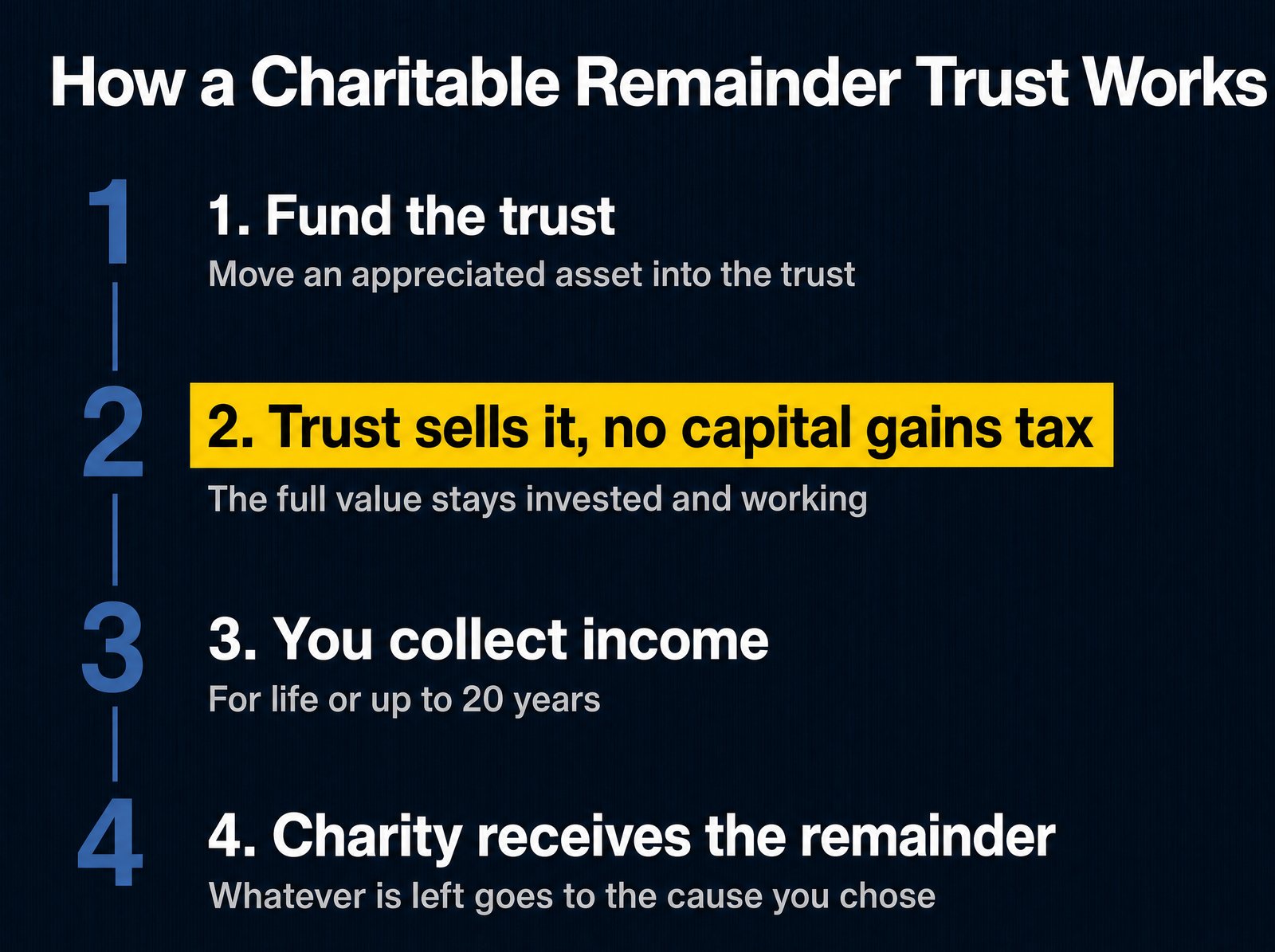
You put an appreciated asset into the bucket. The trust sells it and reinvests the money. You collect payments from the bucket for a set period. When that period ends, whatever is still in the bucket goes to the charity.
Here is the sequence, in four steps:
- You create the trust and transfer an asset into it, like stock, real estate, or a business interest. You also get a partial tax deduction right away for the future gift to charity.
- The trust sells the asset and does not pay capital gains tax on the sale.
- You, or someone you name, receive income payments for life or for up to 20 years.
- When the payment period ends, the remaining balance goes to the charity or charities you chose.
The rules come from Section 664 of the tax code. That section spells out what makes a trust qualify and what benefits you get in return.
A few different people play a role in one of these trusts:
- You, the donor. You create the trust and fund it.
- The income beneficiary. The person who gets the payments, usually you, and your spouse too.
- The trustee. The person or company that manages the trust and cuts the checks.
- The charity. The organization that receives whatever is left at the end.
One thing to keep in mind. This is an irrevocable trust, which means once you fund it, you cannot change your mind and pull the asset back out. We will come back to that, because it matters.
Who a CRT Actually Fits, and Who It Doesn't
I would rather tell you this strategy does not fit than sell you into one that costs you money. So let me be plain about who this is for.
A charitable remainder trust makes sense when four things are true at the same time:
- You hold an asset that has grown a lot in value and would trigger a big capital gains bill if you sold it outright.
- You want income from that asset, either now or starting a few years down the road.
- You genuinely want to support a charity, a church, or a cause.
- You are comfortable giving up access to the asset permanently.
Size matters too. Between the attorney fees to draft it, the annual tax return, and the ongoing management, most of these trusts do not pencil out below the \$250,000 to \$500,000 range.
Now, here is the part that keeps you out of trouble. If you do not have a charitable bone in your body, this is the wrong tool. The charity has to end up with something real. This is not a loophole for keeping everything yourself. If your goal is purely to dodge taxes and pass it all to your kids, a charitable remainder trust is not your answer.
The Four Types of Charitable Remainder Trusts
There is not just one flavor of these trusts. There are four, and the difference comes down to how your payments are calculated.
| Type | How your payment works | Best when |
|---|---|---|
| CRAT (annuity trust) | Fixed dollar amount every year | You want steady, predictable income |
| CRUT (unitrust) | A set percentage of the trust value, recalculated yearly | You want income that can grow with the trust |
| NIMCRUT (net income with makeup) | The lesser of the set percentage or actual income earned, with a catch-up feature | You want little income now, more later |
| Flip CRUT | Starts as a NIMCRUT, then flips to a regular unitrust when a triggering event happens | You are funding it with hard-to-sell property like real estate |
Let me break down each one.
The annuity trust, or CRAT, pays you the same dollar figure every year no matter what happens to the trust value. Say you fund it with \$500,000 and set a 6% payout. You get \$30,000 a year, every year, for the rest of your life. The tradeoff is you cannot add more money to it later.
The unitrust, or CRUT, pays you a percentage of the trust value, and it recalculates every year. Fund it with \$1 million at a 5% payout and you get \$50,000 the first year. If the trust grows to \$1.1 million, next year you get \$55,000. If it drops, your payment drops. You can also add more assets to a CRUT over time.
The net income trust, or NIMCRUT, is built for people who do not need much income yet. It pays you the lesser of your set percentage or what the trust actually earned. In lean years you get less, but the shortfall gets tracked and paid back to you later when the trust earns more. This is a timing tool for someone still working who wants the income to show up after they retire.
The Flip CRUT starts out as a net income trust and then flips to a regular unitrust when a specific event happens, like the sale of a property or a date you pick when the trust is set up. This one is popular for funding with real estate, because the trust pays you little until the property sells, then flips and starts paying you a steady percentage.
The Tax Benefits, the Real Reason People Do This
There are three tax benefits stacked inside a charitable remainder trust. Let me take them one at a time, because they are not all equally valuable for our clients.
First, an immediate income tax deduction. When you fund the trust, you get to deduct part of what you put in right now. Not the whole thing, because you are keeping the income stream. The deduction covers the piece the charity is projected to receive at the end. How big it is depends on three things: your age, the payout rate you pick, and an interest rate the IRS sets each month called the 7520 rate. The older you are and the lower your payout, the bigger the deduction.
The 2025 tax law added new limits on that deduction starting in 2026. Three of them matter when you fund a trust like this:
- The 0.5% floor. If you itemize, only charitable gifts above 0.5% of your adjusted gross income (AGI) count, per IRS Publication 505 for 2026. On \$300,000 of AGI, the first \$1,500 can't be deducted that year.
- The 35% cap. Once your taxable income reaches the 37% bracket, which starts at \$768,700 for married couples filing jointly in 2026, your itemized deductions get trimmed. Each dollar of deduction then saves you about 35 cents instead of 37.
- The AGI limits. When a public charity gets the remainder outright, the deduction for appreciated property you have held more than a year is capped at 30% of your AGI each year, with up to five years to carry forward what you cannot use, under IRS Publication 526. If a private foundation could get the remainder, the cap drops to 20%, and the deduction is generally figured on what you paid instead of today's value.
That 30% limit catches people. On \$150,000 of AGI, 30% is \$45,000 a year, so a large deduction can take years to use, and whatever is still unused after the five carryforward years is lost.
Second, and this is the big one, no capital gains tax when the asset sells. This is usually the whole reason to do this. When the trust sells your appreciated asset, it does not pay capital gains tax on the sale. That means the full value keeps working for you and generating income, instead of a big slice going to the IRS on day one.
Let me show you what that looks like.
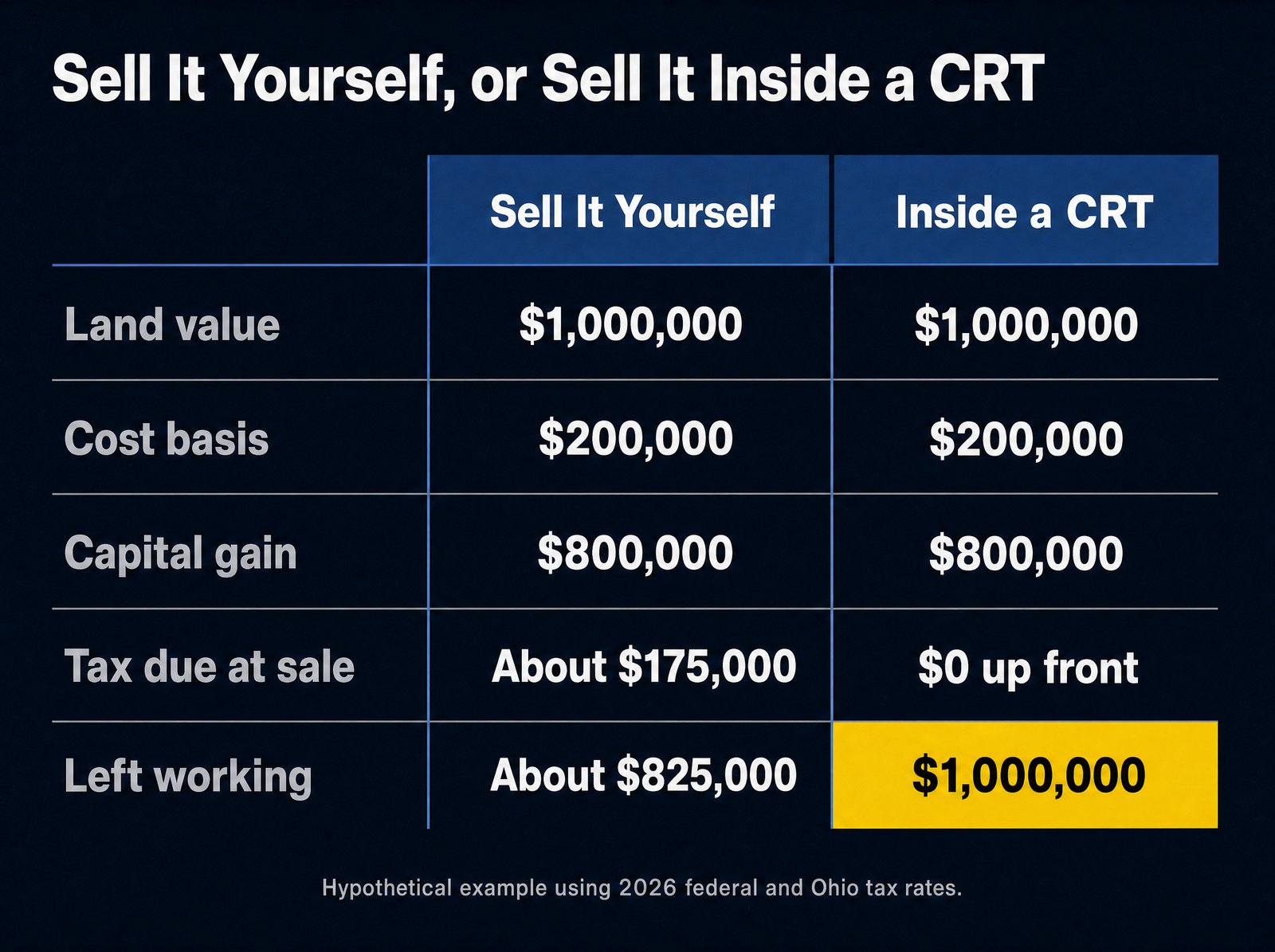
Say you've got a couple, both 66, with about \$100,000 a year of other income from a pension and IRA withdrawals. They own farmland worth \$1 million that they bought for \$200,000 decades ago.
| Sell it yourself | Sell it inside a CRT | |
|---|---|---|
| Land value | \$1,000,000 | \$1,000,000 |
| Cost basis | \$200,000 | \$200,000 |
| Capital gain | \$800,000 | \$800,000 |
| Tax due at sale | About \$175,000 | \$0 up front |
| Left working | About \$825,000 | \$1,000,000 |
Between the 15% and 20% federal capital gains rates, the 3.8% net investment income tax, and Ohio's 2.75%, this couple hands about 22% of the gain to taxes the year they sell. Inside the trust, that money stays invested and paying them.
Now, one caveat so I am not overselling it. The trust spreads the tax on the gain out over time instead of wiping it out.
Every payment you receive is taxed under the IRS four-tier rule for charitable remainder trusts: ordinary income first, then capital gains, then tax-exempt income, then a tax-free return of principal. The point is the gain from the sale reaches your tax return a slice at a time over the years, instead of in one big hit.
Third, a possible estate tax benefit. If you keep the income for life, the trust still counts in your estate when you die, but the charity's share comes right back out as an estate tax charitable deduction.
If your spouse is the only other person receiving income, their share qualifies for the marital deduction for charitable remainder trusts, so a trust for just the two of you and the charity adds nothing to your taxable estate. Name a child as the next income beneficiary, and the child's share does not get that break.
Here is where I will be straight with you. The federal estate tax exemption is \$15 million per person in 2026 under the 2025 tax law.
For the vast majority of our clients, estate tax is not the reason to do this. The capital gains piece and the income are what move the needle.
If you want to go deeper on the tax side, our tax planning work is built around exactly these kinds of tradeoffs.
How a CRT Stacks Up Against Other Charitable Strategies
A charitable remainder trust is one of several ways to give. It is not automatically the best one. Here is how it compares to the others we use with clients.
| Strategy | You get income back? | Complexity and cost | Best for |
|---|---|---|---|
| Charitable remainder trust | Yes | High | Big appreciated asset plus a need for income |
| Qualified charitable distribution | No | Very low | Retirees over 70½ giving from an IRA |
| Donor-advised fund | No | Low | Simple, flexible giving with an upfront deduction |
| Charitable lead trust | No, the charity gets income first | High | Passing assets to heirs with lower gift tax |
| Private foundation | No | Very high | Large gifts with hands-on family involvement |
| Direct gift | No | None | Smaller gifts when you do not need income |
A couple of these deserve a closer look.
If you are over 70½ and giving from an IRA, a qualified charitable distribution is almost always simpler and cleaner than a trust. It sends money straight from your IRA to the charity and keeps it out of your taxable income entirely.
If you want the upfront deduction and flexibility on which charities get money, without the income stream, a donor-advised fund does that at a fraction of the cost and hassle.
The charitable remainder trust earns its keep in one situation the others cannot touch. You have a large, highly appreciated asset, and you want income back from it. That is the situation it was built for.
Setting One Up, and Why Coordination Matters
Here is where a lot of people get tripped up. A charitable remainder trust is not a do-it-yourself project, and it is not a single-professional project either.
To do this right, three people have to be working off the same plan:
- An attorney drafts the trust so it actually qualifies under the tax code.
- A financial advisor manages the money inside the trust and builds the income stream.
- A CPA files the annual return and keeps the tax reporting clean.
When those three do not talk to each other, you end up being the orchestrator. You are the one relaying messages between your lawyer, your advisor, and your accountant, hoping nothing falls through the cracks. That is a lousy job to have in retirement.
This is one of the reasons we built our family office the way we did, with the tax, legal, and financial work coordinated under one roof. A strategy like this has too many moving parts to leave uncoordinated.
There is real paperwork behind it too. The trust needs its own tax ID number. It files IRS Form 5227 every year. It issues tax forms to whoever receives the income. None of that is hard when someone owns it, but all of it has to happen.
You also have to decide who serves as trustee. You can serve yourself, name a family member, or hire a corporate trustee like a bank or trust company. Serving yourself keeps costs down and gives you control. A corporate trustee brings professional management and takes the administrative load off your plate, but charges a fee for it. Some people split the difference and serve as co-trustee alongside a professional.
The Catches You Need to Know
I would not be doing my job if I only told you the good parts. Here are the real limitations.
- It is permanent. Once you fund the trust, the asset is gone from your control. There is no undo button.
- The payout has rules. The trust has to pay out at least 5% and no more than 50% a year, figured on the starting value for a CRAT and on each year's value for a CRUT. Push the payout too high and your deduction shrinks.
- The 10% test. The charity's share, valued with IRS tables on the day you fund the trust, has to be worth at least 10% of what you put in. This limits how high your payout can go, especially for younger beneficiaries.
- You lose liquidity. That money is committed. If an emergency hits and you need a lump sum, you cannot reach back into the trust for it. You need other cash available.
- It costs money to run. Legal fees to set it up, plus annual tax prep and management. On a smaller trust, those costs eat too much of the benefit to be worth it.
None of these are dealbreakers on their own. They are just the reasons this only works for the right person with the right asset.
Replacing the Inheritance With Life Insurance
One worry I hear is fair. If the leftover goes to charity, are my kids getting cheated out of their inheritance?
Here is a move some families make. You take part of the tax savings and the income the trust throws off, and you use it to buy a life insurance policy. When you pass, that policy pays your heirs, replacing what went to charity.
Done right, your family still gets their inheritance, the charity still gets its gift, and you got income and a tax break along the way. It does not fit every situation, and the insurance has to actually make sense on its own. But for the right family, it answers the inheritance question cleanly.
Frequently Asked Questions
Can I be the trustee of my own charitable remainder trust?
Yes, you can serve as your own trustee. The question is whether you want to handle the investment management and the annual paperwork yourself. Many people start out as trustee and later bring in a professional to take the administration off their plate.
How much do I need to make a charitable remainder trust worth it?
Most of these trusts do not make financial sense below the \$250,000 to \$500,000 range. Between setup costs, annual tax filing, and ongoing management, a smaller trust gives too much of the benefit back in fees. The bigger and more appreciated the asset, the more the strategy pays off.
Does a charitable remainder trust avoid capital gains tax completely?
Not completely, but it defers it and spreads it out. The trust itself pays no capital gains tax when it sells your asset, so the full value stays invested. You then pay tax gradually on the income you receive over the years, instead of one large bill the year of the sale.
What happens if the charity I chose closes down?
You can build flexibility into the trust from the start. Many trusts include language that lets the trustee name a different qualified charity if your original choice closes, merges, or loses its tax-exempt status. This is something to raise with the attorney when the trust is drafted.
Should I use a charitable remainder trust or a qualified charitable distribution?
If you are over 70½ and giving from an IRA, a qualified charitable distribution is usually simpler and cheaper. A charitable remainder trust is the better fit when you have a large appreciated asset outside your IRA and you want income back from it. They solve different problems, and some people use both.
Here's What Matters
- A charitable remainder trust lets you sell an appreciated asset without the immediate capital gains hit, collect income, take a partial deduction now, and leave the rest to charity.
- Starting in 2026, the deduction has new limits: a 0.5% of AGI floor for itemizers and a 35% cap in the top bracket, on top of the 30% of AGI yearly limit for appreciated property.
- The capital gains benefit is the real driver for most people. The estate tax benefit rarely matters for our clients, given today's exemption levels.
- There are four types. The difference is how your payment is calculated and when the income starts.
- It only fits if you actually want to give, you need income, and you have an asset large enough to justify the cost, usually in the \$250,000 to \$500,000 range or more.
- It is irrevocable and it has real paperwork, so it needs your attorney, advisor, and CPA working off the same plan.
- If you do not need income back, a qualified charitable distribution or a donor-advised fund is usually the simpler move.
This is a strategy where the details decide whether it helps you or costs you. Before you fund anything, run your specific asset, your age, and your income needs through the actual numbers.
Gudorf Financial Group is a fee-only, fiduciary retirement planning firm based in Dayton, Ohio. We serve clients locally and virtually nationwide.
Article References
- "Charitable Remainder Trusts." Internal Revenue Service. Accessed October 2026.
- "Section 7520 Interest Rates." Internal Revenue Service. Accessed October 2026.
- "Publication 505 (2026), Tax Withholding and Estimated Tax." Internal Revenue Service. Accessed October 2026.
- "Publication 526, Charitable Contributions." Internal Revenue Service. Accessed October 2026.
- "26 U.S. Code 2056, Bequests, etc., to Surviving Spouse." Legal Information Institute, Cornell Law School. Accessed October 2026.
- "About Form 5227, Split-Interest Trust Information Return." Internal Revenue Service. Accessed October 2026.