

10 Financial Moves to Make Before You Announce Your Retirement
By Danny Gudorf | Founder, Gudorf Financial Group | Updated October 2026
So here is the pattern I see over and over.
Someone decides they are ready to retire. They tell their spouse, their kids, their coworkers, and then they start making financial decisions.
That is backwards.
By the time you have announced it, you are making big money decisions under pressure. Sometimes you make the wrong ones, and the wrong ones in year one follow you for the next 25 or 30 years.
I have reviewed hundreds of retirement plans. The people who get this right make the moves first, then they tell everyone.
So before you announce your retirement, here are the 10 things to upgrade.
If you would rather watch than read, I walk through all 10 moves on camera in this video, in the same order.
The First Three Moves Set the Tone for Everything
Get these three wrong in year one, and you will spend the next decade trying to fix them.
They are connected. The first decision drives the second, and both drive the third.
Move 1: Decide Your Withdrawal Order Before You Spend a Dollar
While you were working, the decision was simple. Save as much as you can in the right accounts.
In retirement, it flips. Now the question is which account you pull from, in what order, and how much.
Most people default to their traditional IRA or 401(k) because that is where most of the money sits. The problem is that every dollar you pull from those accounts is taxable income.
That income stacks on top of Social Security. It can raise your Medicare premiums.
And pulling heavy in year one sets a tax tone that follows you for the next 25 to 30 years.
Before you spend a dollar, know three things. First, which accounts fund year-one spending.
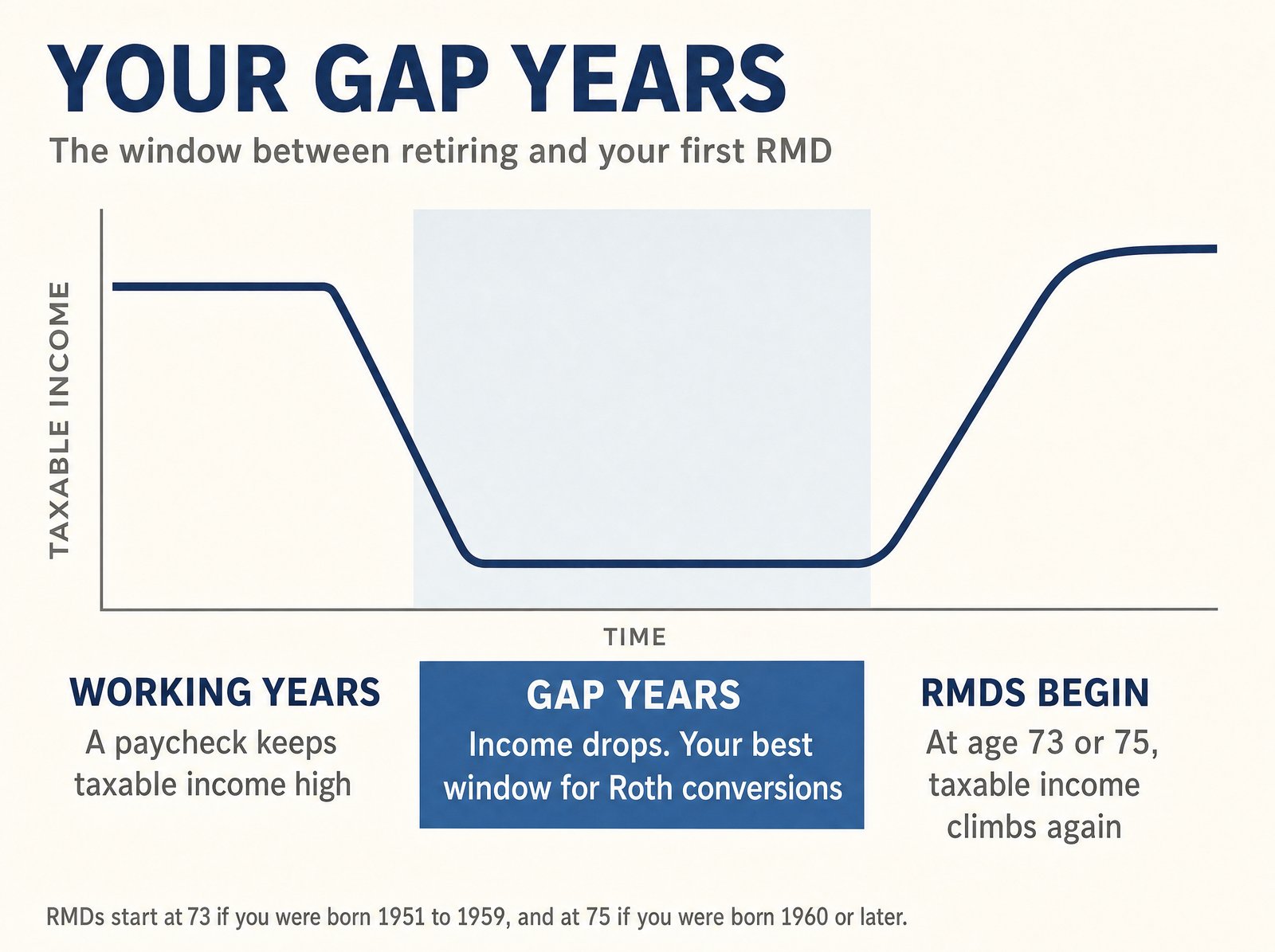
Second, which years are your best window for Roth conversions. Those are your gap years, the window between when you retire and when required minimum distributions start.
Third, how to keep taxable income controlled before RMDs take over at age 73 or 75, depending on your birth year.
This is where smart withdrawal sequencing and tax planning saves you real money. The order you pull from matters as much as the total you pull.
Move 2: Build Your Health Insurance Bridge to Medicare
If you are retiring before 65, your employer coverage ends and you have a gap to fill. You have to bridge to Medicare, and you need to model that bridge before your last day of work.
Affordable Care Act (ACA) marketplace insurance offers premium subsidies based on your income. Here is where Move 1 comes right back into play.
The withdrawal strategy you chose determines how much those subsidies are worth. The extra subsidies Congress added in 2021 expired at the end of 2025, so for 2026 the premium tax credit stops at 400% of the federal poverty line.
| Income Approach | What Happens to ACA Subsidies |
|---|---|
| Income managed and kept below 400% of the poverty line | You get a premium tax credit, and the lower your income, the larger it is |
| Heavy traditional IRA withdrawals push income above that line | No premium tax credit at all for 2026 |
COBRA is available too, but it is often expensive. A lot of my clients go on COBRA for a short stretch, then switch to the marketplace.
Marketplace coverage with managed income is usually the better deal. But you have to model it before you retire, not after.
Move 3: Put a Multi-Year Tax Plan in Place
Most people think of taxes as a once-a-year event. You look backward in April, file, and move on.
In retirement, that thinking will cost you.
Your tax plan now covers the next 25 to 30 years. Year one sets the baseline for all of it.
Bracket filling, Roth conversions during your gap years, capital gain harvesting, managing your IRMAA thresholds. IRMAA is the Income-Related Monthly Adjustment Amount, the surcharge Medicare adds to your Part B and Part D premiums once your income crosses those thresholds.
All of that starts in year one, not year five.
The trap is waiting until April, when your income for the year is already set and there is nothing left to plan. By then the year is over.
Moves Four, Five, and Six Are the Ones People Skip
These three do not get enough attention. They are not about investments, so people put them off.
That is a mistake, because one of them is among the highest-impact, lowest-cost moves on this entire list.
Move 4: Update Your Beneficiary Designations
Most people set their beneficiaries when they opened the account and never looked again. That designation overrides your will and your trust.
If it is outdated, it can send money to an ex-spouse, skip a child, or create a tax problem nobody wanted.
We see both versions of this.
Say a man passes away with an old 401(k) beneficiary designation that was not set up the way he intended. The account passes to minor grandchildren.
That triggers a larger tax outcome and significant court involvement, and it drags out.
Now say another man updates his designations a few months before he passes. His accounts move cleanly to his two sons.
No delays, no disputes, no unnecessary taxes.
Same kind of accounts. Completely different outcome.
The only difference is 30 minutes of paperwork.
Updating your beneficiaries takes about half an hour and costs nothing. It is one of the highest-impact moves on this list.
Move 5: Update Your Estate Plan Documents
Most people have a will or a power of attorney drafted when the kids were young and the financial picture looked completely different. Retiring changes your income sources and your account structure, so those old documents may no longer fit.
Here is what needs to be current:
- Your will or trust
- Your healthcare directive
- Your power of attorney
- Any trust documents tied to your plan
Without current documents, decisions get made by default. That means a court decides, on a timeline you do not control.
You can pull together the documents you need for a secure retirement well before you need them.
Move 6: Right-Size Your Insurance
Your insurance was built around your working life. Once that life ends, some of it no longer fits.
Disability insurance becomes irrelevant once you no longer have earned income. There is nothing left for it to replace.
Life insurance may not be needed anymore if you and your spouse are financially secure. You can cut premiums on policies that no longer serve a purpose.
But it works both ways. Two kinds of coverage become more important in retirement, not less:
- Umbrella and liability coverage. Your net worth is at its highest point right now, so you have more to protect.
- Long-term care planning. This is the piece most people self-insure without realizing it.
So you cut what you do not need, and you strengthen where you do.
The Last Four Moves Are Where Retirement Holds Together or Comes Apart
These four are quieter. Nobody talks about them at the retirement party.
But they are the difference between a plan that works and one that slowly unravels.
Move 7: Build a Bigger Cash Reserve Than You Think
While you were working, three to six months of emergency savings was enough. A paycheck was always coming.
In retirement, that paycheck stops. So your reserve has to be bigger.
A true emergency reserve in retirement is 8 to 18 months of living expenses, kept stable and accessible. It is for the unexpected, not for normal spending.
There is a second piece most people miss. Any major known purchase in your first two or three years needs its own money set aside:
- A new car
- A big home renovation
- A large trip you already know you want to take
If you do not set that money aside ahead of time, those purchases force you to sell investments at the wrong time. That is exactly the mistake a solid cash strategy in retirement is built to prevent.
Move 8: Know Your Actual Spending Number
Most people walk into retirement with a rough estimate of what they spend. A guess.
A guess is not good enough to build a 30-year plan on.
So track your real spending for the first three to six months before you retire. Better yet, practice the spending before you retire to see what it actually feels like.
That real number is what your whole withdrawal plan gets built around. People who guess tend to do one of two things:
- Overwithdraw because they underestimated and now they are short.
- Underspend from the wrong accounts because they were too cautious and never gave themselves permission.
Neither one is winning. The number has to be real.
Move 9: Build a Social Security Claiming Strategy, Not Just a Claiming Age
Most people treat Social Security as one decision. What age do I claim?
That is the wrong question. The right claiming age depends on how the benefit interacts with everything else in your plan.
Your benefit decision touches all of this:
- Your withdrawal plan
- Your Roth conversion window
- Your IRMAA exposure
- Your investment plan
- Your provisional income, which is how Social Security decides what portion of your benefit gets taxed
So what a lot of my clients do is what I call the hybrid strategy. As long as your portfolio is flat or growing, you keep delaying, all the way to age 70, to let the benefit build.
But if a meaningful market downturn hits, you claim. You do not want to be drawing hard from your portfolio when it is taking its biggest hit.
The question is not which age produces the biggest check. The question is which age creates the least tax damage and the most long-term flexibility.
Run the analysis before you claim, because the right Social Security timing is rarely the obvious one. The Social Security Administration shows how much your benefit changes by claiming age.
Move 10: Plan for the Widow's Tax Trap
This is the one that catches couples off guard, and it is the clearest reason to do the work in your gap years.
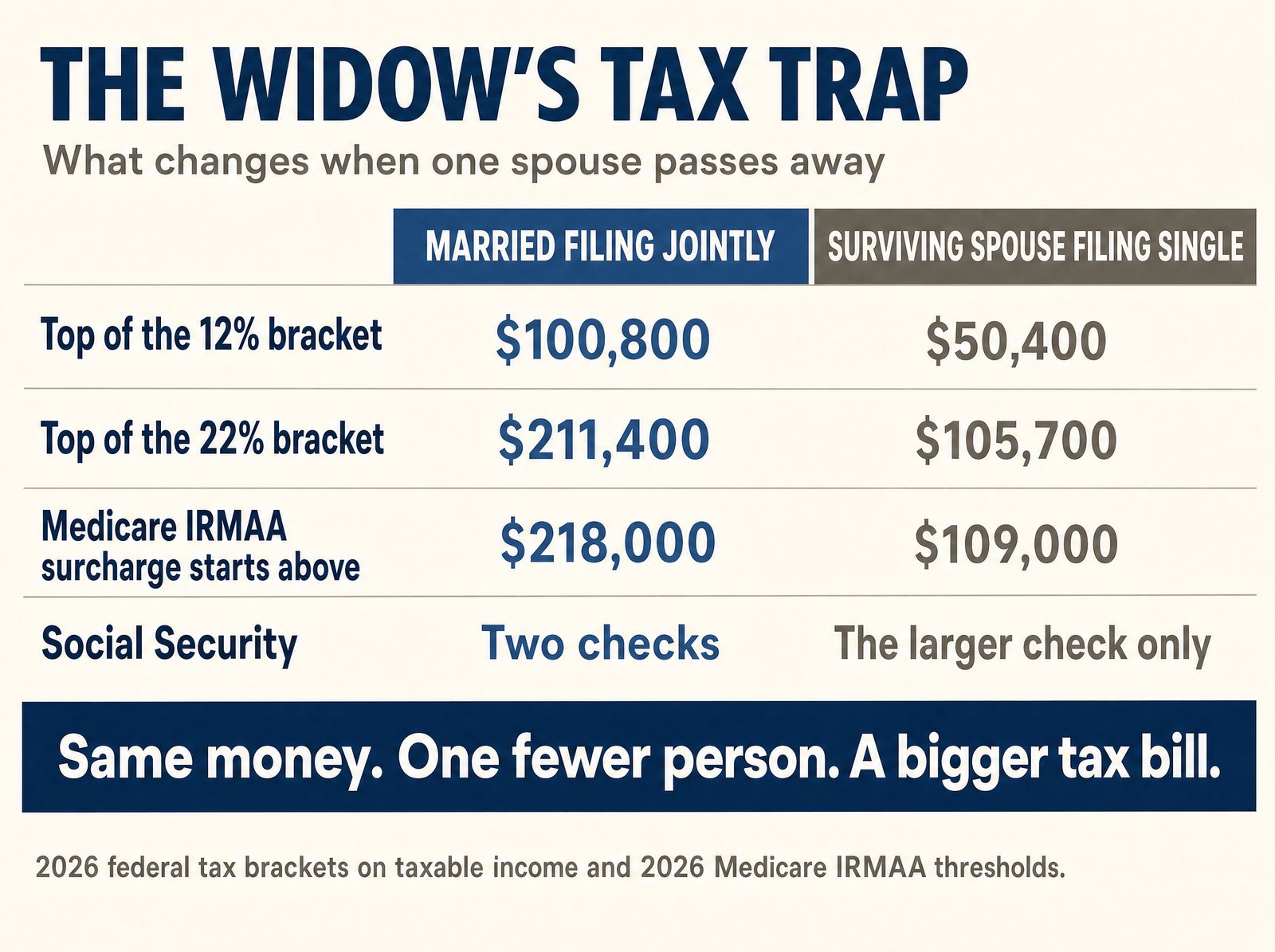
When one spouse passes away, the surviving spouse's tax situation changes hard. Here is what happens, all at once:
- Filing status changes from married filing jointly to single, so the brackets compress
- The larger Social Security benefit continues, but the smaller one stops
- RMDs keep coming on all of the traditional IRA balances
- IRMAA surcharges hit earlier and harder at single-filer thresholds
So the surviving spouse can pay a higher effective tax rate than the couple paid together. Same money, one fewer person, and a bigger tax bill.
We call this the widow's tax trap. If your traditional IRA or 401(k) balance is large, this is a real tax problem that can run 5 to 10 more years.
Now, here is what you can do about it. For many couples, this is the clearest reason to run Roth conversions during the gap years, while both spouses are alive and the brackets are still wide.
You can read more about how to prepare for the death of a spouse in retirement and why this planning matters so much.
Model it before you retire. It is fixable, but only if you see it coming.
How These 10 Moves Fit Together
None of these 10 moves stands alone. That is the part most people miss when they try to handle them one at a time.
Your withdrawal order drives your ACA subsidies. Your tax plan drives your Roth conversions.
Your Roth conversions are what protect the surviving spouse from the widow's tax trap.
| Move | What It Protects |
|---|---|
| 1. Withdrawal order | Your lifetime tax bill and Medicare premiums |
| 2. Health insurance bridge | Your ACA subsidies before 65 |
| 3. Multi-year tax plan | Your next 25 to 30 years of taxes |
| 4. Beneficiary designations | Where your money actually goes |
| 5. Estate documents | Who makes decisions if you cannot |
| 6. Right-sized insurance | Premiums you waste, risks you carry |
| 7. Cash reserve | Your portfolio during a downturn |
| 8. Real spending number | The accuracy of your whole plan |
| 9. Social Security strategy | Tax damage and flexibility |
| 10. Widow's tax trap plan | Your surviving spouse |
This is exactly the kind of coordination our retirement income planning process is built around. The moves are connected, so the planning has to be too.
Frequently Asked Questions
What should I do financially before I retire?
Set your withdrawal order, build a health insurance bridge to Medicare if you are retiring before 65, and put a multi-year tax plan in place. Then update your beneficiaries and estate documents, right-size your insurance, build a larger cash reserve, pin down your real spending number, and plan your Social Security strategy.
Make these moves before you announce, not after.
What are gap years in retirement?
Gap years are the window between when you retire and when your required minimum distributions begin at age 73 or 75. Your income is often at its lowest during this stretch, which makes it the best window for Roth conversions and other tax planning.
Skipping these years is one of the most common and expensive mistakes retirees make.
How much cash should I have in retirement?
A true emergency reserve in retirement is 8 to 18 months of living expenses, kept stable and accessible. That is more than the three to six months you kept while working, because your paycheck has stopped.
Any large known purchase in your first two or three years should be set aside separately so you are not forced to sell investments at a bad time.
What is the widow's tax trap?
The widow's tax trap is the higher tax bill a surviving spouse faces after the first spouse dies. Filing status drops from married filing jointly to single, the brackets compress, RMDs continue on all the IRA balances, and IRMAA surcharges hit harder.
The surviving spouse can pay a higher effective rate on the same money, which is why Roth conversions during the gap years matter so much.
When should I claim Social Security?
The right age depends on how your benefit interacts with your withdrawal plan, your Roth conversion window, your IRMAA exposure, and your provisional income.
A hybrid strategy delays as long as your portfolio is flat or growing, then claims if a meaningful downturn hits so you are not drawing hard from a falling portfolio. The goal is the least tax damage and the most flexibility, not the biggest check.
Here's What Matters
If you take nothing else from this, take this. Make the moves before you announce, not after.
- Year one sets the tone. Your withdrawal order and tax baseline follow you for 25 to 30 years.
- One of the highest-impact moves costs nothing. Updating beneficiaries takes 30 minutes.
- The pieces are connected. Withdrawal order drives subsidies, taxes drive Roth conversions, Roth conversions protect the surviving spouse.
- Know your real number. Track your actual spending before you retire so the plan is built on facts, not a guess.
- Plan for the widow's tax trap now, while both spouses are alive and the brackets are wide.
Knowing the moves is one thing. Knowing exactly how much you will spend once you stop working is a different question.
Most people guess, and guessing with 30 years ahead of you is expensive.
Gudorf Financial Group is a fee-only, fiduciary retirement planning firm based in Dayton, Ohio. We serve clients locally and virtually nationwide.
Article References
- "Retirement Plan and IRA Required Minimum Distributions FAQs." IRS.gov. Accessed October 2026.
- "How to Save Money on Monthly Health Insurance Premiums." HealthCare.gov. Accessed October 2026.
- "Midterm Election Update: The Affordable Care Act Marketplaces." KFF. October 2026.
- "Eligibility for the Premium Tax Credit." IRS.gov. Accessed October 2026.
- "How Much Does Medicare Drug Coverage Cost? (IRMAA)." Medicare.gov. Accessed October 2026.
- "Retirement Topics: Beneficiary." IRS.gov. Accessed October 2026.
- "Starting Your Retirement Benefits Early." SSA.gov. Accessed October 2026.